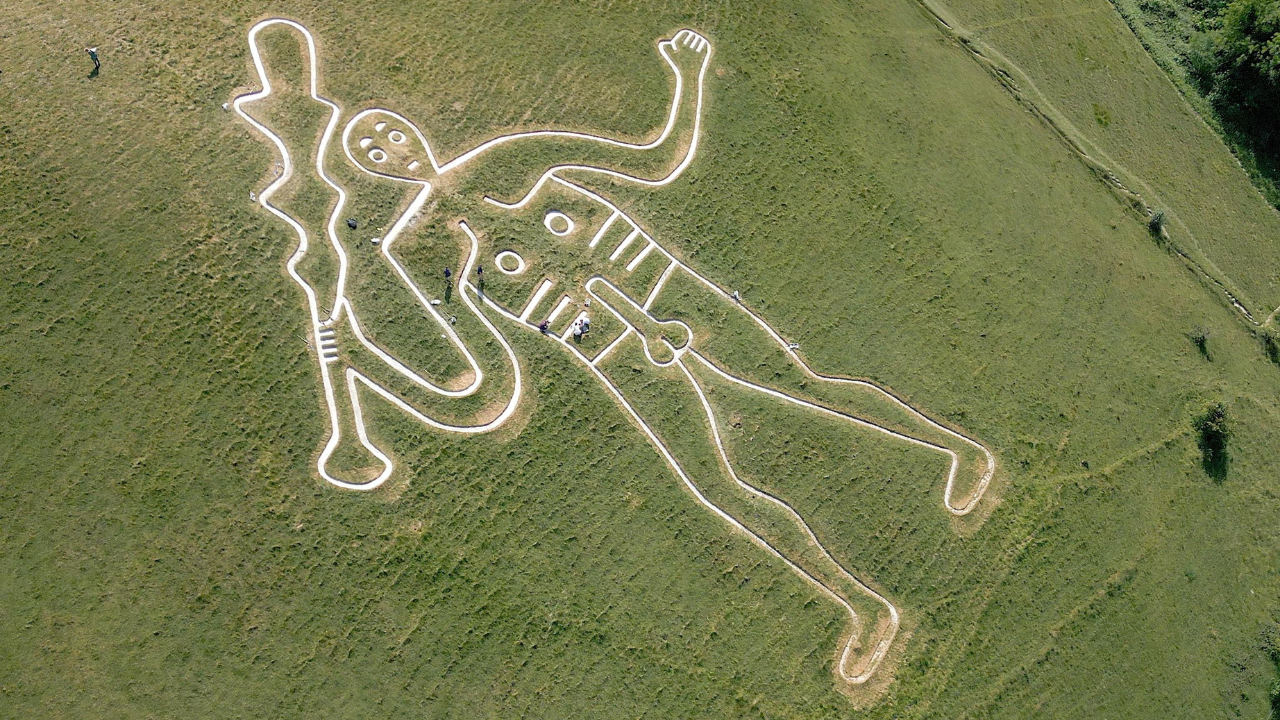
Britain's largest chalk hill figure has spent over a thousand years staring out from the slopes of a Dorset hillside, and this May it needed more than a touch-up. In late May 2026, around 300 volunteers and National Trust staff descended on Giant Hill above the village of Cerne Abbas in southwest England to carry out the latest rechalking of the 55-metre-tall Cerne Abbas Giant one of the country's most recognisable and debated ancient monuments. The work involved hauling 17 tonnes of fresh chalk up a steep, unforgiving slope in temperatures that at points climbed above 30°C, and for the first time it was carried out using a new wet-chalk paste technique designed to make the material bond better and last longer against a hillside increasingly threatened by algae, erosion, and the growing unpredictability of British weather.
Get breaking news anytime, anywhere. Download the TOI app now!

How big is the Cerne Abbas Giant and what makes it Britain's largest chalk figure
The sheer scale of the Cerne Abbas Giant is easy to underestimate from a distance. The figure measures 55 metres (180 feet) from head to foot and 51 metres (167 feet) across at its widest point. The club held in its right hand alone stretches 37 metres longer than many cricket pitches. The entire outline is formed by trenches cut roughly 0.6 metres deep into the hillside turf and packed with crushed chalk, creating the vivid white shape visible for miles across the Dorset countryside.
It sits on a west-facing slope known as Giant Hill or Trendle Hill, just above the village of Cerne Abbas. Atop the same hill is an Iron Age earthwork called the Trendle, a detail that has fed centuries of speculation about the monument's origins and purpose. The giant is listed as a scheduled monument and is owned and managed by the National Trust.
When was the Cerne Abbas Giant made and what the dating research found
Despite centuries of folklore, the documented history of the Cerne Abbas Giant is surprisingly short. The earliest known written reference appears in churchwarden accounts from St Mary's Church in Cerne Abbas, dated 4 November 1694, recording a payment of three shillings for "repairing ye Giant." No earlier document including a detailed 1540s survey of Cerne Abbey lands and a 1617 survey by John Norden entions the figure at all, even while noting the Trendle and other local landmarks.
Research commissioned by the National Trust concluded in 2020 and confirmed through radiocarbon analysis that the giant most likely dates to between AD 700 and 1100 placing it in the late Saxon period rather than the Roman or prehistoric era that earlier theories had proposed. That puts it at around 1,200 to 1,300 years old, considerably younger than many popular accounts suggested but still among the oldest dateable chalk figures in Britain.
What 17 tonnes of chalk actually means and how the rechalking process works
Rechalking the Cerne Abbas Giant is not a light conservation job. The process begins well before any chalk is applied. First, cattle are brought in to graze Giant Hill, stripping away the surrounding grass and giving workers a clean surface to operate on. Then rangers and volunteers use spades to carefully scrape out the old, weathered chalk from the trenches some of which has compacted, darkened, or been overgrown with vegetation before the fresh material goes in.
The 17 tonnes of chalk used in the 2026 restoration was not simply poured in dry, as has been done in past restorations. Luke Dawson, the National Trust's lead ranger for West Dorset and Cranborne Chase, explained that the team this year trialled a new approach: mixing the chalk with water before application to create a paste-like consistency. "It's like a putty," Dawson said, "which makes it easier to make it stick." The resulting material behaves more like plaster than dry rubble, bonding with the trench walls and compacting more effectively when packed in by hand.
This matters because the hillside on which the giant sits has a gradient of roughly one in three steep enough to make every tonne of chalk a serious logistical challenge to move uphill, and steep enough that improperly packed chalk simply washes away in heavy rain. Rangers pack the material tightly by hand rather than using machinery, a process that has remained essentially unchanged for generations. Afternoon work sessions were cancelled during this year's restoration due to the extreme heat, with workers operating only in shorter shifts each hour and taking shelter under gazebos erected at the top of the hill.
Why climate change is now one of the biggest threats to the Cerne Abbas Giant
The 2026 restoration was triggered in part by a problem that previous rechalking campaigns did not have to contend with at the same scale: algae. Dawson noted that the giant's chalk outline has begun showing visible greening in sections, losing the sharp white brightness that makes it so distinctive. "Rather than a nice white chalk sheen, you are getting a dull grey-green kind of sheen like slime," he said, describing the biological film that accumulates when chalk stays damp for extended periods.
The suspected driver is changing weather patterns. Milder winters and wetter summers are creating conditions in which algae thrive on chalk surfaces that would previously have dried out and cleared naturally over the colder months. At the same time, more intense rainfall events are accelerating erosion washing freshly packed chalk out of the trenches faster than in previous decades. Michael Clarke, a National Trust ranger who has worked on the giant for more than thirty years, noted that the previous rechalking in late summer 2019 saw significant material washed away almost immediately by heavy autumn rain. "Last time, we did the rechalking in late summer and the rain washed a lot of it away," Clarke said. Scheduling the 2026 work in May was a deliberate attempt to give the fresh chalk more time to settle before the autumn rains arrive.
The giant is typically rechalked every seven to ten years. The National Trust has now publicly acknowledged that this schedule may need to change. Dawson said the trust is also exploring landscape-level interventions allowing scrub to develop in certain areas and establishing permanent grassland to retain more water within the hillside ecosystem and reduce surface runoff that contributes to chalk loss. "It may be we have to adapt and perhaps rechalk more often," Dawson said.