After graduating from Kent State, Brian DiPietro joined WTW Architects, a national leader in student centers. By 2019, he had become a partner, leading the firm's multifamily and student housing sectors, two areas that flourished under his direction.
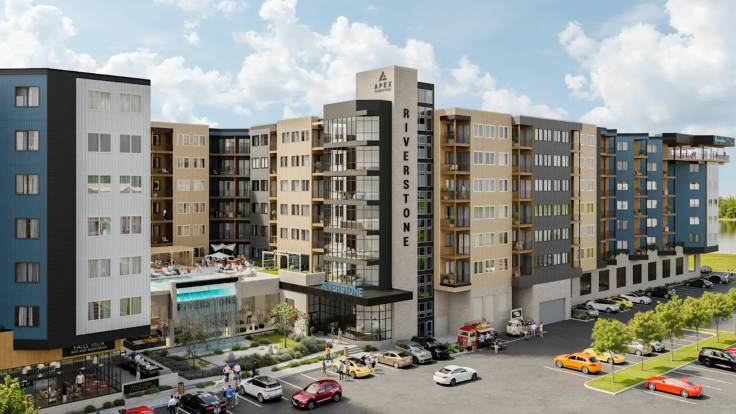
In 2021, he decided to leave citing, "They were trying to sell the firm, and I didn't agree with the approach, among other things." Within a week, a former client called with a proposal for a major apartment project. DiPietro won the job against two large Pittsburgh firms. The development, stretching more than 1,000 feet and including 277 units, recently opened to residents.

The name ROCKiT Architects reflects both mentorship and heritage. "'Rocket' was my mentor's nickname. My last name means 'of rock' in Italian," he explained. "I like to say we rock it. We're direct and grounded." The firm's philosophy centers on creating communities within buildings, a principle shaped by his early work in student housing and applied across all of the firm's projects.
Designing for Efficiency in an Unpredictable Market
For DiPietro, innovative architecture starts with efficiency. In a volatile market, where construction costs and regulations shift overnight, flexibility becomes essential.
"You have to be flexible with the design," he said. On one recent project, his team replaced a signature wood panel with a flat solid color to stay within budget. The change saved the client hundreds of thousands of dollars. "From fifty feet away, no one can tell the difference. The design still looks great."
That discipline translates directly to the bottom line. "We were awarded a project because our design shaved seventeen million dollars off the building before discussing materials or finishes; a typical source of saving money." He often explains architectural fees in terms of return. "When you pay us, you should see construction savings as well as added revenue."
The Architect Developers Trust
ROCKiT's's on-site approach is a differentiator. "We're there and we're empathetic to our clients," says DiPietro. He encourages electricians to rough-in sample units before full wiring so owners can walk the space and approve placements. "For clients who struggle to read drawings, that avoids a fifty-thousand-dollar change order two months later when they decide they don't like something."
His approach to aesthetics is steady and cost-aware. "Architects own aesthetics contractually. But we only push for changes when the cost is minimal or nonexistent, like adjusting a paint color." One developer later thanked him for insisting a feature wall be painted black, while the developer wanted white. "He said it made the space, and it didn't cost him anything."

Competing on Culture, Not Scale
As national firms consolidate, DiPietro keeps ROCKiT intentionally lean, while only hiring the best. "We treat everything we do like a white-glove service. Clients get me, along with twenty years and six million square feet of expertise, focused entirely on their project. If not, they get a team member like Paul, with over four million SF designed, and another two million managed when he worked for EdR Trust (now part of Greystar)." The approach keeps the studio profitable, with a million square feet currently in design.
His background in construction also gives him an edge. "The founder of a prominent Pittsburgh construction company told me that I have the best sense of balancing cost and aesthetics of any architect he's worked with," he said. "Any architect can design a beautiful building with the right budget. It takes a great architect to do it with a lesser one."
Creating Amenities at Little to No Cost
Recently, a client compared one of ROCKiT's non-traditional apartment layouts to a more conventional design. They didn't like the shape of the proposed apartment unit. DiPietro explained the unique geometry saved money while increasing value.
He noted that renters often judge units by the size of main living spaces. He admitted that while the layout was five percent smaller, it translated to more competitive rents or more profit, without losing quality.
ROCKiT's main living spaces were considerably larger than the competitor's. Living rooms were longer and wider. Bedrooms were longer and wider. All within less square footage. As if that weren't enough, the layout also gives 98% of all units a corner-view feel, a feature that typically commands premium rents.
"We try to create a no-cost amenity in every project," he said. "Something that drives value up without costing the owner anything. And in down markets, it sets the product apart."

Growth Born from Grit and Imagination
Brian's daughter calls him the Little Red Hen. Early in his career, few wanted to work on the projects he was assigned, but he saw potential and put in the time to master them. When the student housing market softened, he pivoted into apartments. Again, few wanted to help. By the time he left his previous firm, his apartment portfolio was larger than many firms in the city. Today apartments are one of the most in-demand sectors in architecture.
Like the children's story, the Little Red Hen, Brian sowed the seeds of his success, nurtured and cared for them, put in the hard work, and because no one helped him, he is reaping the benefits with those closest to him. He believes that if you enjoy what you do, you can make anything meaningful with discipline and imagination.