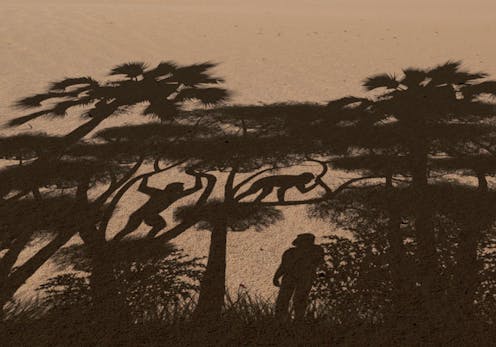
The study of present-day species has delivered a clear verdict on humanity’s place in the living world: right alongside chimpanzees and bonobos. However, this does not tell us much about our earliest human representatives, their biology or geographical distribution – in short, how we became human. For this, we mainly have to rely on the morphology of frustratingly rare fossils, given paleogenetic information is only preserved for recent periods – and even then, in rather cool climates.
Since the 1960s and the identification of the very early age of Australopithecus – including the famous Lucy aged 3.18 Ma (million years ago), discovered in 1974 in Ethiopia – the acquisition of bipedalism has been regarded as a decisive step in human evolution. Indeed, it is an essential feature that marks the transition from non-human to human long before the significant increase in the size of our brain.