
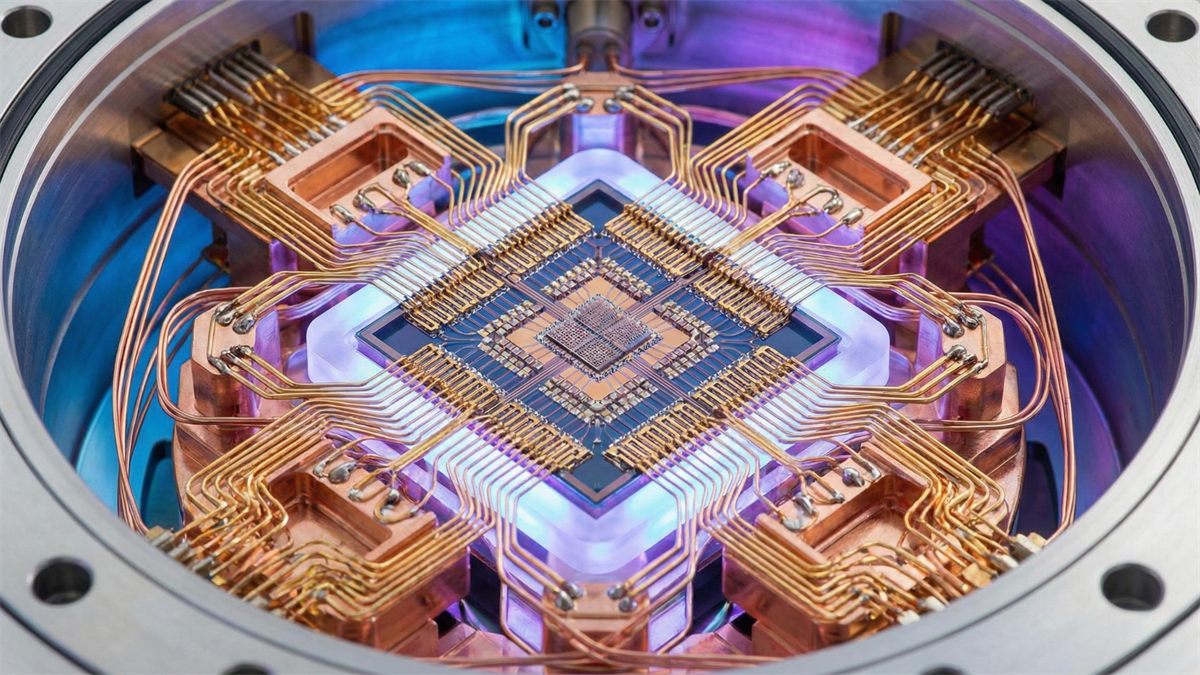
An influx of cash for some of the leading quantum computing companies, thanks to a research and development grant from the U.S. Department of Commerce, could have far-reaching impacts for investors even beyond the initial payout. Under the CHIPS Act, the Commerce Department will provide $100 million in funding each to D-Wave Quantum Inc. (NASDAQ: QBTS), Rigetti Computing (NYSE: RGTI), and Quantinuum (NASDAQ: QNT).
Together, these grants appear to send a message to the markets: Washington is committed to having a rigorous domestic quantum computing industry, but not every firm will receive federal support. In total, the quantum initiative promises more than $2 billion in incentives across the industry, with most of the funds going to support scaling of domestic manufacturing. Benefits of these grants are many, but it also means that investors will need to watch for government involvement as Uncle Sam takes a minority stake in many of the leading names in the industry.

Rigetti Is One of the Biggest Beneficiaries
Rigetti may be one of the pure-play quantum firms most positively impacted by the Commerce Department's cash influx. The $100-million CHIPS award should help the company to accelerate its development of quantum hardware.
Rigetti will be able to benefit by directing this capital completely toward R&D efforts, and it is a significant cash injection indeed: the company ended last quarter with only about $541 million in cash reserves and liquid investments. This is not a paltry sum overall, but it is smaller than some of Rigetti's prominent rivals.
As the company has mounting expenses—operating expenses widened to more than $30 million in the latest quarter—its cash pile has depleted, falling by close to $50 million between the end of 2025 and the end of Q2 2026. It's not yet to the point that investors may be concerned, but boosting the company's financial foundation now would be very welcome.
D-Wave Also Enjoys Reduced Need for Dilution
For D-Wave, the $100-million CHIPS award presents similar benefits. The firm is coming off of a fairly disappointing quarter as far as the market was concerned, and investors are looking for ways that the company might restore confidence.
Washington's choice to include D-Wave in the recipients list for the Commerce Department's awards shows the government's confidence in D-Wave's multi-pronged technological approach, an aspect of D-Wave's strategy that has previously left some investors wondering if the firm is attempting too wide a set of goals.
Perhaps the biggest benefit to D-Wave of this grant, however, is the fact that it may help the company to avoid dilutive paths to build its own cash stockpile. D-Wave has a fairly solid reserve of $546 million, and that's even after spending $250 million at the beginning of the year on a major acquisition. But it has gotten there only after multiple equity offerings that have threatened to dilute shareholder positions.
IonQ Is Left Out, But Why...and Does It Matter?
Among the group of quantum firms that did not receive CHIPS funding support in this latest round of grants, IonQ Inc. (NYSE: IONQ) may stand out. After all, the company had one of the strongest earnings reports of the last cycle and seems to be pulling ahead as an emerging leader in the industry. However, the answer could be as simple as corporate bureaucracy: IonQ acquired semiconductor maker SkyWater Technology recently enough—and the regulatory fallout of that deal is still sufficiently unresolved—that it may have simply not been eligible for funding support this time.
Ultimately, it may not matter for IonQ. The company has one of the strongest financial footings of any quantum firm, with noteworthy revenue growth last quarter despite a significant net loss. While the benefit of government funding may be useful, IonQ is arguably the quantum firm that least needs this support at this time.
The other factor that may be to IonQ's benefit is the potential impact a government stake in quantum firms has down the line. The Commerce Department may exert influence over Rigetti's or D-Wave's R&D efforts or sway how these companies prioritize their objectives. Additional oversight, restrictions on foreign partnerships, controls over exports, or other limitations may all be hurdles for companies receiving this support that could show up at some point in the future.
Overall, the uneven distribution of CHIPS funding doesn't necessarily put one quantum company ahead of all of the others. It may, however, signal to investors what the government's priorities are as the quantum industry continues to grow, and this may be worth watching to see how it affects these and other companies in the space in the future.
The article "Breaking Down the Impact of the CHIPS Funding Deal for Quantum Firms" first appeared on MarketBeat.







