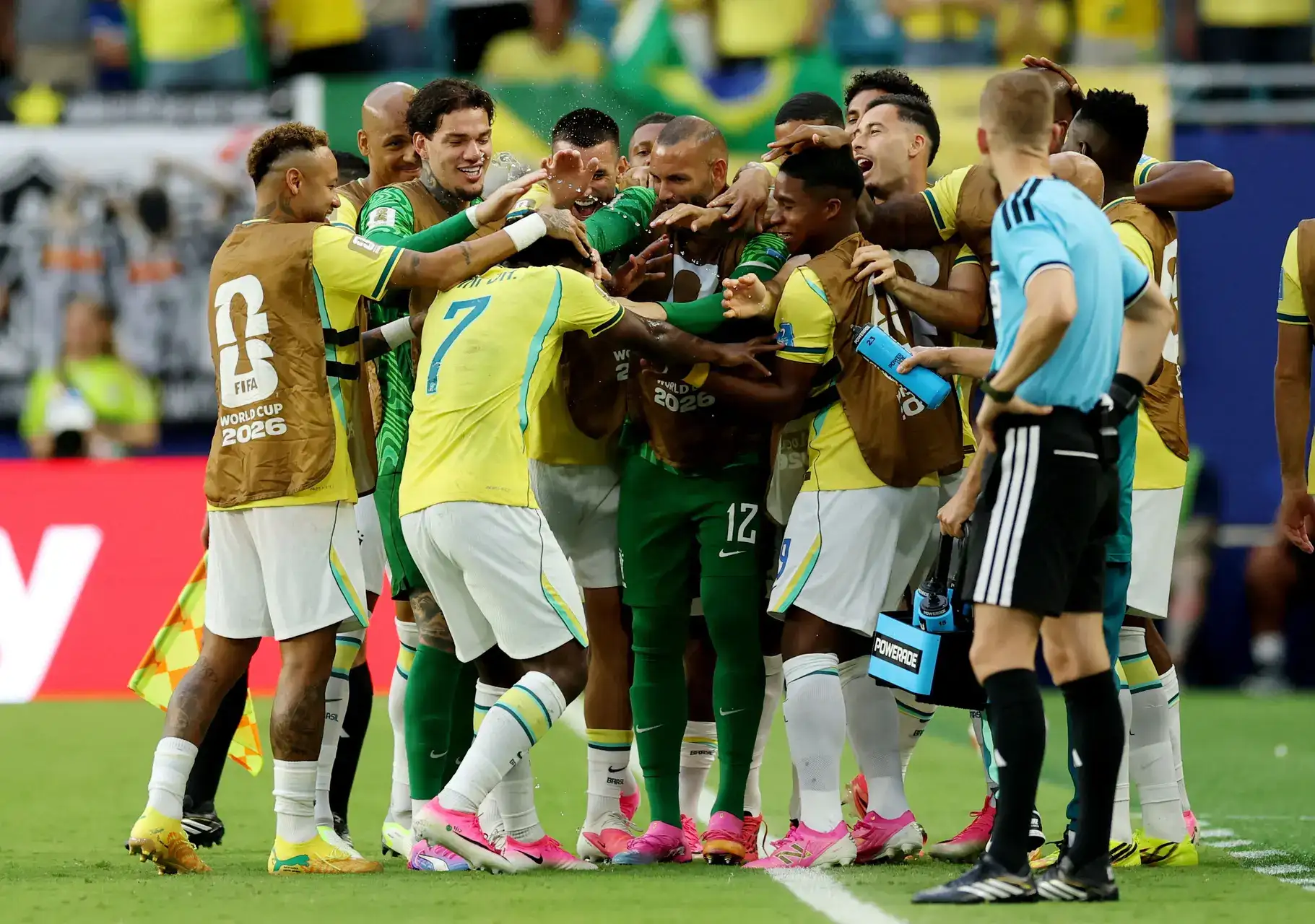
Brazil, with the firepower of Neymar and Vinicius Jr., have looked every bit like a team capable of lifting a record-extending sixth FIFA World Cup 2026 trophy. Japan, meanwhile, have quietly gone about their business, earning respect without attracting the same headlines as football's traditional heavyweights.
So when the knockout draw threw up a Brazil versus Japan clash in the Round of 32 of FIFA World Cup 2026, most fans saw it as another routine hurdle for the Selecao on their road to the latter stages.

Click here to read latest developments on FIFA World Cup 2026
But there is one prediction that has suddenly gone viral among football fans.
It is not from a former Brazil star. It is not from a bookmaker. Nor does it come from an artificial intelligence chatbot.
Instead, it comes from an economist whose World Cup forecasting record has become one of the most remarkable stories surrounding international football.
And before making his biggest call yet, he had already got one major prediction exactly right.
Who is Joachim Klement?
Joachim Klement is the Head of Strategy, Economics & ESG at Panmure Liberum, a London-based investment bank. Every four years, he publishes a World Cup prediction report built using an econometric model rather than traditional football analysis.
His model combines a country's GDP per capita, population, average temperature, host-nation advantage and current FIFA ranking points. It also includes an element of luck, recognising that football can often be decided by a single mistake, a deflection or a penalty shootout.
It sounds unusual.
But so far, it has been difficult to argue with the results.
Klement correctly predicted Germany would win the 2014 World Cup, France would lift the trophy in 2018 and Argentina would triumph in Qatar in 2022. Three tournaments. Three correct champions. Even Klement admits the streak surprised him, joking that the model was originally created to show how unreliable forecasting can be before it kept proving him wrong.
Also Read: FIFA World Cup 2026: Check full round of 32 fixtures
His latest report also predicted something else before the tournament began.
It forecast that Brazil and Japan would face each other in the newly expanded Round of 32.
That prediction has now become reality.
Brazil in FIFA World Cup 2026 have looked strong
Brazil entered the tournament carrying enormous expectations and have done little to disappoint.
Klement's model gave them a remarkable 99% probability of finishing in the top two of Group C, comfortably ahead of Morocco, Scotland and Haiti.
The Selecao have justified that confidence.
They have cruised through the group stage, looked solid at the back, dangerous going forward and have once again reminded the football world why they remain one of the favourites every time the World Cup comes around.
With their rich history, attacking talent and experience on the biggest stage, few would back against Brazil making another deep run.
Which makes what comes next all the more surprising.
While Brazil have dominated the headlines, Japan have quietly built one of the strongest reputations in international football.
Klement's model tipped them to finish second behind the Netherlands in a difficult Group F ahead of Sweden and Tunisia, describing Japan as one of the tournament's genuine dark horses.
The economist believes Japan's recent record against elite opposition deserves far more attention than it receives.
His report points out that Japan defeated Germany at the last World Cup before following it up with a 3-2 victory over Brazil in an international friendly in October 2025.
The team also recorded 1-0 wins over Scotland and England in recent matches.
Perhaps even more impressively, Klement notes that Japan beat England despite missing three key players — Ko Itakura, Takefusa Kubo and captain Wataru Endo.
Brazil vs Japan FIFA World Cup: So what does Klement's model predict?
This is where the report makes its boldest claim.
According to Klement's econometric model, Japan will knock Brazil out of the FIFA World Cup 2026 in the Round of 32.
He describes it as one of the biggest upsets in World Cup history.
The prediction is not based purely on Japan's recent form.
Klement argues that knockout football is far less predictable than the group stage because one poor performance, a moment of brilliance or a penalty shootout can completely overturn the balance between two teams.
He also believes the expanded 48-team tournament makes surprises even more likely because there is now an extra knockout round where favourites are exposed to another high-pressure winner-takes-all match.
His report argues that Japan arrive with confidence, momentum and recent victories over some of football's biggest nations, making them far more dangerous opponents than many fans appreciate.
The surprises continue throughout the tournament.
Instead of Brazil, France, Spain or Argentina lifting the trophy, Klement's model predicts the Netherlands will finally win their first-ever FIFA World Cup by defeating Portugal in the final.
Whether that extraordinary forecast becomes reality remains to be seen.
Football has humbled countless experts, pundits and prediction models over the years.
Yet Klement's model has already called the last three World Cup winners correctly, and it successfully forecast that Brazil and Japan would meet in this Round of 32 before the tournament even began.
If his remarkable run continues for one more game, Brazil's dream of a sixth world title could end much earlier than anyone expected.