
Get all your news in one place.
100’s of premium titles.
One app.
Start reading
Guitar World
Guitar World
Entertainment
Connor Flys

“Boss has packed some serious muscle into a small box... For its price, it’s going to be very tough to beat”: Boss GX-1B review

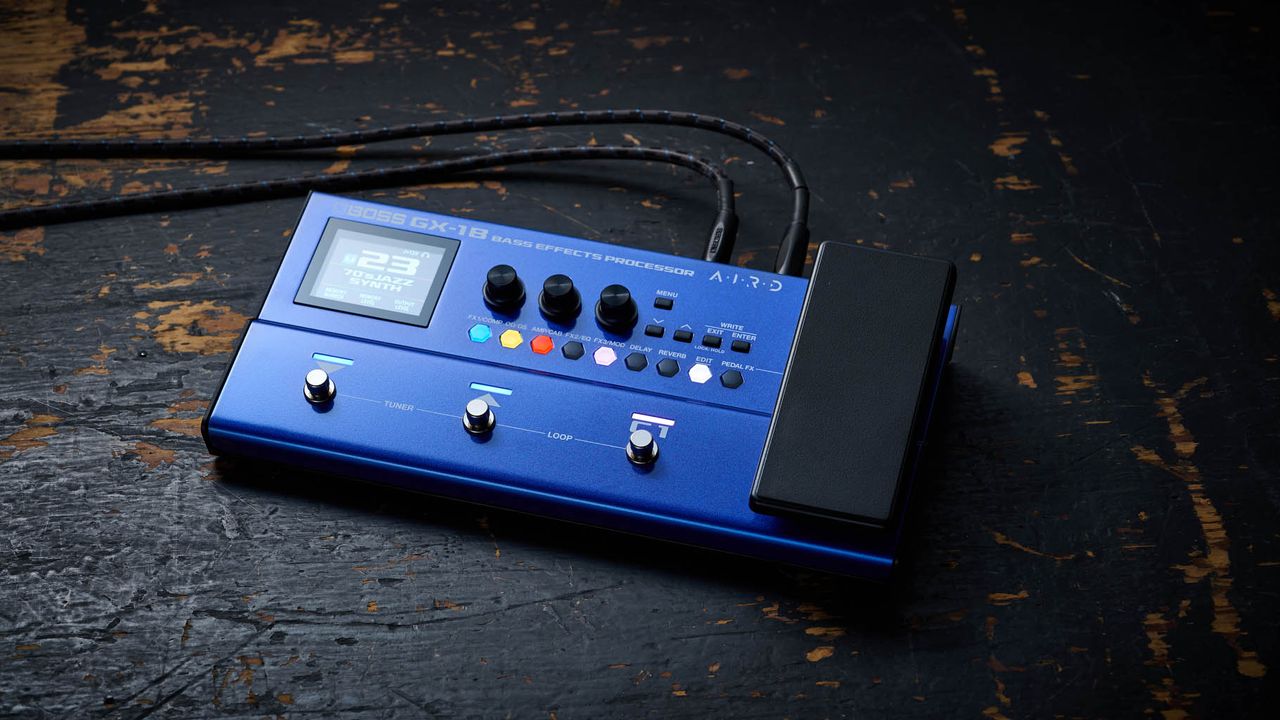
Boss GX-1B, the multi-effects pedal designed specifically for bass has a blue enclosure, three assignable footswitches and an integrated expression pedal – and it's digital display is easy to read.

What is it?

Boss pedals are industry standard, and for a reason. That ingenious, sturdy enclosure design, those multitudes of brilliant circuits that have helped shape entire genres of music, and that astonishingly diverse line-up making it possible to find something for just about anyone.

Boss (and parent company Roland) was also at the spearhead of multi-effects units, with almost four decades of history there alone. Bass-specific multi-effects pedals followed soon after, combining dozens of well-loved effects from Boss's compact pedals into a practical, space-efficient form factor – and today we check out the latest of these.

The GX range appeared in 2022; the new kid on the block relative to Boss's other multi-effects series. It's a more streamlined, cost-effective counterpart to the long-running GT range (and loses some of that line's ultimate flexibility) but is by no means short-changed technologically. Its ethos is decidedly modern, and it provides a large range of digital models for amplifiers and effects alike, using Boss's latest AIRD modelling technology.

The latest model in the series is this, the GX-1B, launched alongside the guitar model GX-1. While the larger GX-10 and GX-100 models do offer some bass functionality, this little newcomer is a specialised bass processor that packs in 16 different bass amp models and over 130 effects. It’s the first model specifically for bass guitar in the GX range, and one of only three such multi-effects in Boss’s current line-up.

Specs

(Image credit: Boss)
  • Price: $229.99 | £225 | €259
  • Type: Bass multi-effects unit
  • Controls: 3x multi-purpose rotary encoders, Menu button, Up and Down buttons, Exit button, Enter button, illuminated shortcut buttons for FX1/Comp, OD/DS, Amp/Cab, FX2/EQ, FX3/Mod, Delay, Reverb, Edit, Pedal FX, 3x multi-purpose footswitches, expression pedal
  • Features: 16 amp models, 130+ effects, up to 8 amp/fx blocks simultaneously, Boss Tone Studio app functionality
  • Connectivity: 1/4" instrument input, R and L/mono 1/4" output, 3.5mm headphone input, external control/expression output, USB-C input
  • Power: 9v DC, 250mA (or 400mA if powered via USB-C)
  • Dimensions: 307 x 73 x 149 mm (with pedal heel-down)
  • Weight: 1.2kg
  • Contact: Boss

Build quality

(Image credit: Future/Matt Lincoln)

Build quality rating: ★★★★½

The GX-1B is small, but not too small; about the size of a Line 6 HX Stomp XL. Of course, that trusted modelling mainstay is festooned with eight footswitches while the Boss only boasts three – but here, we get an expression pedal built in, and that’s a very useful thing to have.

We also get a slew of buttons in addition to the three multi-purpose rotary encoders.

The sleek, vividly blue enclosure feels fairly robust – the top side is metal, the base, sides and pedal are tough-feeling plastic. All the buttons and knobs are nicely damped and feel sturdy too. Digital tech permitting, one could picture a battle-scarred GX-1B still doing the rounds on stage in ten years’ time; really, that toughness is expected from Boss.

Usability

(Image credit: Future/Matt Lincoln)

Usability rating: ★★★★☆

The buttons for each different link in the signal chain are neat – it’s definitely useful to skip straight to the Amp/Cab block, or Delay, or any other, with a single button press

The small screen (not a touchscreen as on bigger GXs), and the relatively few knobs and switches, means that scrolling the menus on the unit can be time-consuming. The Boss Tone Studio app is on hand to make this easier, which is useful. Without it, you’ll be doing a lot of clicking on the menu ‘up’ and ‘down’ buttons.

The digital architecture is clearly well-designed, however; the display is crisp, and the menu and rig layouts easy to understand and utilise.

There are also a couple of valuable ways to speed things up. The buttons for each different link in the signal chain are neat – it’s definitely useful to skip straight to the Amp/Cab block, or Delay, or any other, with a single button press (featuring colour-coded lighting, no less). Further to this, every effect model contains a few expertly-dialled presets to expedite the setup process – this new feature is called Gear Suite, and it's another great time-saving idea.

(Image credit: Future/Matt Lincoln)

Plugging in the freshest-stringed bass on the rack, my passive Yamaha BB five-string bass guitar, I went for a wander through the presets. That's 99 manufacturer slots, which cannot be overwritten, and 99 user slots which can.

Initially these user slots are filled by duplicates of the manufacturer presets. A lot of memory – likely more than many users will ever need, but it means you’ve plenty of space to experiment at will.

Sounds

(Image credit: Future/Matt Lincoln)

Sounds rating: ★★★★½

As ever with preset-heavy modelling units, some of the sounds are difficult to imagine any use for, but there are many which are gig-ready right away

A favourite clean setting, ‘Down Town’, is a full-bodied, ‘squishy’ compressed tone that works a treat for busy funk and disco lines. Several well-dialled-in filter and auto-wah presets enliven slap and fingerstyle playing alike.

As ever with preset-heavy modelling units, some of the sounds are difficult to imagine any use for, but there are many which are gig-ready right away. The Gear Suite presets for each effect generally sound excellent too – truly saving time when dialling in.

There's an abundance of modulation, delays and reverbs for more esoteric sounds. And, interestingly, there's a model of Boss's rare Slow Gear volume-swell effect – plus the astonishing Slicer tremolo/synth/processor; a particularly powerful creative tool. All the effects can even be set to trigger momentarily, should you require it.

(Image credit: Future/Matt Lincoln)

There’s more than enough in the way of gain-stage effects to achieve almost any overdriven sound desired

Switching to my Warwick Thumb five-string, I spent time tweaking another setting, 'Djent Core’ to emulate the aggressive, percussive tone of modern metal bass work.

There’s more than enough in the way of gain-stage effects to achieve almost any overdriven sound desired, and – crucially – they allow the distorted and clean signals to be balanced for the right combination of definition and growl.

The AIRD amp and effect modelling is impressive – representing the peak of Boss's digital architecture thus far, it does give realistic sounds and feel whether using simple or complex settings.

Verdict

(Image credit: Future/Matt Lincoln)

It packs in more amps and effects than many will ever need, but only after nailing the fundamentals

The GX-1B takes its place alongside a huge number of modern multi-effects units, but is one of relatively few to be designed specifically for bassists.

Its small size means physical control of the unit can be long-winded, but then, this is the modern world; many will doubtless engage the Tone Studio app to set things up. The time-consuming button mashing then becomes a non-issue – and what you're left with is a compact, slick, very solid and great-sounding multi-FX.

It packs in more amps and effects than many will ever need, but only after nailing the fundamentals. From there, you could ladle in esoteric effects and tweak to your heart's content, or you could set up a few great sounds and place it straight onto the stage.

Guitar World verdict: Boss has packed some serious muscle into a small box, and for a relatively small outlay too. The GX-1B is chock-full of amps and effects, and delivers its goods with aplomb - a well-finished package with solid digital architecture, and a contemporary, unfussy aesthetic approach. For its price, it's going to be very tough to beat.

Ratings scorecard

Test

Results

Score

Build quality

A solid and smart-looking device, hopefully exhibiting Boss's trademark durability.

★★★★½

Usability

Digitally very slick and capable, but reliant on lots of button-mashing when editing manually.

★★★★☆

Sounds

A veritable playground of amps and effects, although not every preset will be useful.

★★★★½

Overall

Great value and stuffed full of high-quality features, the GX-1B will doubtless appear on stages far and wide.

★★★★½

Also try

Hands-on videos

Boss

Sign up to read this article
Read news from 100’s of titles, curated specifically for you.
Already a member? Sign in here
Related Stories
Top stories on inkl right now
One subscription that gives you access to news from hundreds of sites
Already a member? Sign in here
Our Picks
Fourteen days free
Download the app
One app. One membership.
100+ trusted global sources.