Get all your news in one place.
100’s of premium titles.
One app.
Start reading
The Times of India
The Times of India
World
TOI World Desk

‘Boom in the sky’: How Iran’s missile strikes turned Dubai into a travel trap

What was meant to be a relaxing corporate retreat in Dubai quickly turned into a stressful ordeal for a group of European travelers as conflict in the region escalated.

Filip Sobiecki, who works at an AI startup in Poland, had arrived in Dubai with 18 colleagues and family members for a week-long getaway. The plan was simple: enjoy a few sun-filled days away from the bleak winter back home in Germany and Poland. But their holiday took a dramatic turn after Iran and joint US-Israel forces exchanged strikes following the killing of Iran’s supreme leader Ayatollah Ali Khamenei.

Soon after, Dubai found itself in the middle of the fallout. Explosions were heard across the city as defence systems intercepted Iranian drones and missiles. With airspace across the region shutting down, Sobiecki and thousands of other travellers suddenly found themselves stranded.

Their return flight on LOT Polish Airlines was cancelled, forcing Sobiecki to look for alternatives. He briefly considered chartering a private jet but discovered the price had shot up fourfold as desperate travellers scrambled to leave the city.

He then explored other routes — from hiring a yacht to Mumbai to arranging armoured vehicles that could drive his group to Oman, where they hoped to catch a corporate jet to Istanbul and then continue home. None of those plans worked out.

In the end, Sobiecki and his group were stuck like tens of thousands of other visitors in Dubai, a city known for being one of the world’s most reliable global travel hubs. Even during crises like the pandemic or the war in Ukraine, Dubai had continued to function as a gateway connecting travellers and businesses.

This time, however, the situation was different.

Missiles and drones fired from Iran reportedly damaged parts of Dubai, including the main airport terminal and the iconic sail-shaped Burj Al Arab hotel. Flights were cancelled, the airspace closed, and even sea travel became difficult.

Suddenly, the bustling global hub felt cut off.

“We had this assumption that this is going to be a wonderful time spent together,” Sobiecki told Bloomberg from his hotel room in Dubai’s Marina, where he reported hearing several blasts and could feel the building shake. “All of a sudden there was a boom in the sky, probably one of those rockets got intercepted, and that’s where we just decided to stay in.”

Dubai has long built its reputation as a haven of stability in a region often marked by conflict. The city’s ultramodern skyline, luxury resorts, and endless shopping options helped attract nearly 20 million international overnight visitors last year, according to the Dubai Department of Economy and Tourism — an average of more than 50,000 visitors every day.

Tourism plays a major role in the UAE’s economy. According to Statista, travel and tourism accounted for about 13% of the country’s GDP in 2025.

Bloomberg Intelligence analyst Rami Abi-Samra said the ongoing conflict could hit the UAE harder in the short term because of its heavy reliance on tourism and expatriates.

“Higher oil prices may support regional budgets, but the UAE’s visitor and expat mix makes the near-term hit sharper,” Abi-Samra wrote.

Dubai’s hotel industry is among the largest in the world, with more than 154,000 rooms spread across over 800 properties — more than cities like Bangkok, New York, Paris and Singapore, and nearly on par with London. Hotels recorded an average occupancy of over 80% in 2025.

Among the many visitors now stuck in the UAE are thousands of Russian tourists. The Association of Tour Operators of Russia estimates that around 50,000 Russians are currently in the country, with about 20,000 unable to leave as flights remain suspended.

The UAE government has said it will cover the cost of accommodation and support for affected travelers, according to local media reports.

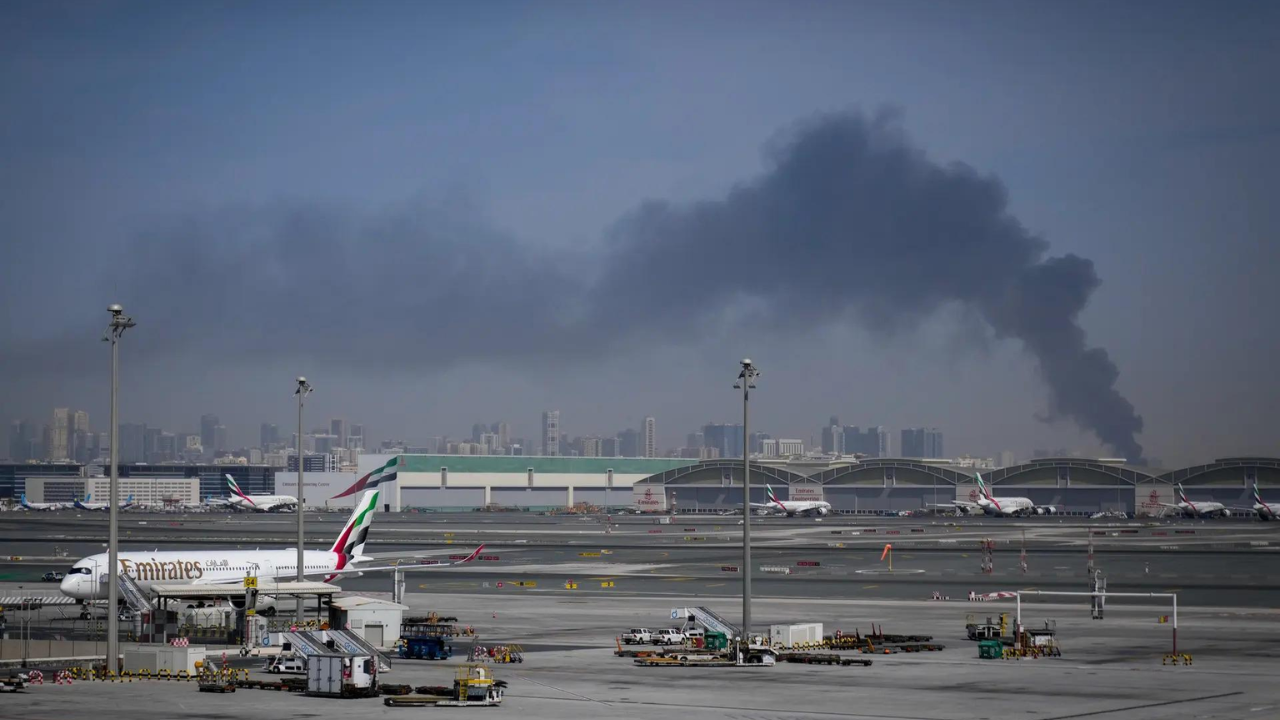
At Dubai International Airport, the initial chaos of stranded passengers has given way to an unusual calm. Emirates’ giant Airbus A380 aircraft now sit idle at their gates, including one that was slightly damaged during a suspected aerial attack overnight that injured several workers.

George Koshy, a US-based tech and communications entrepreneur, also found himself caught in the disruption. He was flying from Mumbai to Dubai when his flight was forced to reroute multiple times over Afghanistan before eventually returning to Dubai.

His Airbus A380 carrying more than 500 passengers landed back at the same terminal it had departed from only hours earlier.

Koshy said Emirates arranged hotel accommodation for many stranded passengers, but uncertainty still hangs in the air.

“In the central district areas in Dubai, hotel authorities have been asked to switch off lights at night amid missile and drone attacks,” he said. Still stuck in Dubai, Koshy said he won’t be able to meet his family in Los Angeles until tensions ease.

How quickly Dubai returns to normal will depend largely on how long the conflict continues and how soon flights resume.

For now, many travelers are simply waiting.

Ekaterina Zamyatova, a private school owner from Moscow, arrived in Dubai last week with her husband and son on a package tour. She was scheduled to fly back to Moscow on Sunday, but her Aeroflot flight was cancelled.

Her hotel agreed to extend her stay for a short time, but when the tour company failed to arrange alternatives, she had to look for accommodation herself.

Despite the chaos, she remains optimistic about returning.

“We will come back anyway,” said Zamyatova. “We love Dubai, and this situation will not affect our future plans to travel here, provided that peace is restored.”

Sign up to read this article
Read news from 100’s of titles, curated specifically for you.
Already a member? Sign in here
Related Stories
Top stories on inkl right now
One subscription that gives you access to news from hundreds of sites
Already a member? Sign in here
Our Picks
Fourteen days free
Download the app
One app. One membership.
100+ trusted global sources.