
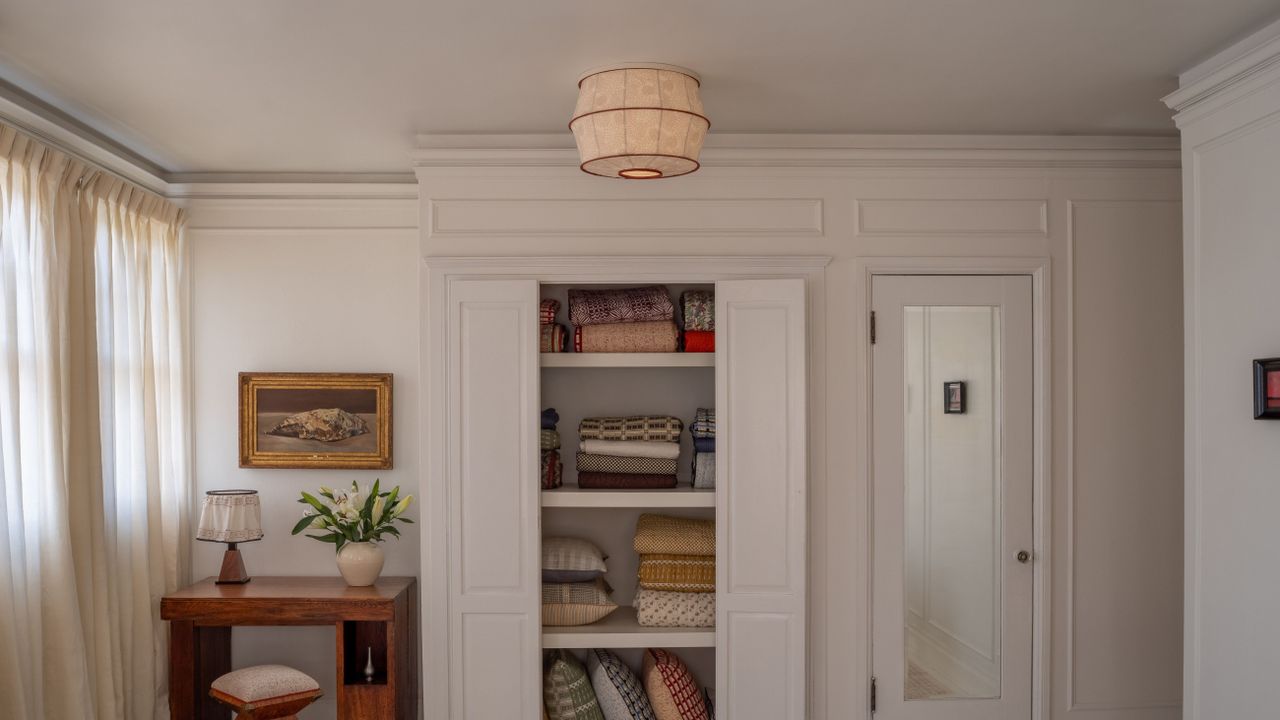
My pre-war New York apartment has plenty of unphotogenic quirks, but the bathroom is the real offender. It’s so small that even I – at 5’5” – have to choreograph my movements. The tub crowds the toilet, the toilet blocks the sink, and overhead looms the worst offense of all: a ceiling light, installed lord knows when, casting a harsh, interrogation-style glow.
Or rather, it was. Because I eventually stumbled upon a workaround with potential to make my bathroom lighting not only update the space, but totally change it: the Gem by Tulip.

I’d been seeing Tulip’s wire-free, renter-friendly, anti–‘boob light’ shades everywhere online. My fixture doesn’t technically protrude, but I figured it was ugly enough to qualify. Still, I hesitated. Would the adhesive actually hold up in a damp bathroom? Would the sculptural designs overwhelm a space this cramped? And were the ‘easy’ installs truly easy, or just influencer-easy?
I went back and forth until I saw Tulip’s collaboration with LA-based textile atelier Studio Ford. The Gem Tuberose – a floral block print in soft pink with contrast piping – ultimately sealed my fate.
So, renter or not, should you buy one too? Ahead, my experience installing the very viral Tulip lighting idea and living with it for nearly two months to help you decide.
Tulip’s Gem shade is one of three silhouettes offered by the brand (alongside the Lamp and Drum) and features a tiered form paired with a block-printed design produced in Jaipur, India, as part of its collaboration with Studio Ford. This renter-friendly shade includes installation materials and fits over existing light fixtures measuring 15 inches or less in diameter and 13 inches or less in height. Rated 4.9 stars across nearly 600 reviews.
Setting Up

Fresh out of the box, my first thought was: wow, what a lovely fabric. I’d happily take it as a throw pillow or a drape, should Tulip ever pivot. I’d also been bracing for something far flimsier, but the shade felt surprisingly durable. Alongside it came a circular ceiling mount, screws, alcohol wipes, and 3M strips – all part of the included Tulip installation kit.
As an Aquarius, I’m famously opposed to chores, instructions, and anything remotely tedious. I was relieved to discover that Tulip’s ‘How To’ section is a one-minute-and-43-second video, which I watched instead of reading anything. Perfect.
The screws gave me a brief jump scare, but a quick glance at the instructions confirmed that because my ceiling is smooth, I could skip them entirely and use the adhesive strips instead. (The drywall screws are meant for popcorn ceilings or more permanent installs.)
I cleaned the six intended contact points on the plastic ceiling mount (the areas without magnets – those are what the shade eventually snaps onto, and what makes future shade swaps possible), waited for them to dry, then paired up the Velcro strips and pressed them firmly into place. After that, I cleaned the area around my ceiling light, peeled the remaining adhesive backing, and pressed the mount onto the ceiling – holding each section down for a full 30 seconds, per instructions.

Then came the fun part: attaching the shade. The magnets snapped it into place instantly. Immediate gratification. For about 14 minutes.
Then the whole thing fell down.
I’m fairly confident this was due to the state of my pre-war bathroom ceiling, which – if I’m being honest – had never been cleaned by me or, I suspect, anyone before me. I ran out, bought rubbing alcohol, gave the area a real clean, repeated the process, and reinstalled everything. The second attempt took minutes and has held perfectly ever since.
So, if you live in a similarly old city apartment, consider this a warning that you may need a little extra cleaning power beyond what’s included.
Once it was finally up for good, I stepped back and admired it. The scale felt a touch excessive in my small bathroom, which I actually loved. It looked like the cool-girl bathroom chandelier I was never supposed to have. Am I... an electrician? Unclear, but I was pleased.
Living With My Gem Light

My one hesitation going in was that my ceiling light also functions as a fan – essential in a bathroom this small – and I worried the shade might interfere. Thankfully, the design accounts for this: the bottom of the Gem is open, so airflow continues uninterrupted. Moisture control remains intact.
The lighting itself was the bigger upgrade. What had been harsh and unforgiving is now softly diffused into something warmer and more flattering. I can still see well enough to do my makeup and move around comfortably, but the room feels calmer – almost elegant, words I truly never thought I’d use to describe this bathroom.
Beyond that, there’s very little to report. I turn the light on and off as usual, and nearly two months in, I haven’t adjusted, fussed with, or thought about it once.
Final Thoughts

Despite the slightly rocky start of having to reinstall the Gem Tuberose a second time, it was more than worth the trouble. In one reasonably priced $169 move, I solved my ugly bathroom light problem and added a piece of Studio Ford’s textile work to my ceiling. No Taskrabbit required. (If I can do it, you absolutely can.)
Of course, this is an especially good solution for renters, but the thing about the Gem Tuberose – and Tulip’s shades more broadly – is that they don’t read like a band-aid. Even if you could swap out a fixture entirely, these look good enough that you might not want to.
I also like knowing it’s not permanent. When I eventually tire of it (hasn’t happened yet), the ceiling mount stays put, and I can simply snap on a new magnetized shade for a quick refresh.
I’ve already started eyeing other lights in my apartment that could use the same treatment – and after this experience, I’d suggest you do the same.
Another standout from the Studio Ford collaboration is the Lamp Fennel. With its wide bottom opening and softly rounded corners, it’s best hung over a dining table, where it naturally lends itself to more intimate meals and conversations.
Tulip’s Drum shade is the simplest silhouette in the lineup, which also makes it the most versatile. Available in nine prints and colorways, including this version with a fern-green border, it reads less like an accent and more like something that’s always belonged.
Living in a rental, I am all about the no-reno design hacks, and this has been one of the easiest and most transformative yet. The Tulip Shade gets the seal of approval from me.