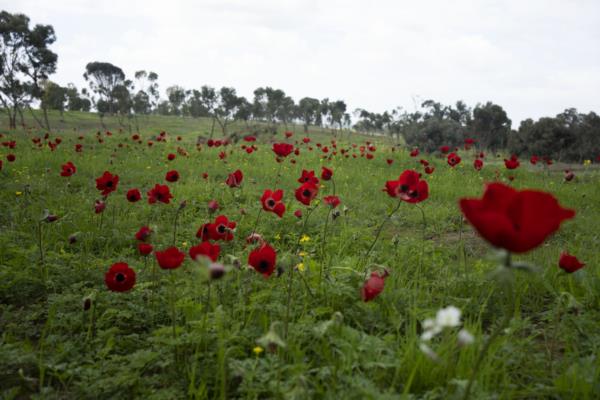
Each year, as spring arrives in Israel, colorful wildflowers blanket the landscape, offering a vibrant display before the scorching summer heat sets in. Nowhere is this floral spectacle more captivating than in southern Israel, near the Gaza border. Here, fields of brilliant red anemones, reminiscent of poppies, burst forth with such intensity that the rolling hills appear to be adorned in crimson carpets.
For nearly two decades, these blossoming flowers have served as the centerpiece of a renowned festival known as Darom Adom, or Scarlet South. This festival has not only become a major economic engine for the region but also a source of local pride. However, this year, the festival has been canceled, yet another casualty of the ongoing war in Gaza.
Vered Libstein, the organizer of the festival, has experienced profound personal loss due to the conflict. Her kibbutz, Kfar Azza, situated along the Gaza border, was heavily impacted by the October 7th Hamas attack that initiated the war. Tragically, Libstein lost her husband, Ofir Libstein, as well as her 19-year-old son, Nitzan, her mother, Bilha Epstein, and her nephew, Netta Epstein. Ofir Libstein, a member of the kibbutz's local security team, was one of the first casualties, while it took 12 days to locate Nitzan's body.
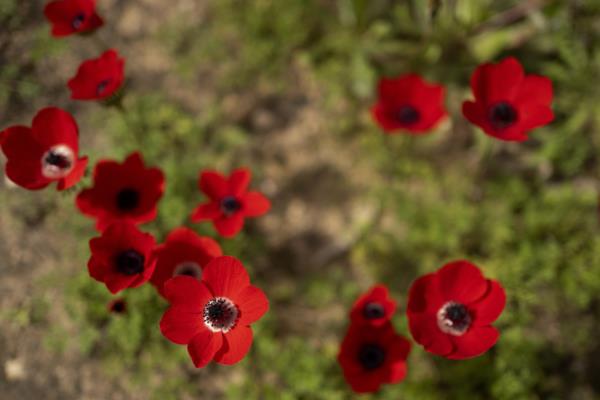

Walking through a field and observing the vibrant blooms, Libstein shared her conflicting emotions: 'On one side, it's hard, but on the other side, it just proves to us that life is stronger than everything, and it renews itself, and we'll need to find the strength to renew ourselves as well.'
The October 7th attack by Hamas resulted in the deaths of approximately 1,200 people and the abduction of around 250 others. In response, Israel launched a devastating air-and-ground offensive, resulting in the loss of over 28,500 lives in Gaza, predominantly women, children, and young teens, according to Gaza's Health Ministry.
Indeed, the blooming anemones hold profound symbolism, not only for Israelis but also for Palestinians. These red flowers, with their black-and-white centers and green leaves, mirror the colors of the Palestinian flag and have become a recurring motif in Palestinian artwork. In a 2013 popular vote, the red anemone was even designated as Israel's national flower by an Israeli conservation group.
Initially starting as a small volunteer hotline to guide hikers to the most concentrated blooms, the Darom Adom Festival quickly grew in popularity. It eventually evolved into one of Israel's largest nature events, featuring a packed schedule of concerts, organized hikes, bike rides, races, kids' events, foodie markets, art galleries, and visits to local farms. The festival, held during January and February when the anemones are at their peak, attracts over 400,000 visitors annually and contributes more than 80% to the local tourism income for the entire year.
While this year's festival had to be canceled, some local businesses and artisans have organized pop-up markets, allowing visitors to still enjoy the beauty and purchase anemone bulbs to nurture at home. Despite the challenges, the resilience of nature can be witnessed as the scarlet blooms emerge amongst the charred remains of trees—a symbol of hope and renewal.
Moshe Federman, a reserve soldier who spent three months near the site of a music festival where 364 people were killed, expressed his amazement at the sight of new eucalyptus saplings and vibrant wildflowers in the once-devastated area. 'It's growing anew,' he remarked. 'I guess that's part of life.'
Nevertheless, for Anat Katz, a visitor from New York, the stark contrast between the beauty of the flowers and the somber reality of the conflict creates a poignant tension. She described the flowers as both beautiful and a reminder of bloodshed. 'We see them popping up everywhere we go, so that feels a little hopeful in a place that feels like a real hit in the stomach,' she shared. 'There's something that feels cyclical, how they're alive right now, how they're blooming at a time when it doesn't feel like there's a lot of blossoming.'
Currently residing away from the region in a hotel with other members of the Kfar Azza community, Libstein is overseeing the move into mobile homes on a kibbutz located about 20 kilometers (12 miles) east of their original homes, which were significantly damaged. She finds herself in the midst of the flowers that she and her husband had once made synonymous with the region, yet without him and far from the home she loves during the most beautiful time of the year.
As she reflects on the delicate yellow dandelions that intermingle with the anemones, Libstein is reminded of the 134 hostages believed to still be held in Gaza. These yellow ribbons have become a symbol of protests demanding their release. While nature marks the passage of time and the possibility for renewal, Libstein acknowledges that true healing and moving on will take a considerable amount of time and effort.
'It's a symbol to us about the importance of blooming again, but it will take a long time,' she said.