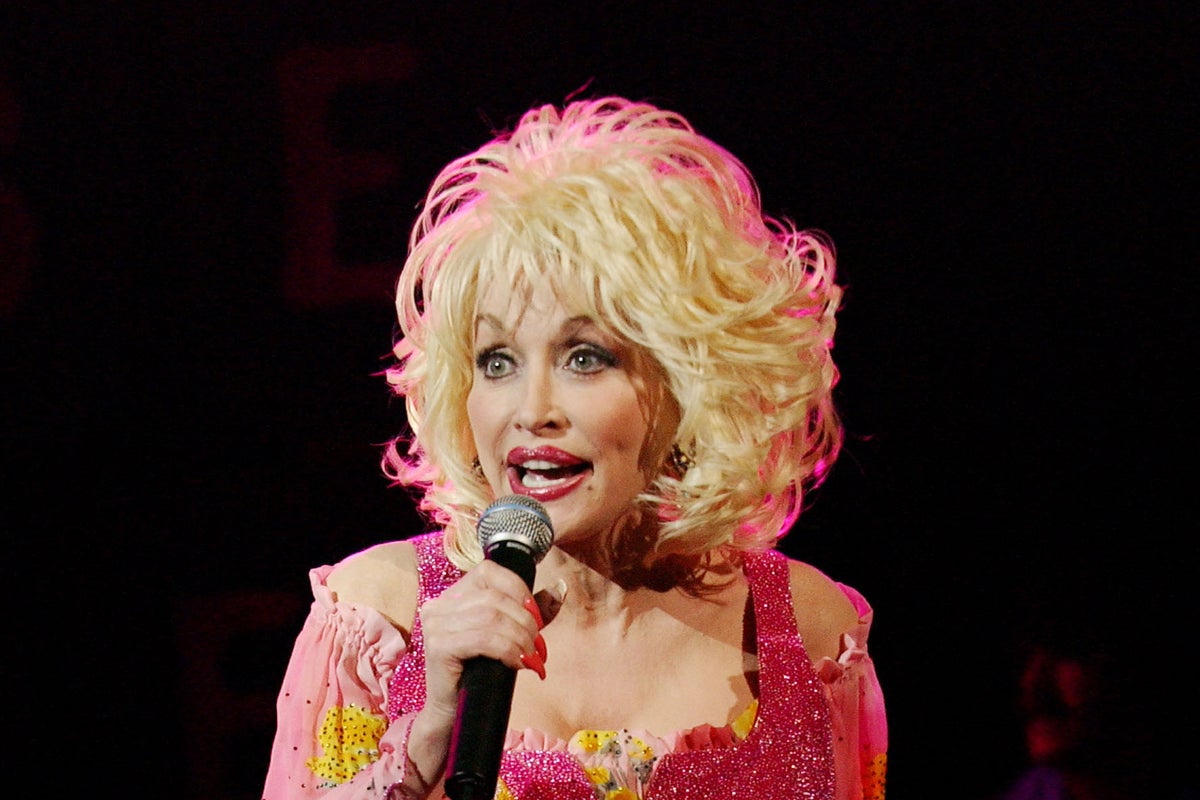
We’ve got a little girl here up from east Tennessee. Her daddy’s listening to the radio at home and she’s gonna be in real trouble if she doesn’t sing tonight, so let’s bring her out here.” Out from the wings comes Dolly Parton, 13 years old and awestruck by Johnny Cash, introducing her Grand Ole Opry debut in Nashville, 25 July 1959.
“Johnny was like Elvis – he stirred everything up in me,” Parton recalls in her new book, Star of the Show: My Life on Stage. “He was just so sexy, and he moved around in all these weird ways. “ She found out later that his strange jerking movements were “probably just because of what he might’ve been on or coming off of at the time”, but still, having the country music king introduce her was a huge deal. So overwhelming, in fact, that Parton almost froze right there onstage at the storied Ryman Auditorium. Then someone in the audience snapped a photo. Flash! She snapped back into it: “I just let loose.” That night, she got three encores.

At 79, Parton is both a star and an enigma poured into a bejewelled, bust-hugging bodysuit. She is a country music trailblazer, business genius and, to many fans, fairy godmother. As she remembers, she wrote her first song when she was five years old (“Little Tiny Tasseltop”, about the doll her mum made for her) and hasn’t stopped writing since. Her audience has grown from her brothers and sisters on the porch of the family home in Locust Ridge, Tennessee, to millions around the world.
And so it’s into this mythology that Star of the Show arrives – the third and final chapter in Parton’s photographic trilogy, after 2020’s Songteller and 2023’s Behind the Seams: My Life in Rhinestones. This one chronicles Parton’s career in great detail, from her childhood growing up in poverty to the empire she now runs, spanning an extraordinary catalogue of music, books, films, theatre and TV shows (both as an actor and producer), her Dollywood Parks and Resorts, music venues and, most recently, the Dolly Hotel in Nashville. It is widely speculated that Parton would be a billionaire were she not such a generous philanthropist, donating millions to charities such as her Imagination Library, founded to promote literacy for young children.
It makes sense that this book should focus so intently on her career. As wide-ranging and impressive as it is, her work sometimes takes a backseat to the big blonde hair, the famous bosom and the lovable persona. Star of the Show is a reminder of the tireless work ethic that has got her to where she is – and a testament to her superb storytelling ability both on and off the mic.
Anyone diving in with hopes that she might finally open up about her romantic life will therefore be disappointed. There are only fleeting mentions of her late husband Carl Dean, including their meet-cute outside of the Wishy Washy laundrette in Nashville on the very day she arrived in town. From there, the only other references to Dean are made in relation to her work – how he supported Parton financially while her star was still in the ascendent, and the time in 1978 when he surprised her on stage at the Kentucky State Fair.

In lieu of romantic recollections, we are treated to a play-by-play of Parton’s early years. She takes great pride in reflecting on her humble origins, while also impressing on the reader that she always knew she was destined for greatness. It’s a good thing that Parton has a remarkable memory, calling to mind small but charming details, like the sky-blue suit and lavender boots Porter Wagoner wore for their last show together, or the road-side cookouts she and her band put on during her early solo tours. Her voice is so distinctive that you can practically hear her country twang as she regales us with tales of her uncle Bill teaching her to play guitar – little Dolly beaming with pride at the tough calluses on her fingers: “Most of the kids would give up before they learned to play like that. I never gave up. I never gave up for anything.”

We hear at length about the “Porter years”, when Parton successfully auditioned to be the “girl singer” – as they were known back then – on country star Wagoner’s TV show. Her recounting of that time makes for some of the book’s most engrossing chapters. Wagoner, she writes, refused to give her a pay rise, instead offering her lavish gifts, from jewellery to a Cadillac. But Parton wanted to buy her own gifts. She writes that the friction between them worsened, coming to a head whenever he tried to dictate which songs she could perform. She exited the show in the early Seventies; her 1974 song “I Will Always Love You”, inspired by that professional breakup, went to No 1 on the country music chart that year.
As Parton recalls it, Wagoner was an aging artist who saw her rapidly ascending star as a threat. “It was his show,” she explains, “but I was trying to grow in the business and grow as an artist myself… But trying to grow within somebody else’s show when he takes everything as a threat or gets mad if you’re getting more attention than him — what ends up growing is tension. You have to know your own place, so to speak, and my place was anywhere I felt I needed to be. I thought, You ain’t my director. God is.”

I wonder if this book, with all its nitty gritty details about her rise to the top, is perhaps Parton’s final say against anyone who might dare still try to suggest she’s a “dumb blonde”, fooled by the big hair and the makeup and the clothes. “It costs a lot of money to look this cheap,” Parton often jokes. While she has laughed off the insults with a level of grace most could never muster, she doesn’t pretend they don’t happen. And her steadfast apoliticism certainly doesn’t mean she tolerates hate. There’s a sharp retort to the bigots who challenge her open-armed acceptance of drag queens: “I don’t care what they’re dragging as long as they’re dragging it to my show!” What this book does so well is reveal what remains most astonishing about Parton: that, more compelling than the heartbreaks or feuds we expect from a celebrity memoir, are the years of hard work she has devoted to her craft – and continues to devote today. After all, it was only in 2014 that she played to the biggest international audience of her career: 180,000 fans gathered around the Pyramid Stage at Glastonbury Festival, where she played the Legends Slot.
Late in the book, Parton writes that she was always aware of the music industry mantra that dictated artists have a shelf life. “During the early 2000s,” she says, “it seemed like most of the music business had decided that’s what was going to happen to me. Instead, I hit the best period of my touring life nearly 40 years into my career on the national stage. I ended up selling out strings of arenas and even stadiums on three different continents at an age when many of my peers start thinking about winding things down.” Parton knows she was destined to be a star, but here we see just how much work she’s done to shine so brightly.
‘Dolly Parton: Star of the Show’ is out now on Ten Speed Press