
We've seen plenty of restored historical photos and old images turned into video using generative AI, but there's also free tech out there that allows us to travel in time in three dimensions.
Gaussian splatting is a volume rendering technique that can turn 2D photos or videos into 3D scenes that capture lighting and reflections as well as geometry. To explore the possibilities and test how effective it can be, a game developer has been bringing old photos of London to life in Blender, a free program that features highly in our guide to the best 3D modelling software.
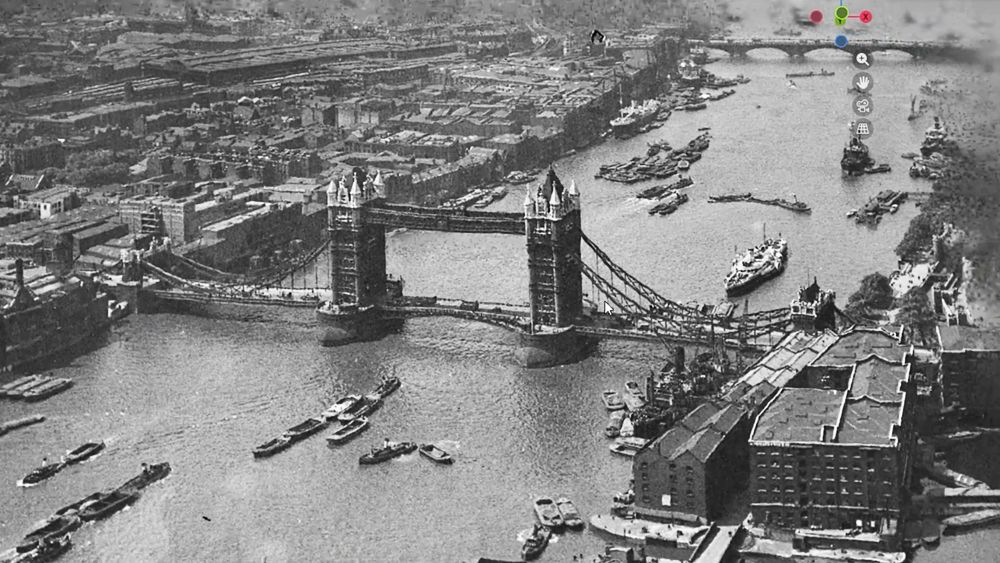
Turned 1930s shot of London Tower Bridge into Gaussian Splat then test it on Blender from r/blender
Unlike photogrammetry, which requires multiple photos, Gaussian splats can be created from the depth and focus data of just a single image. Instead of traditional polygons, the technique uses millions of fuzzy 3D ellipsoids with defined position, size, orientation, colour and transparency to represent and render a 3D environment in real-time in a way that looks highly accurate from a particular viewpoint.
As shown in the post above, Krzysztof, AKA Virtual Szkoda, used the technique to bring a black-and-white photo of London's Tower Bridge in the 1930s into Blender. To create the splat, he used Apple's SHARP, an experimental open-source AI model.
As some have noted in the comments on Reddit, the machine learning model doesn't know what's out of view in the original image, so it fills the scene with statistically similar data based on its training. That means the 3D scene isn't the 'real' London from that moment captured in the 1930s, although the approximation is convincing, allowing the historical image to be explored.
Krzysztof has been experimenting by using the same technique other historical images of London, including of the famous double-decker buses and Regent Street as shown in the Instagram posts below.
Krzysztof notes that he had to install Nvidia CUDA so it could tell his graphics card to create a 3D space within the code when processing began. He used 3DGS Render by KIRI Engine to import the Gaussian splat into Blender.
All three tools used for the workflow: SHARP, 3DGS Render and Blender are free to download (Apple's SHARP is available on GitHub).
For more inspiration, see our collection of Blender tutorials.