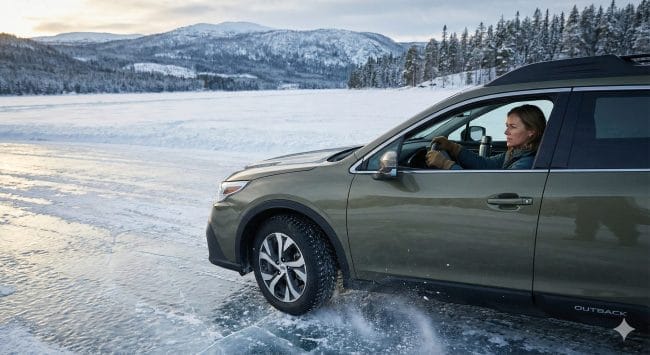
We all know that guy. He drives a massive 4WD truck, and when the snow starts falling, he zooms past everyone in the slow lane. He thinks his drivetrain makes him invincible. Two miles down the road, you usually see him in a ditch. The physics of winter driving are unforgiving, and they do not care about your vehicle’s features.
The most dangerous adversary on the road isn’t snow; it is black ice. It is that thin, invisible glaze that forms when the temperature hovers near freezing. You can’t see it, your tires can’t grip it, and your 4WD cannot stop on it. Surviving a black ice encounter isn’t about skill; it is about the micro-decisions you make *before* you hit the patch. Here is how to survive when the road turns to glass.
The 4WD Fallacy
Let’s debunk the biggest myth first: Four-Wheel Drive helps you *go*, it does not help you *stop*. Having power sent to all four wheels helps you get out of a snowbank, but when you hit ice, your braking distance is exactly the same as a Honda Civic.
Overconfidence is the number one cause of winter accidents. If you are driving faster because you have AWD/4WD, you are already in the danger zone. The moment your tires lose friction with the road, your engine power is irrelevant. You are simply a heavier projectile moving at a higher speed.
The Cruise Control Death Wish
Using cruise control in freezing conditions is one of the deadliest mistakes you can make. If your car hits a patch of black ice while cruise control is on, the tires will lose traction. The computer will sense the wheel spin and try to accelerate to maintain speed.
This sudden burst of power on a frictionless surface will cause an immediate and violent loss of control. You will spin out before you can even touch the pedal. If the temperature is below 35 degrees, turn the cruise control off. You need to be in full manual control of the throttle at all times.
The Bridge Trap
Bridges and overpasses freeze first. We learn this in driver’s ed, but we forget it. Because cold air circulates both above and below the bridge structure, the road surface temperature drops much faster than the rest of the pavement.
You might be driving on wet asphalt that offers decent grip, but the second you hit the bridge, you are on a sheet of ice. Always lift your foot off the gas *before* you cross a bridge. Do not touch the brakes while on the bridge if you can avoid it. Coast across until you are back on solid ground.
The Steering Reaction
If you hit ice and start to slide, your instinct is to slam on the brakes and jerk the wheel. This is exactly what causes the car to flip or spin. The micro-decision here must be counter-intuitive: do nothing.
Take your foot off the gas. Do not touch the brake. Look where you want the car to go and gently steer in that direction. Braking locks the wheels (even with ABS on ice), removing any chance of steering. You have to ride out the slide until the tires find a grip point again.
Respect the Invisible Threat
Black ice driving is a psychological game. You have to assume the road is dangerous even if it looks fine. Watch the tires of the cars in front of you—if they aren’t spraying water, the road is frozen.
Slow down. Leave three times the normal following distance. And remember, arriving 15 minutes late is better than not arriving at all. The ice doesn’t negotiate, so don’t try to fight it.
Winter Driving Confessions
Have you ever spun out on black ice? Share your story in the comments and tell us what you learned from the experience.
What to Read Next…
- First Fender Bender? A Step-by-Step Guide to Handling Insurance After Your First Car Accident
- 6 Driving Mistakes That Drastically Increase Your Risk of an Accident
- 7 Tiny Car Accidents That Turned Into Legal Nightmares
- Mechanics Speak Out: Stop Buying These 4 Reliable Car Brands (They Rust Fast)
- Driving Blind? The Headlight Rule for Rain and Fog Everyone Forgets
The post Black Ice Doesn’t Care How Good You Drive: 7 Micro-Decisions That Prevent a Crash appeared first on Budget and the Bees.