Get all your news in one place.
100’s of premium titles.
One app.
Start reading
Sports Illustrated
Sports Illustrated
Sport
Emma Baccellieri & Michael Rosenberg

Biggest Takeaways From Women’s NCAA Tournament Bracket

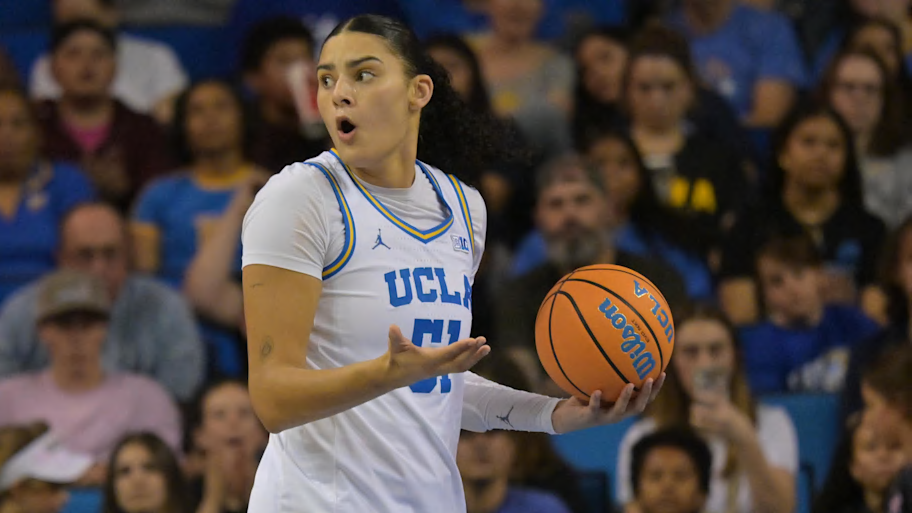
The women’s NCAA tournament bracket is finally set. And while there weren’t too many surprises or snubs at first glance, there are several interesting threads to pull when you look deeper at the regions and potential matchups later in the tournament.

Sports Illustrated’s Emma Baccellieri and Michael Rosenberg dive into their biggest takeaways from Selection Sunday. 

Case for No. 1 overall seed 

The first question that ESPN reporter Holly Rowe asked NCAA committee chair Amanda Braun on the broadcast was about giving the No. 1 overall seed to UConn over UCLA. Braun singled out the committee discussion around the “observable component”—or, in other words, the eye test. “The types of wins that [UConn] had and the way they played from the beginning of the season to the end of season, I would tell you that’s probably what put it over the edge,” Braun told reporters later on Sunday night. 

It’s been more than a year since UConn lost a game. The Huskies are No. 1 in the country in just about every statistic where a program would like to be No. 1. It’s incredibly hard not to give the overall top seed to a team in that position. Even when the team that played the toughest schedule in the country is right behind them in UCLA. 

But I’d love if we got to settle this once and for all with a matchup in the national championship. —Baccellieri

Toughest path to Final Four

Last year’s NCAA tournament featured zero significant upsets. Zero. The only No. 1 seed that did not advance to the Final Four was Southern Cal, which lost to UConn after JuJu Watkins tore her ACL. UConn was favored in that game. The NCAA tournament is not supposed to be that predictable. Theoretically, the lack of upsets were the price we paid for an incredible, heavyweight-filled Final Four … but we didn’t really get that, either. Favorites won both Final Four games and the national title—and all three were blowouts.

I scoured the bracket looking for any possibility that UConn, UCLA, South Carolina or Texas might lose before the Elite Eight.

North Carolina, the No. 4 seed in UConn’s region, has won 13 of its last 15 games, but UConn is a different beast. Nobody who watched Big Ten basketball this year thinks Minnesota will beat UCLA. Texas seems more vulnerable than it is; Madison Booker is a matchup nightmare for anybody.

Oklahoma did take South Carolina to overtime this year, but that actually makes me more skeptical that the Sooners can beat South Carolina if they play in the Sweet 16. Dawn Staley will have her players ready, mentally and strategically, for that one.

I kept coming back to this: Mississippi is 21–6 with sophomore guard Sira Thienou and 2–5 without her.

Thienou has not played since Feb. 17 because of a bone bruise, but she is expected to return for the tournament. If Thienou is healthy, Ole Miss is an underseeded No. 5 in UCLA’s region. The Rebels are also the rare team with the size to at least have a fighting chance against 6' 7" Bruins star Lauren Betts: Ole Miss starts 6' 4" Latasha Lattimore and 6' 3" Christeen Iwuala, and if Thieonou plays, the Rebels will start five players who are 6' 1" or taller.

Ole Miss beating UCLA would be a massive upset. But if you’re looking for a massive upset … well, that’s one to consider. —Rosenberg

Notre Dame  guard Hannah Hidalgo (3) shoots against Duke
Hannah Hidalgo has had another standout season for the Fighting Irish, but will she be enough for Notre Dame to survive the first weekend? | Brett Davis-Imagn Images

Best upset potential 

This bracket looks to be chalky as ever across the first weekend. (Let’s not count eight-versus-nines here.) But there was one first-round matchup that jumped out at me. 

Few players can swing a game singlehandedly as much as Hannah Hidalgo. But Notre Dame’s season felt like one long reminder that even Hidalgo cannot save every game. And she and her teammates might have their work cut out for them against 11-seed Fairfield. 

It’s the third consecutive tourney appearance for Fairfield. The mid-major has been here before—even if it’s never advanced—and it poses an especially tricky challenge this year. Fairfield scores more from beyond the arc than any other team in Division I. (The Stags recorded 45.2% of their points from three.) But opponents can’t just lock down the perimeter and hope that will be enough: Fairfield is top 10 in the country in two-point shooting percentage, too. The Stags will be a tough out. And Notre Dame is not a notably gifted defensive team. —Baccellieri

ACC title not enough for Duke

Duke has spent the last four months playing like a team that easily deserves a two-seed. Unfortunately for the Blue Devils, however, the games they played in November count, too. There were five teams vying for the four two-seeds: Vanderbilt and LSU were locks. Iowa and Michigan each had strong cases, and given that Michigan had the better overall résumé while Iowa had the head-to-head battle over Michigan, it was presumably difficult for the committee to put one above the other. There are a slew of numbers you can point to here to argue for Duke, but in the end, it’s hard not to see how the committee likely focused on one. Vanderbilt, LSU, Iowa and Michigan all finished with four to six losses. Duke finished with eight. That alone likely made the difference. —Baccellieri

Iowa vs. Michigan

Texas’s reward for beating South Carolina in the SEC tournament championship game is the No. 1 seed in Fort Worth. That is huge for the Longhorns, and well-deserved.

And yet …

The No. 2 in Texas’s regional is Michigan. The No. 2 seed in South Carolina’s regional is Iowa. I think Michigan is a significantly more dangerous team than Iowa.

Yes, Iowa beat Michigan twice in the last three weeks—by 18 in Iowa City, and by 17 in the Big Ten tournament semifinal. But Michigan is the more talented team. The Wolverines are young—their best players are all sophomores—and Iowa is a physical, veteran team that can slow the game down. But against elite talent, Michigan has done quite well. The Wolverines nearly beat UConn, UCLA and Vanderbilt.

This is a long way off, but if Michigan does face Texas in the Elite Eight, it will be a fascinating test. Texas is a physical, veteran team that can slow the game down—and has significantly more talent than Iowa. —Rosenberg

Best potential Elite Eight matchup

I’m most intrigued by the potential for UConn versus Vanderbilt. (Which, for the record, is a matchup that will soon exist in the regular season.) The biggest storyline would be Geno Auriemma pitted against his former protégé Shea Ralph—a former player of his who left her spot on his bench five years ago to steer her own ship in Nashville. These coaches know each other better than any other pairing in the field. But this one would be just as fascinating on the court. UConn is the No. 1 team in the country, yes, but Mikayla Blakes of Vanderbilt is the No. 1 scorer in the country. Blakes combines with freshman point guard Aubrey Galvan for one of the most exciting backcourt pairings in the country. The odds would still be stacked against Vanderbilt. (UConn is simply that good.) But the matchup should, at the very least, provide a little bit of fun texture on what might otherwise be a fairly anodyne march to the Final Four for UConn. —Baccellieri


More March Madness on Sports Illustrated


This article was originally published on www.si.com as Biggest Takeaways From Women’s NCAA Tournament Bracket.

Sign up to read this article
Read news from 100’s of titles, curated specifically for you.
Already a member? Sign in here
Related Stories
Top stories on inkl right now
One subscription that gives you access to news from hundreds of sites
Already a member? Sign in here
Our Picks
Fourteen days free
Download the app
One app. One membership.
100+ trusted global sources.