

Steve Morse's articulate and expansive technique is admired the world over. His new power trio album, Triangulation, features his versatile picking, colorful riff sequencing and searing string bends – plus two guitar elite friends in Eric Johnson and John Petrucci.
Steve has kindly agreed to this unique tutorial on big intervals, a core component of his trademark style. He defines big intervals as anything larger than using adjacent notes, such as playing a linear scale (eg root, second, third). Typically, big intervals involve skipping strings, and he does this in both his compositions and general playing to outline chords.
Wide intervals often have an ear-grabbing quality, be they quickly played or sustained as long as possible to give the effect of accompaniment and melody happening at the same time. To facilitate this, Steve often uses open strings as they can be left to ring on while the fretted notes change.
For the video performance, five contrasting approaches are stitched together with eighth-note chugging to create a functioning mini etude. We have carved this up into five tabbed four-bar examples. Steve then talks us through these five examples, highlighting all the extra details and we have included all the relevant notation markings in the tab so you can follow along.
There are technical hurdles to overcome when articulating wide intervals, and in the video Steve demonstrates ways to approach string skipping and the use of open strings. He also sometimes frets the bass notes on the sixth string by wrapping the fretting hand thumb over the top of the neck. If you find this awkward, Steve demonstrates that it’s possible to rework the fingering of the chords.
This performance is fairly involved so we’d recommend starting slowly and using the slowdown feature to really focus on the picking hand.
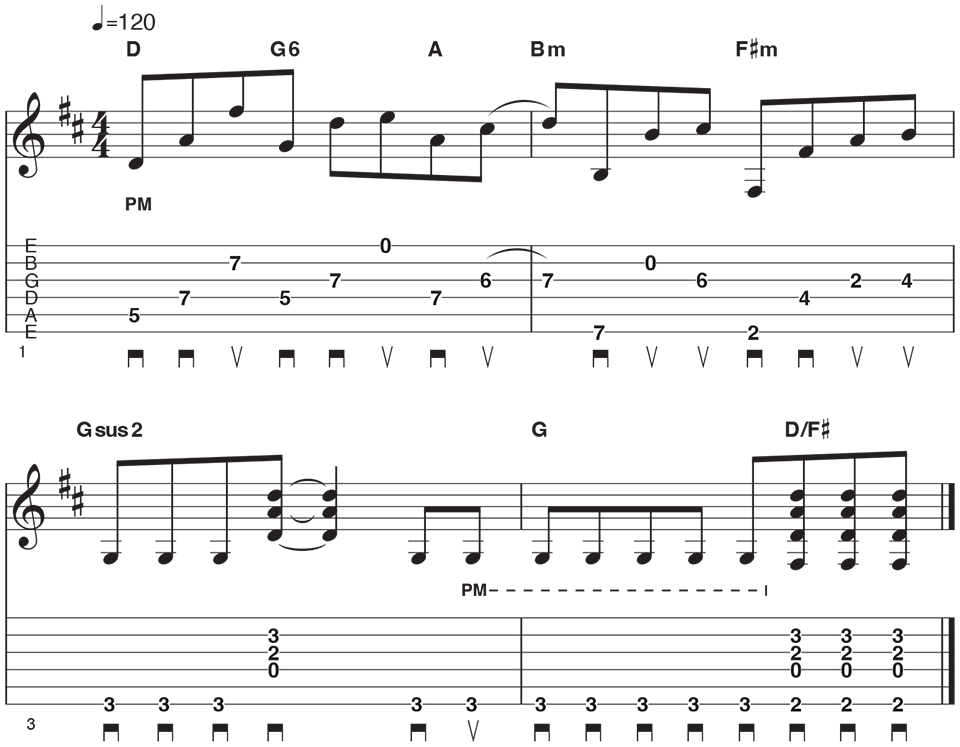
Example 1. Arpeggiating chords
This first example is an arpeggio melody idea using diatonic chord changes from the key of D. The open voiced triads are played with a down, down, up picking pattern as shown under the tab. Steve uses any and all available strings to transition from chord to chord smoothly.
The open first and second string notes are a colorful addition, helping with fluid transitions and tonal contrast to their fretted counterparts. The bass notes on the sixth string are played by wrapping the fretting hand thumb over the top of the neck.
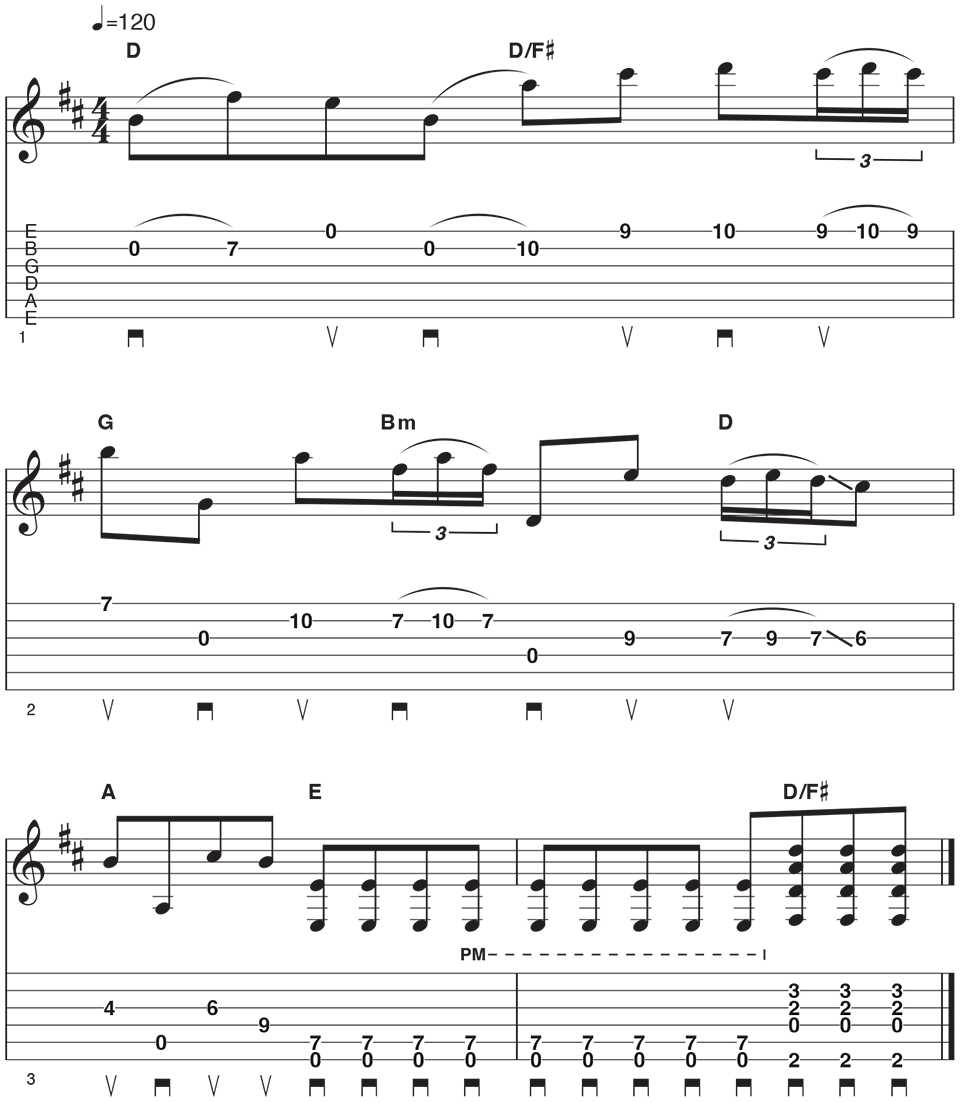
Example 2. Using open strings
For this second example, Steve goes all out to demonstrate the power of using open strings by using all six! You'll start by targeting the open first string and then move down in order to the sixth string. The picking pattern is down-pick, hammer-on, up-pick, and this creates a cascade effect.
Steve goes for a little bit of economy picking here (bar 3, beat 2) either side of an outside picking movement and the double E down picking. We have included all of the picking directions in the tab, but feel free to experiment and find a method that feels comfortable to you.
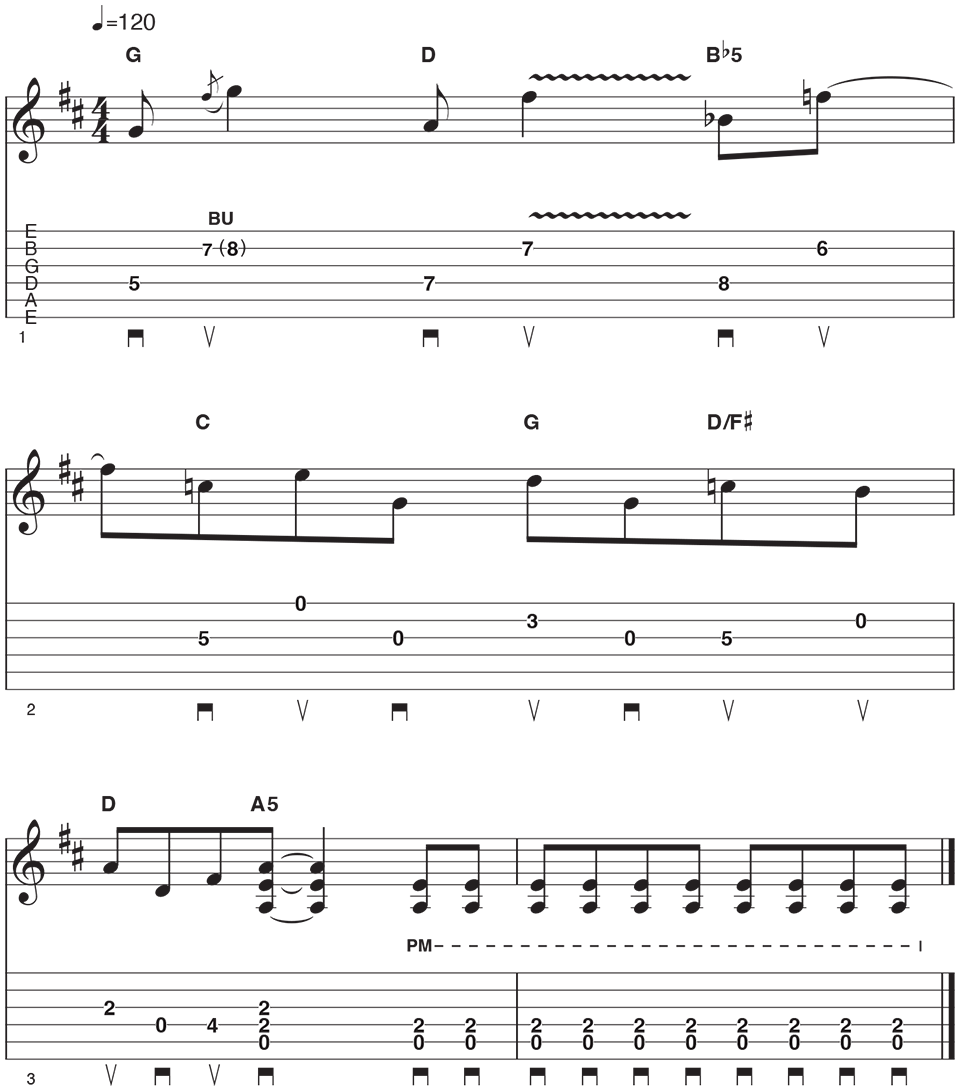
Example 3. Skipping strings
This starts with an octave interval and then moves in contrary motion: as the top melody note ascends, the bottom note descends. This sounds sophisticated, but as there are only two notes, it is relatively easy to play.
Once again, the open strings are used to create a cascade effect over the C and G5 chords. As with the previous examples, there is some eighth note chugging on the open A5 to take us into next example. Steve uses down-picking to play this.
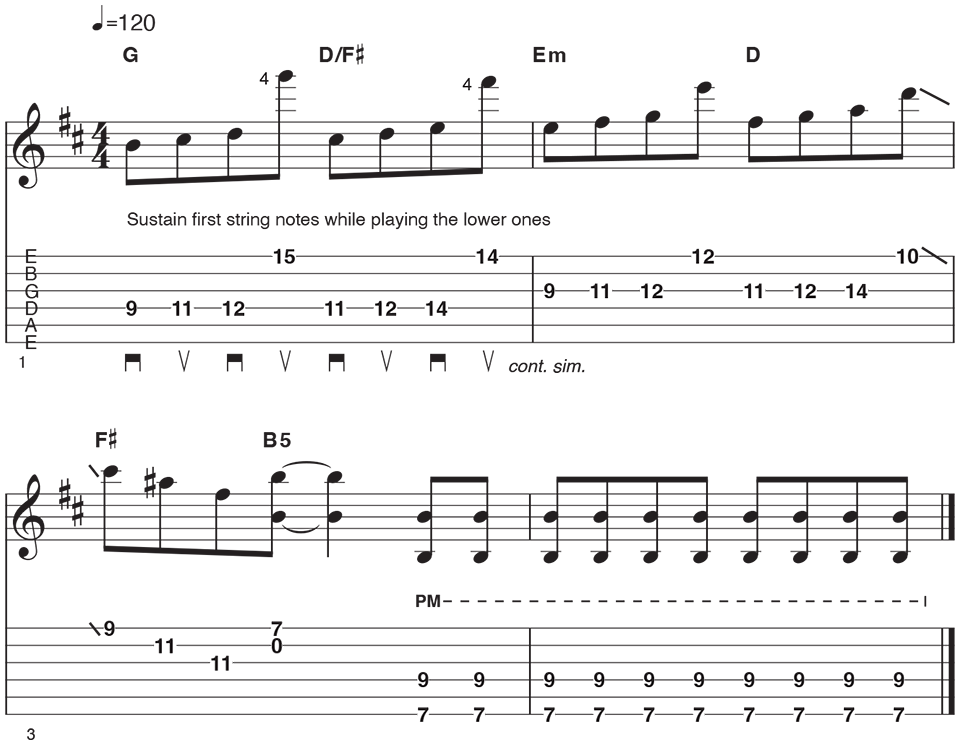
Example 4. Linear motion with string jumps
This next example is Steve’s favourite as it gives the impression of two parts happening at once. To improve the facility required to make the big stretches, the fretting hand thumb is placed back a little bit on the neck. It’s also good posture practice to keep the headstock of the guitar pointing up to the ceiling whilst maintaining a straight back.
Steve uses alternate picking for three notes on the fourth string and then the high melody note on the first string is played with an up pick. The ability to sustain the high note may feel awkward at first so perseverance – with some fretting hand relaxation/shake off pauses – is the ideal focus for progress.
Example 5. Melodic repetition and variation
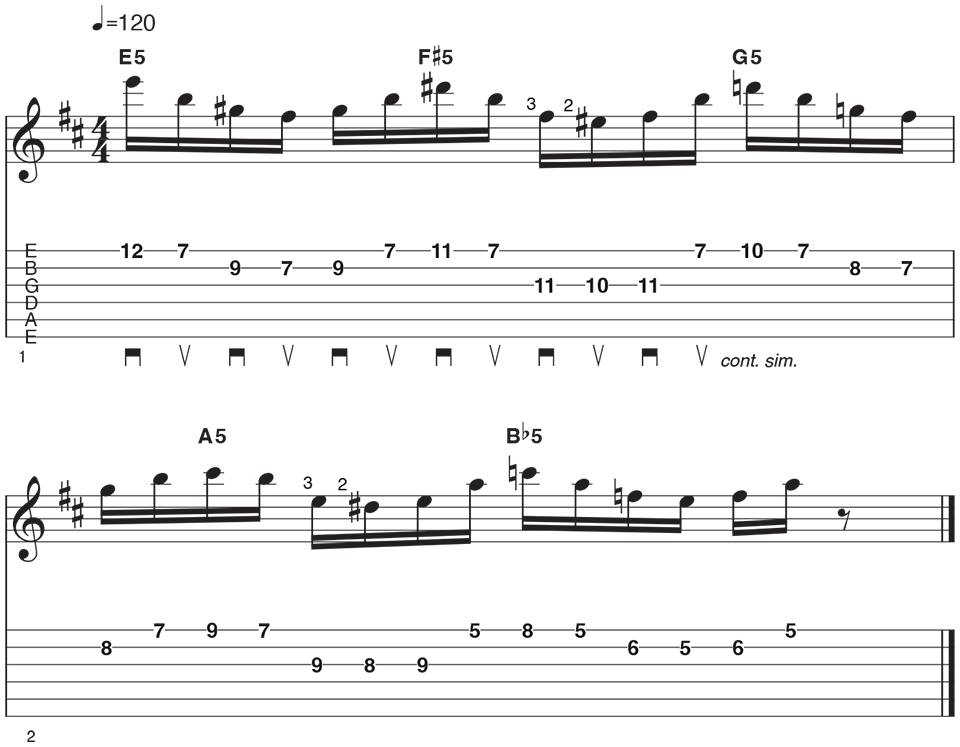
Here, we are working on establishing a continuous obligato part (E-D#-E notes on the third string) underneath higher-string melodic motion. The example exploits Steve’s excellent picking technique.
We’d recommend taking this slowly to start with, just to get it under the fingers and to get all of the picking directions dialled in. Steve explains that he slightly changes his pick angle to make this easier to play, so feel free to experiment with the angle of your wrist. It's also worth exploring the angle of the pick when addressing the string: angled makes for an easier 'cut' (but often a raspier tone) while flat to the string can sound thicker (but results in more picking resistance).
How deep your pick goes either side of the string will provide you with further tone and technique realizations.
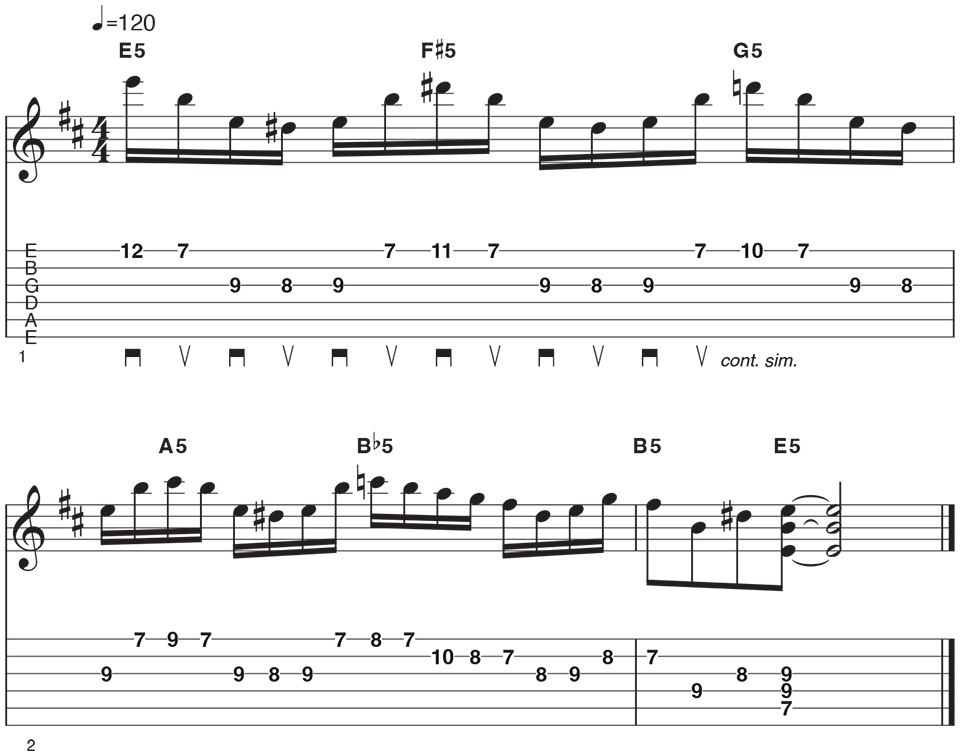
Example 6. Melodic repetition and variation (part 2)
To finish off you have a bonus example that demonstrates a variation on the previous example. Instead of just changing the top note and keeping the other notes underneath the same, you can also change the notes underneath.
Changing the notes underneath the melody note helps to clearly outline the tonality of the chord changes as they pass.
Steve Morse in action!
Steve Morse Band - Triangulation
Steve's trio in the studio – check out the riff, changing key centres and (of course!) sophisticated intervallic action. While John Petrucci isn't in the studio with them, you can hear his Morse influenced soloing very clearly.