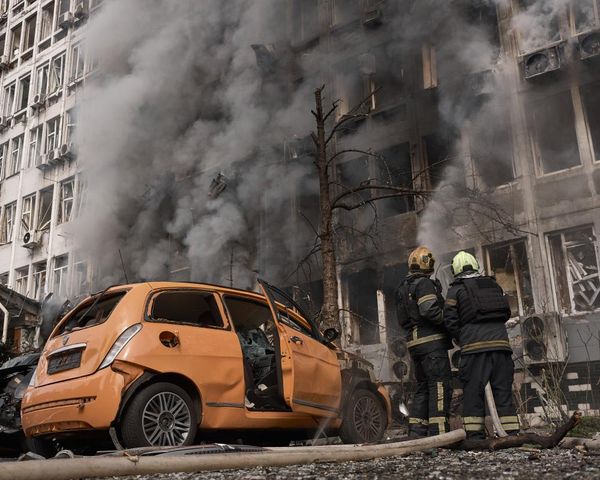
WASHINGTON — President Joe Biden announced Friday that the U.S. will suspend normal trade relations with Russia on Friday as part of the ongoing effort to punish President Vladimir Putin for his unprovoked war in Ukraine.
“Putin is the aggressor and he must pay the price,” Biden said in remarks from the White House, declaring that sanctions already imposed by the West are “crushing” Russia’s economy and warning that Moscow would pay “a severe price” if it deploys chemical or biological weapons in Ukraine, as the White House suggested this week it may be plotting to do.
The latest move, which came in concert with the Group of 7 and European Union, paves the way for the administration to increase tariffs on Russian imports above the levels pledged to all World Trade Organization members.
Thanking lawmakers for holding off on legislation until he could coordinate with allies, Biden announced that “each of our nations is going to take steps to deny most favored nation status to Russia,” which he said will “make it harder for Russia to do business with the United States.”
Emphasizing the importance of moving in lockstep with Europe, Biden added that “doing it in unison with other nations to make up half of the global economy will be another crushing blow to the Russian economy.”
Speaking shortly after a phone call with Ukrainian President Volodymyr Zelenskyy, Biden fully threw his support behind a bipartisan proposal that has gained steam in Congress in recent days that would revoke Russia’s Permanent Normal Trade Relations (PNTR) status and direct the U.S. Trade Representative’s office to seek Russia’s ouster from the WTO.
The top Democrats and Republicans on the House Ways and Means Committee and the Senate Finance Committee first proposed the move in a letter Monday. House Speaker Nancy Pelosi said the House will take up legislation to formalize the revocation next week and that she anticipates a bipartisan vote.
Actually booting Russia from the WTO requires a vote and support from two thirds of the organization’s 164 member nations. As such, most experts don’t believe it likely to occur. But nothing prevents individual countries from revoking Russia’s WTO privileges, as Canada and Ukraine have already done.
Biden also announced that the U.S. was banning Russian imports of seafood, vodka and diamonds.
The U.S. is not a major importer of Russian goods, with only $30 billion in imports in 2021, accounting for only about 1% of total imports. Thus new potential tariffs on Russian products are unlikely to have a major impact on American consumers, already bearing the brunt of inflation spiking to a 40-year high.
More than half of what the U.S. bought from Russia were petroleum crude and oil products. Other major imports from Russia include iron, frozen crabs and precious metals like palladium which are used for catalytic converters.
When the war began more than two weeks ago, the administration focused its initial response by leveling sanctions against Russian oligarchs and the country’s banks. As support has deepened for Ukraine across the West, the U.S. and Europe have taken additional steps, expanding sanctions to Putin himself and members of his inner circle and, earlier this week, took action to reduce their dependence on Russian energy.
On Tuesday, Biden announced the U.S. would ban imports of Russian oil, gas and coal. Europe, which is far more reliant on Russian energy, has also proposed a plan to cut its use of oil and gas from Russia by two-thirds this year.
After that move, Friday’s announcement was largely symbolic, indicating that the U.S. doesn’t see Russia as a trading partner. But coming in coordination with European allies that trade more heavily with Russia, the move will further isolate Russia from the global trading system.
Gary Hufbauer, a trade expert at the Peterson Institute for International Economics, said even if the move is mostly symbolic, doing it legislatively would establish a significant and likely enduring precedent.
Once Permanent Normal Trade Relations “is revoked for Russia, the path will be established for congressional voices to call for revocation against China, and then, as conflicts arise, against other countries,” he said. “And once PNTR is revoked, it will take a new act of Congress to restore PNTR. This will put a burden on future presidents, since side issues will likely be attached to restoration, even when U.S. relations with the partner country are harmonious.”