
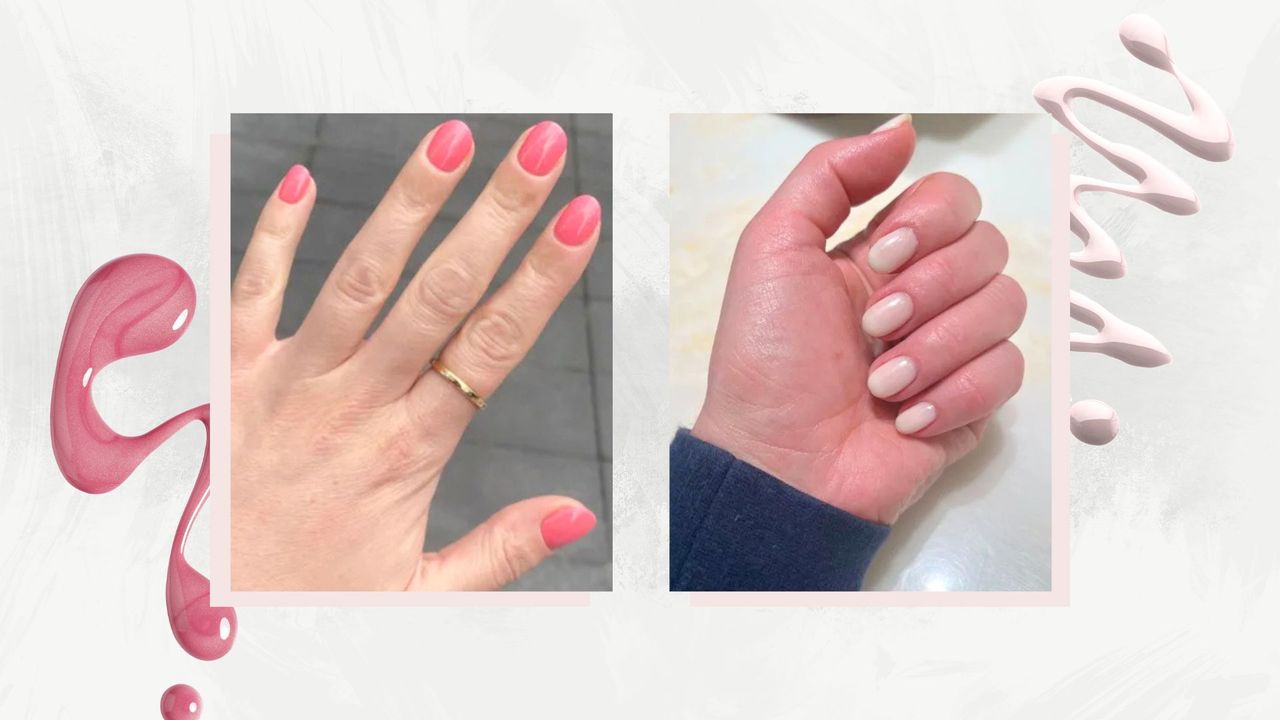
The nail salon menu has evolved so much that one's choice is no longer limited to gel, acrylics or regular polish.
The classic and well-loved gel manicure has been around for decades, while BIAB nails refer to a specific type of builder gel, a category that has surged in popularity over the past few years alongside Bio Sculpture nails. Both BIAB and gel are brilliant options that have amassed legions of loyal fans, but there are key differences between the two – and understanding them will help you decide which one is best for your next manicure.

To help, I've tried both and spoken to three nail experts to get their qualified insights into the pros and cons of each one. The following detailed guide covers everything you need to know about BIAB vs gel nails...
What are BIAB nails and gel nails?

A gel manicure involves painting the nails with coloured polish that has to cure under a lamp to set it. Available in just about every shade you could hope for, including on-trend summer nail colours, these polishes are more durable than traditional varnishes. Gel can be soft (i.e. slightly flexible) or hard, but what we'd traditionally refer to as a gel manicure tends to involve the former.
On the other hand, BIAB is a type of builder gel and stands for “Builder In A Bottle”, an acronym trademarked in the UK by The GelBottle Inc. Technically, it has slight flexibility, but it's thicker and much more durable than other gel polishes.
“BIAB is a medium viscosity builder gel designed to be used as a natural nail overlay, mimicking the nail’s natural apex and providing strength to the nail plate underneath any gel colour or top coat,” Giorgia Cappella, the brand’s training and education manager, explains. “Unlike a regular manicure, this service can protect the natural nail against breakages by providing structure to the nail’s stress point.”
This is what has driven its surge in popularity over the last few years, as this added protection means many people who have historically struggled to grow their nails find they can do so with builder gel.

Although gels are traditionally applied in salons, many at-home gel nail kits are available - and Mylee's are some of the most popular and widely used. It's important to learn how to do gel nails at home to ensure your DIY gel job is as safe and long lasting as a professional mani.

Not strictly BIAB, but this builder gel kit does work on a similar principle, building up the strength and length of natural nails underneath as well as adding smooth, glossy colour. This one is HEMA free, too, ticking the non-irritation box.
BIAB vs gel nails: Key differences
- Appointment length: BIAB requires more sculpting and building of the layers to create structure and durability and therefore takes longer if colored polish is also applied over the top. Expect to allow up to an hour for a gel manicure and an hour and a half for BIAB nails.
- Colours: The choice of colours, though it's grown significantly over the past couple of years, is a little more limited with builder gel formulas. However, if your chosen colour isn't available in BIAB, manicurists usually get round this by applying a clear or light shade of builder gel as a base, then regular gel over the top.
- Durability: As with acrylic or dip powder nails, BIAB is more durable than regular gel polish and therefore more hard-wearing, so you are less likely to chip or break a nail.
- Feel: Similar to the above, there’s a difference in how these treatments feel on your nails. Depending on their natural strength, your nails can still feel a little flexible with regular gel polish, but barely so with builder gel, due to it being more durable and applied in thicker layers.
- Look: Because builder gel is and is sculpted into a protective overlay, and has a denser consistency than most gel polishes, BIAB nails look a bit thicker, too.
- Price: Because of differences in appointment length and technique, gel manicures cost less than BIAB nails, usually by at least £10.
Is BIAB the same as gel?
While BIAB is a type of builder gel, it's different to regular flexible gel polish or shellac nails. "BIAB is a strengthening gel that contains pigment, which means it can be built up on top of your natural nail to create a beautiful, shiny manicure," Aussie Parnell-Raghnal, nail technician at Duck & File Mayfair, confirms. "Gel polishes are a liquid form of polish cured under a UV lamp, whereas BIAB has a much thicker consistency with a stronger base."
The thicker consistency also means builder gels like BIAB are applied very differently, as manicurist Alex Philamond notes: “It cures differently under the lamp, so it's important that it does so on a low heat setting for the prescribed amount of time." BIAB is also usually "sculpted" to create the even, uniform shape because of its thickness, rather than simply painted on.

Does BIAB last longer than gel?
Yes, BIAB does tend to last longer than the two-week lasting time of a gel mani. "It's applied with a thicker layer to your natural nail, while gel polish is usually applied as a thin layer," says Parnell-Raghnal. "It is more durable, so [can last] three to four weeks." This will appeal to any readers who find that they still manage to chip or break a regular gel manicure.
"That's the innovation behind it that has created its spike in popularity," Philamond says of the durability of builder gels like BIAB. “Most manicurists would not prescribe leaving more than three to four weeks between appointments, to preserve the health of the natural nail. Builder gel can either be soaked off or infilled by removing old, lifted product and applying fresh gel over the top."

Are there any downsides to BIAB vs gel nails?
BIAB is brilliant, but there are a couple of reasons that a gel manicure could be a better choice for you. For one thing, the longer technique and time means that the service tends to cost at least £10 more than regular gel.
“There are barely any downsides, bar the fact that due to its thicker consistency, it can take an extra couple of minutes to soak off and remove [than traditional gel polish],” Philamond says. “It is important for your manicurist to have enrolled in the correct training in how to apply builder gel, as it's a technical application process that differs greatly from regular gel polish.” We would add that, for anyone who likes to remove their own gel polish at home, to save money on removal or simply for convenience, it's far trickier if not impossible, to do with BIAB, which is worth factoring in.
BIAB vs gel nails: the woman&home verdict
When weighing up BIAB vs gel nails, it's not really about one service being "better" than the other as they are quite different. It really comes down to your priorities. If you want to grow your natural nails or need something more hardwearing, but you aren't keen on acrylic nails, builder gel is without a doubt the harder choice. The sturdiness protects nails from the environment and significantly reduces the chance of splitting or peeling – several woman&home team members will attest that we've only grown our natural nails to an extension-worthy length with BIAB.
If you want to spend less on a shiny manicure, however, gel is still a great choice as it is reasonably chip-resistant and lasts for around a fortnight, which is still far longer than most people can make a manicure with traditional nail polish last. The generally shorter appointment length, for both application and removal, is also a plus for those who struggle to fit in a salon visit.
Ultimately, think about your manicure needs from a time, cost and lifestyle perspective to work out which is best for you. It may be worth booking in for both services and comparing the results on your own nails.

With a lovely, sweet (but not too sweet) peachy scent, this lightweight oil is super fluid but loaded with nourishment. Keep it by your bed or, if you work from home, on your desk to remind you to apply it daily.

This hand and nail cream manages to be both indulgently thick and nourishing without leaving too much of a heavy or greasy feel behind. An ideal one to carry round in your handbag.

One of the go-to nail files among beauty experts, this quality crystal file comes from podiatrist Margaret Dabbs' eponymous brand. It's perfect for filing away any snagged edges, should they develop, or to use post removal.