
Get all your news in one place.
100's of premium titles.
One app.
Start reading
Marie Claire
Marie Claire
Lifestyle
Sara Holzman

Bhavitha Mandava’s Chanel “Jeans” Exposed a Met Gala Contradiction

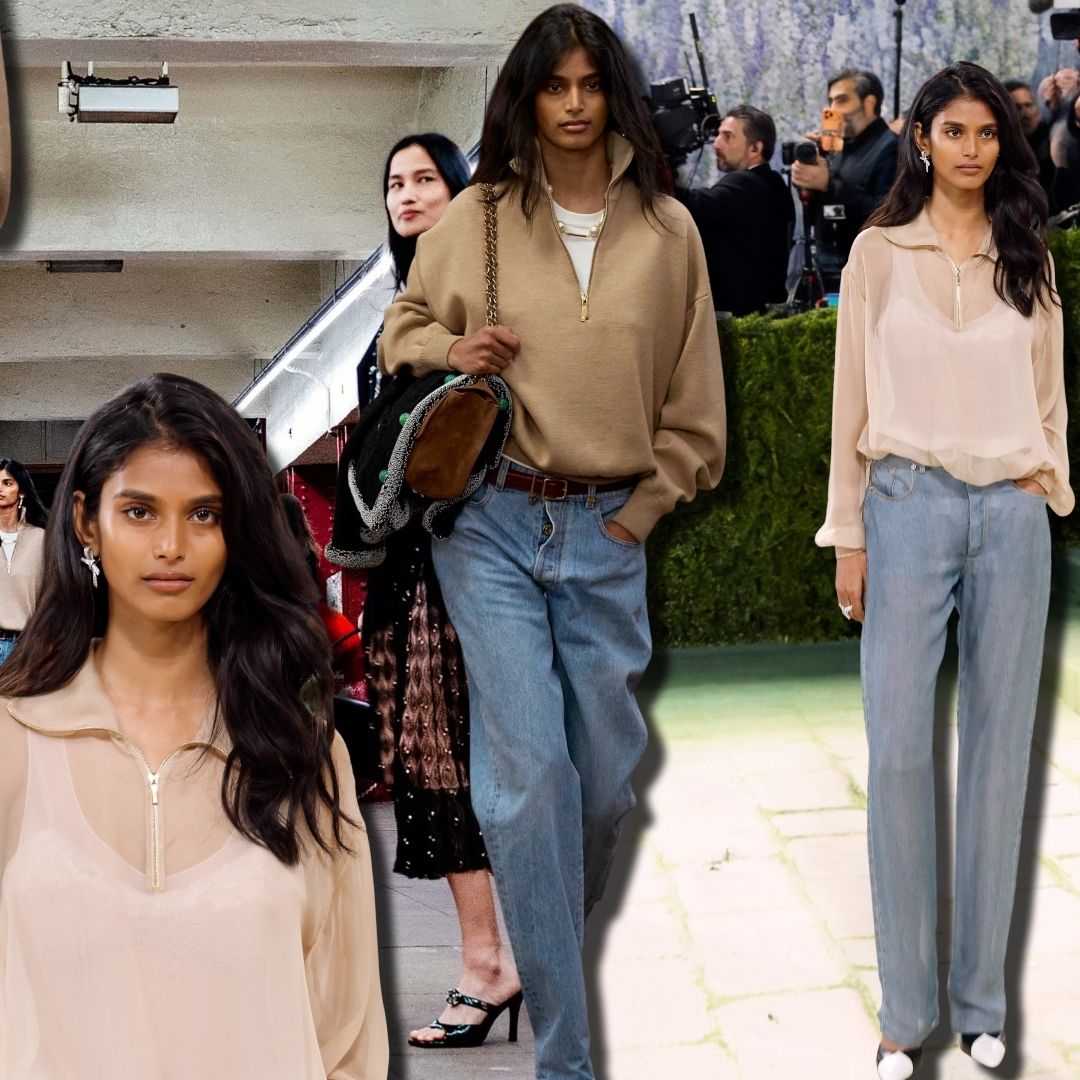
A collage compares Bhavitha Mandava’s Chanel Métiers d’Art runway look—featuring relaxed trompe l’oeil denim and a beige quarter-zip sweater—with her similarly styled 2026 Met Gala outfit.

Bhavitha Mandava’s 2026 Met Gala look began with a very modern fashion mystery: whether the most controversial “jeans” of the night were jeans at all.

The model arrived on fashion’s most scrutinized staircase in what appeared to be a white tank, faded blue denim, and a sheer zip-up—a combination that, on any other Monday night in New York, might have suggested a Trader Joe’s run, a downtown casting, or someone with excellent cheekbones waiting for the L train. On the Met Gala carpet, it read like the kind of look that warranted a few Getty refreshes just to make sure you were seeing it correctly.
Where was the giant train? The archival tiara? The look-at-me corsetry? The 40-pound gown requiring three handlers and a prayer to make it up the carpeted steps? Bhavitha Mandava’s Chanel look had none of the usual visual shorthand of Met Gala grandeur. Instead, it arrived with the unnerving familiarity of an outfit you might actually own.

The “denim,” as it turns out, was not denim at all. According to the House of Chanel, Mandava wore a “Haute Couture reinterpretation” of the look she wore to open Chanel’s Métiers d’Art show in New York last December—a deliberate callback to the city where she was first discovered. Chanel also confirmed that the ensemble required 250 hours of work by the house’s ateliers.

In other words, the apparent simplicity was the craft exercise. In the hands of Chanel’s ateliers, one of fashion’s most ordinary garments became something painstakingly engineered to look that way on purpose.

For the 2026 Met Gala, Bhavitha Mandava revisited the understated Chanel formula she first wore opening the house’s Métiers d’Art show. (Image credit: Getty Images)

Almost immediately, the internet split into camps. Some people thought the look was smart and understated; others felt it was underwhelming for a Met Gala debut—especially for a model having such a significant Chanel moment. Accounts like Diet Prada started asking a more uncomfortable question: would this exact “downtown girl” styling concept have landed differently on a white supermodel or major Hollywood actress? Or would the house have pushed further into fantasy?

Lost somewhere in the discourse was the question of whether anyone had actually stopped to ask Mandava what she thought of the look herself. The conversation quickly became less about her and more about the internet’s own expectations of what a “fashion moment” is supposed to look like.

That tension is part of what made the reaction so intense. Earlier this year, Mandava became the first Indian model to open a Chanel runway show after starring in the house’s Métiers d’Art presentation staged inside a decommissioned New York subway station. The casting itself carried autobiographical weight: Mandava was famously discovered in a Brooklyn subway station while studying at NYU.

The look was not random; it was a couture-level echo of the runway moment that made Mandava one of Chanel’s breakout faces.

But fashion narratives do not exist in a vacuum, especially at an event as loaded as the Met Gala. Some fashion fans felt Mandava had been denied the sort of overt fantasy usually afforded to people making major fashion-history debuts. Fashion says it loves understatement until someone actually shows up that way.

Bhavitha Mandava opened Chanel’s Métiers d’Art show in the kind of downtown uniform that looks easy until Chanel gets involved: light-wash “denim,” a white tee, and a relaxed quarter-zip, all staged inside a decommissioned New York subway station. (Image credit: Chanel)
Before the Met Gala discourse, Bhavitha Mandava had already become a Chanel favorite thanks to her quietly compelling off-duty style—often built around the same downtown uniform of relaxed denim, soft tailoring, and understated layers that later informed her now-viral Met Gala look. (Image credit: Getty Images)

And honestly, that contradiction sits at the center of modern luxury right now. Fashion is obsessed with making expensive things look deceptively normal: the battered-looking bag that costs more than rent, the perfectly plain white tank that is anything but basic, the “jeans” that turn out to be silk muslin painstakingly engineered by Chanel ateliers.

That is what made Mandava’s look more interesting the longer the argument went on. It was not built for the first scroll. It required context: the subway casting, the runway callback, the fabric trickery, the unease of seeing something so casually coded in a space that still rewards obvious spectacle.

And yes, Anna Wintour famously approves Met Gala looks, meaning none of this was accidental. Chanel knew people would question whether the outfit was glamorous enough. The house also likely understood that the current obsession with stealth wealth, normcore luxury, and trompe l’oeil dressing would make the look discourse bait.

Fashion will happily convince us to covet an ordinary-looking flap bag with an eye-watering price tag, yet a pair of not-jeans on the Met steps still sends the internet into existential crisis. Maybe that's because people still want the Met Gala to follow a very specific visual dress code. But fashion has never really moved forward by following the rules too closely. Though somewhere, Jeff Bezos is probably relieved the internet found someone else to get mad at for the night.

Sign up to read this article
Read news from 100's of titles, curated specifically for you.
Already a member? Sign in here
Related Stories
Top stories on inkl right now
One subscription that gives you access to news from hundreds of sites
Already a member? Sign in here
Our Picks
Fourteen days free
Download the app
One app. One membership.
100+ trusted global sources.