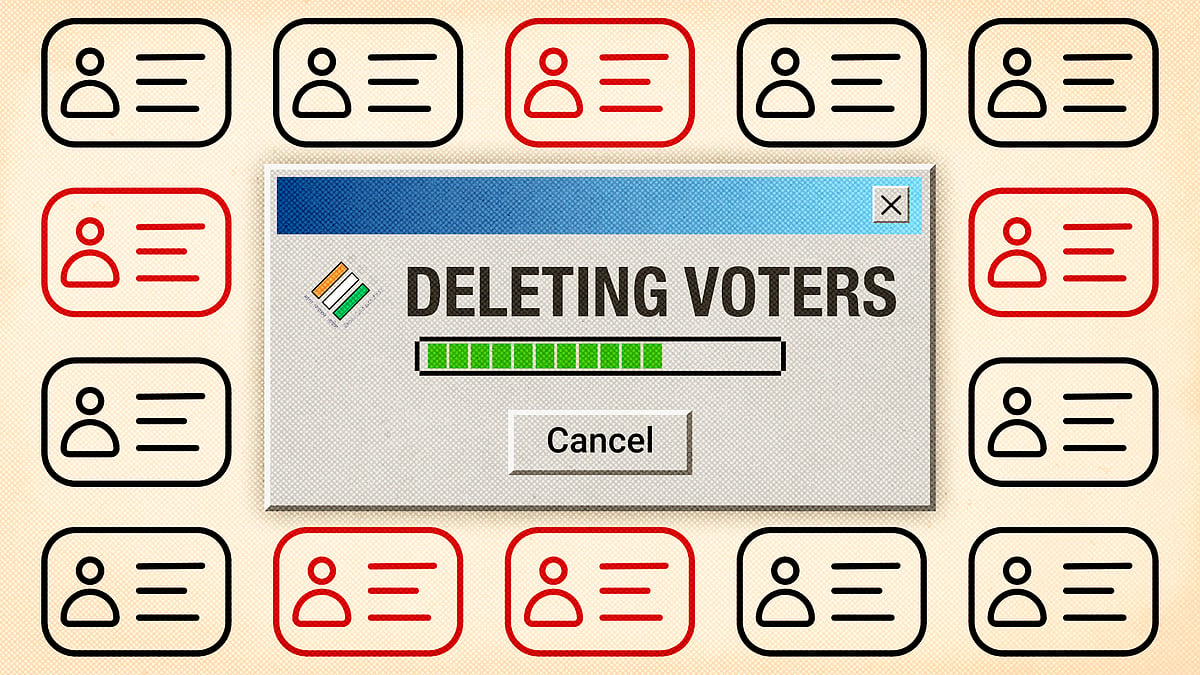
The Election Commission of India (ECI) and the Indian government have consistently framed the Special Intensive Revision (SIR) as a routine and much-needed clean-up of India’s electoral rolls.
In reality, however, it marks a deep shift.

The push to use software systems to sanitise electoral rolls could be traced to the early 2000s with the explosion of the Information Technology industry. Despite the massive relevance of these systems in our democracy, the ECI has publicly disclosed very little about their algorithms and software architecture.
The goal is no longer maintaining unique voters in the electoral system with no duplicate records. With the SIR, the goal is also to create a tech-driven, centralised, algorithmic mapping of individuals, their networks, familial and marital ties.
The technology behind SIR could pave the way for increasing centralisation and automation of electoral roll management. This raises questions about who ultimately makes decisions about inclusion and exclusion from the electoral roll, what role election officials retain, and whether the technology being used is subject to the transparency and safeguards that govern the electoral process.
EROs, BLOs sidelined?
At the centre of this ecosystem sits ECINET, a centralised portal that integrates all election-related services for voters and candidates, displays election results, and logs complaints related to electoral rolls. A super app, as one might call it, for all electoral functions of the ECI.
Not a lot of information is available about ECINET’s functions. Instead, let us look at ERONET 2.0, a network of Electoral Registration Officers (EROs).
In its annual report for 2024–25, Tata Consultancy Services (TCS), which built the software, showcased ERONET 2.0 as a ‘success client’ story. It described ERONET 2.0 as the end-to-end life cycle of electors that has revolutionised electoral roll management in India.
It further said, “ERONET 2.0 application has a centralised database that serves as the single source of truth for the election body.”
The electoral roll is a source of truth for elections, which needs to be public. Its preparation is a democratic exercise, and requires transparency and public hearings to remove anyone from electoral rolls. All of this is governed through the Representation of the People Act, 1951. Under the Act, the ERO is the final authority to include someone or to remove a voter from the electoral roll for a constituency.
Are these electoral laws and rules being codified into the software system?
The making of electoral rolls is a highly decentralised process, where the ERO decides who is on the voter list and who needs to be removed from it. The ECINET or ERONET can assist the ERO through this process by acting as a decision support system. But if the ERO and Booth Level Officers (BLOs) are entirely sidelined through the process, it is no longer a decision support system.
Instead, the decision is being taken by the software or another actor in control of the software, leading to algorithmic voter deletions.
What are these algorithms anyway?
The top-down cybernetic model
The early researchers involved in the development of India’s cybernetic and systems activity concluded from their experiences at TCS that top-down approaches have greater validity at the societal level and bottom-up approaches of modelling were better for individual organisations.
When top-down cybernetic principles are applied to electoral rolls, one is attempting to create a cybernetic model of how voters can be mapped, creating digital profiles of every voter. This process of creating a profile is no longer based on the individual but on the relationships the individual has. The identity of an individual is thus dependent on the networks he/she is part of. This, when designed right, can produce a chain of truths emerging from parental and marital networks. This is usually done using Aadhaar, linking an individual with his family and his own information across government systems to help build a 360-degree model.
Single Source of Truth is a mathematical model actively employed by various private sector software firms, as well as the Government of India in digitising different systems in India. It creates a network of systems with a highly centralised database that has all the details and acts as the only source of truth.
In the case of identity, we have the Central Identities Data Repository (CIDR) for Aadhaar; for vaccines, we built Co-WIN; for vehicle registrations, VAHAN; and for education, we built APAAR registries. All these information registries were proposed by Infosys co-founder Nandan Nilekani as India’s National Information Utilities. All of these systems are similar, with the same model of identity-based digital infrastructures being built.
The ECI is applying these ideas to electoral rolls by determining the birth lineage of every voter.
‘SIR, Aadhaar-voter ID linking are both exclusionist’
The ECI has been using software for de-duplication of voters for a while and trying to address the problem of duplicate voters. In February 2015, then Chief Election Commissioner HS Brahma announced the National Electoral Roll Purification-Authentication Programme (NERP-AP).
Even though the Supreme Court of India stopped this process in August 2015, it cost several people their vote, especially in Telangana, where the initial experiments to link Aadhaar to voter ID were carried out.
The push to link Aadhaar to voter ID was actively carried out in 2014 through experiments in Telangana, much before the Aadhaar Act of 2016 was forced as a money bill. These experiments led to the ECI deciding to link Aadhaar to voter ID across the country in 2015 under NERP-AP. This entire process has resulted in at least 30 lakh voters being unable to vote in the 2018 Assembly elections of Telangana.
The announcement of SIR in 2025 in Bihar and West Bengal was in reaction to voter manipulation allegations by Rahul Gandhi and the Indian National Congress, who demanded the poll panel clean up electoral rolls using Aadhaar.
After allegations of 40 lakh new voters being added in Maharashtra, the chairman of All India Professionals Congress Praveen Chakravarthy pushed this idea and defended a 100% Aadhaar linkage as necessary to de-duplicate and create clean voter lists. The ex-CEO of Unique Identification Authority of India (UIDAI) RS Sharma called out SIR for its exclusion and suggested Aadhaar be used instead to fix this mess. Ahead of the SIR in Telangana, Bharat Rashtra Samithi urged ECI to use Aadhaar to ensure the rolls are accurate.
But exclusions are an everyday story in Digital India and they have been normalised with Aadhaar.
SIR is not different from the Aadhaar-voter ID linking, since it is actively doing that at a foundational level. Voters are unable to file Form-6 without Aadhaar, and exact matching of Aadhaar and voter ID is mandatory for SIR.
But what exactly is this linking process, and why is it so mandatory to link everything everywhere?
‘Tech appropriated for unconstitutional ambitions’
Aadhaar-voter ID linking was not the only experiment carried out in Telangana. Several other forms of digital experiments, such as India’s first facial recognition for voting, were tested in the state. They were primarily pushed by the Indian IT industry in their effort to create a domestic market for information technology in India.
Yet, these experiments are quite important, as they form the basis for One Nation One Election, a proposition India is actively pushing, with a draft bill introduced in the Lok Sabha. This idea of One Nation One Election is being mathematically modelled with the One Cybernetic Model into Digital India’s infrastructure, with Aadhaar as the foundation. India has even promoted Aadhaar and its other digital public infrastructure as part of G20 with the slogan of “One Earth, One Family, One Future”. These imaginations are very closely linked to Sanatan Dharma and its ideas of a single ultimate truth.
The purpose of Aadhaar in SIR is to clean electoral rolls. But linking Aadhaar with voter ID creates an interdependency with Aadhaar, inheriting all of the problems with the unique identity system into the electoral systems. If your name is wrong on your Aadhaar card, then that becomes a problem for keeping your name on the electoral roll. This simple name mismatch is one of the many logical discrepancies that have come up with the SIR.
With SIR, the linking extends beyond Aadhaar to older electoral rolls from 2002, increasing the complexity of the model.
What we are witnessing is the appropriation of technological systems for the unconstitutional ambitions of various political parties. The election-related experiments in Telangana were actively carried out during the term of Bharat Rashtra Samithi. The Aadhaar project itself was pushed without any laws by the Indian National Congress. The Bharatiya Janata Party is taking the game much further.
‘Purpose limitation should be written into law’
British cybernetician Stafford Beer coined a heuristic in systems thinking: ‘The purpose of a system is what it does (POSIWID)’, stating that there is “no point in claiming that the purpose of a system is to do what it constantly fails to do.”
The linking of Aadhaar with voter ID or any other system is centralising governance in India and replacing all the lower-level bureaucracy. India’s own bureaucrats do not trust its administrative system, requiring the State to centralise governance. This has consistently resulted in exclusion on the ground. While these effects have been repeatedly documented and shared with concerned officials, no corrective action has been undertaken.
BLOs and EROs have lost control over electoral roll management with the introduction of ERONET, as has every other bureaucrat across India when digitisation took over their work. This was not an outcome of bad design. It was the purpose of the design of India’s digital infrastructure.
Aadhaar and its various cybernetic models, including 360 profiling, were forced on every Indian with a claim of it being required for welfare service delivery. In fact, the full title of the Aadhaar Act 2016 is Aadhaar (Targeted Delivery of Financial and Other Subsidies, Benefits and Services) Act, 2016.
It is important for us to ask why we need this system everywhere, in every part of our life, especially when it constantly fails to do what it is claimed to have been designed for.
Any information collected by the ECI needs to be used only for the purpose of elections and nothing else. But that is rarely the case. The electoral photographs collected by the ECI were used to build facial recognition systems in Telangana. The ECI willingly shared information with the police for use in facial recognition.
Under India’s Digital Personal Data Protection Act, there needs to be a purpose limitation for any data collected with lawful aims. This is hardly the case with complete exemptions being given to the Government of India.
Srinivas Kodali is an independent researcher based in Cyberabad. Views expressed here are the author’s own.
Newslaundry is a reader-supported, ad-free, independent news outlet based out of New Delhi. Support their journalism, here.