Introduction
Industrialization has significantly shaped human progress, transforming how we live and interact with the world. Beginning with the Industrial Revolution in the 1700s, the shift from manual labor to machine driven production laid the foundation for the technological advancements we see today. Early manufacturing systems, focused on producing essential goods like tools and textiles, spurred the rapid growth of industries and cities, meeting the needs of a rapidly evolving population.
As industrialization advanced, manufacturing drove groundbreaking innovations that transformed society. The invention of airplanes revolutionized long-distance travel, while autonomous cars are reshaping personal mobility, offering safer and more efficient transportation. Mobile phones, once a luxury, have become essential tools for global communication, with advancements like video calls connecting people instantly across vast distances. These innovations demonstrate how industrialization has continuously evolved to meet the demands of a faster, more connected world.
Today, manufacturing is entering a new era, driven by automation and the Internet of Things (IoT), where technology works autonomously to fulfill the ever expanding needs of humanity. This shift is culminating in the concept of "Dark Manufacturing", also known as "lights-out manufacturing", an AI-powered production model that operates with minimal human intervention, offering vast improvements in efficiency, scalability, and innovation.
The Evolution of Industrial Revolutions
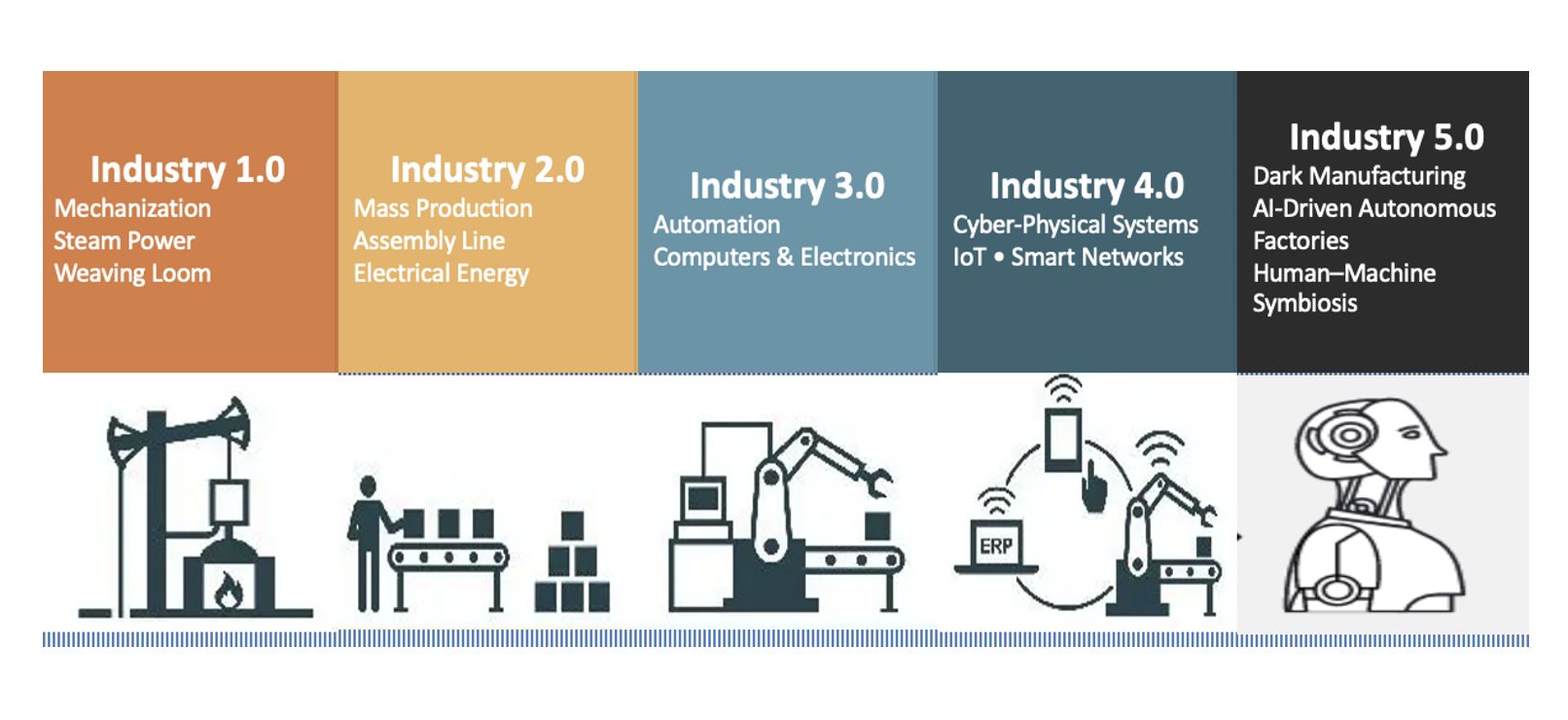
- Industry 1.0 (Late 1700s)–Mechanical Production
Introduction of production mechanization driven by water and steam power. - Industry 2.0 (Late 1800s – Early 1900s)–Mass Production
The rise of electricity and assembly line manufacturing, revolutionizing mass production. - Industry 3.0 (1970s Onwards)–Automation and Electronics
The integration of electronics, computers, and basic automation in manufacturing processes. - Industry 4.0 (2010s Onwards)–Cyber-Physical Systems
The development of IoT, Cloud computing, AI, and interconnected smart systems. - Industry 5.0 (Emerging)–Human-Centric and Cognitive Collaboration
AI-powered collaboration between humans and robots, focusing on personalized, human-centered manufacturing.
Dark Manufacturing: The Future of Industrial Innovation
Dark Manufacturing refers to fully automated industrial operations that function without human intervention, enabling continuous production with minimal manual oversight. This advanced model relies on cutting-edge technologies such as robotics, AI-driven decision-making, autonomous material handling, and predictive maintenance, all integrated within highly synchronized OT/ICS systems. By leveraging these technologies, dark manufacturing optimizes efficiency, reduces downtime, and maximizes operational productivity. It marks the culmination of Industry 4.0 automation, evolving further with the intelligence of Industry 5.0, where factories operate autonomously with limited human presence. In this state, production systems are self-sustaining, capable of adapting to changing conditions in real-time while ensuring safety, quality, and cost-effectiveness. Dark manufacturing represents the next phase in industrial evolution, where smart factories are not only automated but also intelligently connected, driving unprecedented levels of efficiency and flexibility across various sectors. This transition is poised to revolutionize traditional manufacturing, reshaping production processes and the workforce while offering new opportunities for innovation and sustainable growth.
The Need for Dark Manufacturing
- Scalability & Flexibility: To stay competitive, industries must operate 24/7, increasing output, minimize downtime, rapidly scale to meet changing demands without sacrificing efficiency and meeting the pressures of global supply chains.
- Labor Shortages & Skills Gap: With the decreasing availability of skilled labor, especially in manual and technical roles, the need for autonomous, self sustaining facilities becomes paramount.
- Operational Efficiency & Cost Reduction: Automation reduces the need for human intervention, reducing energy waste and optimizing resources, significantly lowering operational costs while improving precision, consistency and contributes to more sustainable production practices
- Safety in Hazardous Environments: Dark manufacturing eliminates human exposure to dangerous working conditions, such as chemical plants, heavy manufacturing environments, or high-temperature processes, ensuring worker safety.
- Resilience & Reliability: Autonomous systems ensure continuous production, even during unexpected disruptions such as pandemics, workforce shortages, or shifts to remote operations.
- Higher Quality & Predictability: AI driven automation, equipped with advanced sensors, reduces defects and ensures more accurate, real-time decision-making, enhancing product consistency and quality.
The Blueprint for Dark Manufacturing Architecture / Standard
Currently, there is no globally recognized official reference framework/standard for dark manufacturing. Instead, dark manufacturing is viewed as an advanced application and natural evolution of broader frameworks such as Smart Manufacturing, Industry 4.0, and the Industrial Internet of Things (IIoT). These frameworks and standards encompass key components like automation, AI, data management, robotics, and connectivity, all of which are integral to the concept of dark manufacturing. The absence of a dedicated standard stems from the fact that dark manufacturing focuses more on the degree of automation and system integration achieved through existing and emerging technologies such as robotics, AI, advanced sensors, and IIoT protocols. The primary objectives are to ensure extreme reliability, rigorous quality control, and sophisticated error handling, all of which function without requiring on-site human intervention. As a result, companies implement these highly automated systems by integrating best practices, internal checklists, and components from the aforementioned frameworks, rather than adhering to a single, universally mandated dark manufacturing standard.
Cybersecurity Imperative in Dark Manufacturing
- Expanded Attack Surface: Highly interconnected OT, ICS, IoT, and autonomous systems increase entry points for attackers.
- Remote & Unattended Operation: Lights-out facilities lack real-time human oversight, increasing risk of undetected compromise.
- Legacy OT Systems: Older PLCs/RTUs lack authentication, encryption, or secure update mechanisms.
- Supply Chain & Third-Party Risks: Autonomous robotics, sensors, and AI platforms rely on external vendors and cloud services.
- Lateral Movement & ICS Impact: Automated workflows allow attackers to move quickly across production lines with minimal human detection.
Essential Cybersecurity Controls for OT / ICS
- Zero Trust for OT/ICS: Enforce identity, segmentation, least privilege, and continuous authentication across all devices.
- Network Segmentation (ISA-95/ISA-99): Separate enterprise, control, and field networks with strict access controls.
- Secure Remote Access: Use VPN with MFA, jump servers, bastion hosts, and session recording.
- Robust Monitoring & Anomaly Detection: Deploy OT-aware IDS/IPS, AI/ML anomaly detection, and continuous asset inventory.
- Hardening of OT Assets: Disable unused ports, implement secure boot, firmware signing, patching, and secure configuration baselines.
- Safety & Resilience Measures: Include fail-safe modes, redundant control paths, and isolation capabilities for autonomous operations.
- Vendor Risk Management: Validate firmware/software supply chain and require SBOM (Software Bill of Materials).
- Continuous Threat Exposure Management: Continuously identify, assess, and prioritize emerging threats to proactively mitigate risks, ensuring robust defense against cyberattacks.
Dark Manufacturing Security: Moving Beyond Legacy Controls
- Autonomous Threat Response: Implement AI/ML-based detection to autonomously isolate compromised devices or production cells without human intervention.
- Digital Twins for Security Testing: Use virtual replicas to test patches, configurations, and security policies before applying them to live systems.
- Robotic System Hardening: Secure robot controllers, AGVs/AMRs, AI models, and machine-vision systems against tampering or unsafe instructions.
- AI Model Governance: Protect training data, prevent model poisoning, and validate AI decision-making for autonomous operations.
- Continuous Integrity Monitoring: Use cryptographic checks to ensure the integrity of PLC logic, firmware, robotics software, and control algorithms.
- Zero-Human Operation Controls: Establish automated fallback modes, emergency stops, and isolation mechanisms for unmanned environments.
- Cyber-Resilient Architecture: Design systems to auto-recover from attacks with redundancy, failover, and self-healing capabilities.
- High-Assurance Machine Identity: Use machine identity management to authenticate robots, sensors, and subsystems.
- Secure Autonomous Supply Chain: Validate robotic firmware, sensor hardware, and AI modules with SBOM and trusted build pipelines.
Dark Manufacturing Risk Controls and Security lifecycle
Pre-Deployment (Design & Build Phase)
- Risk Modeling & Threat Simulation: Identify risks to autonomous robotics, AI logic, ICS controllers, and M2M communication.
- Secure Architecture Design: Apply Zero Trust architecture, network segmentation, machine identity, and resilient fail-safe paths.
- Digital Twin & Scenario-Based Testing: Validate all control logic, AI decisions, safety interlocks, and failure scenarios in a virtual environment.
- Secure Supply Chain Validation: Verify firmware, robotics software, sensor hardware, and AI models using SBOM and trusted components.
Operations (Day-to-Day Autonomous Environment)
- Continuous Integrity Assurance: Real-time monitoring of PLC logic, robot instructions, AI models, and firmware signatures.
- Autonomous Detection & Response: ML-driven anomaly detection and auto-isolation of compromised devices or production cells.
- High-Assurance Access Control: Enforce MFA, role-based access, and machine identity for all autonomous subsystems.
- Periodic Testing & Safety Validation: Scheduled functional and resilience testing to ensure outcomes remain predictable, safe, and consistent.
Post-Deployment Controls
- Security Reviews: Analyse incidents, anomalies, and deviations from expected autonomous behaviour.
- Robotics & AI Patch Management: Apply updates to robotic controllers, AI models, and ICS systems using controlled, tested workflows.
- Model Drift & Behaviour Validation: Regularly validate AI performance to ensure decisions align with intended operational goals.
- Lifecycle Security Assessments: Conduct quarterly or biannual assessments of robotics, OT/ICS, IoT, cloud, and AI subsystems to ensure continuous security and operational integrity.
Synthesis and Key Takeaways
Securing dark manufacturing requires a shift from traditional OT/ICS controls to advanced, autonomous, self-defending architectures driven by AI and integrity-based security measures. These systems must be designed with continuous scenario-based testing, autonomous monitoring, and rigorous lifecycle security validation to ensure reliable, predictable, and resilient operations in unmanned environments. Security considerations must be embedded at every stage (design, operation and post deployment) to address emerging threats, ensure robust data protection, and maintain the integrity of autonomous systems. By integrating these modern cybersecurity practices, dark manufacturing can achieve secure, efficient, and scalable operations, while minimizing risks and ensuring long-term sustainability in an increasingly automated industrial landscape.
About the Author
Fayyaz Ahmed is a technology and cybersecurity professional with over 20 years of experience in enterprise IT networking and cybersecurity, specializing in integrated IT and OT/ICS environments. He holds the Cisco Certified Internetwork Expert (CCIE – Enterprise Infrastructure, Emeritus Lifetime) certification and is additionally certified as an ISC2 Certified Information Systems Security Professional (CISSP), Certified Cloud Security Professional (CCSP), and GIAC Global Industrial Cybersecurity Professional (GICSP).
His expertise spans secure network architecture, large-scale infrastructure design, and the protection of mission-critical systems across enterprise and industrial domains. Fayyaz has led and contributed to complex, high-impact initiatives focused on resilience, security, and digital transformation. His professional work and research interests include industrial cybersecurity, IT/OT convergence, and emerging autonomous manufacturing models such as dark manufacturing.
Fayyaz Ahmed