Get all your news in one place.
100's of premium titles.
One app.
Start reading
The Economic Times
The Economic Times
Muskan Singh

Between 2001 and 2019, satellites watched 250,000 farming areas across the world, revealing how government payments, crop rules and conservation measures can slowly restore degraded cropland and strengthen food security

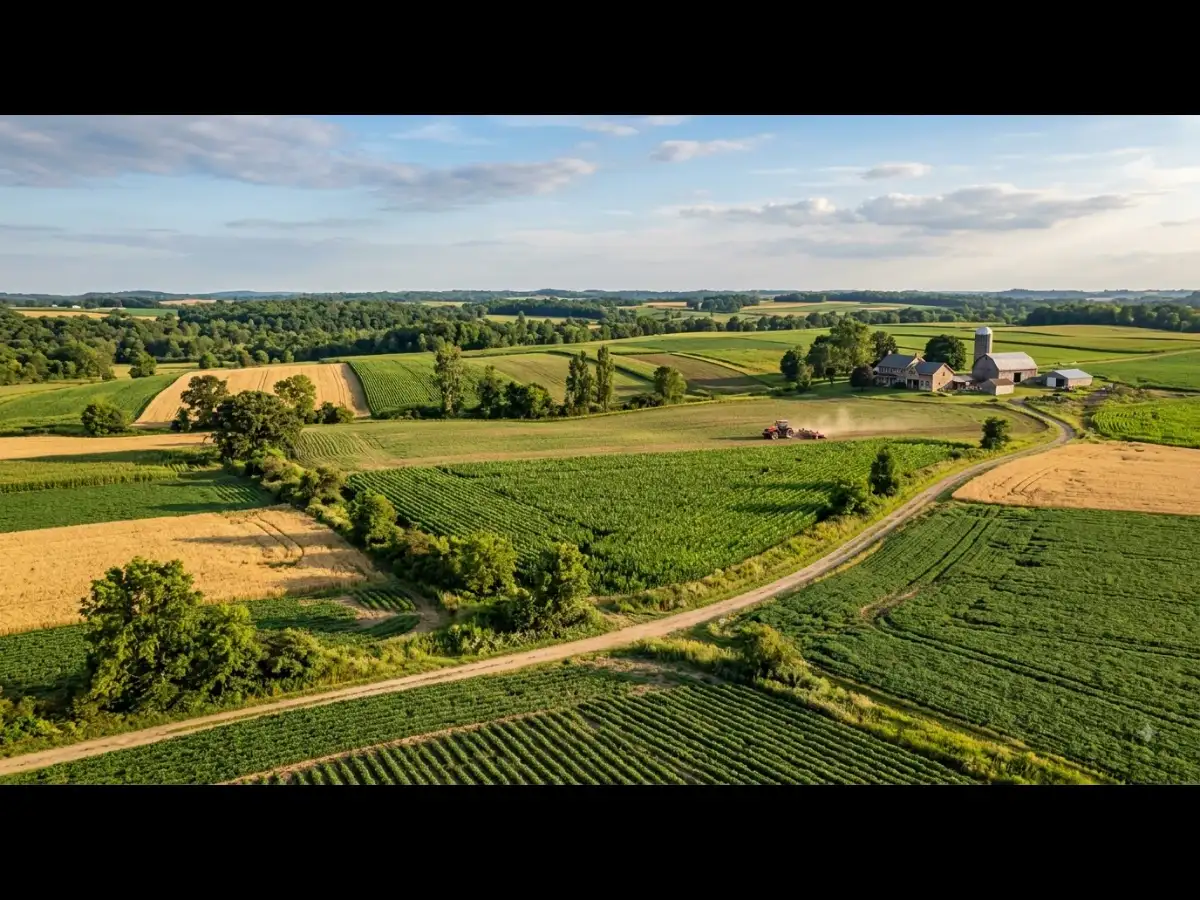
Healthy farmland is essential for producing food, but soils around the world are under pressure from intensive farming, climate change and biodiversity loss. A new study from the University of Bonn suggests that government policies can make a measurable difference.

Researchers examined changes across millions of satellite pixels and found that financial incentives, land-management rules and conservation measures can help improve cropland quality.

The findings suggest that protecting agricultural land is not only an environmental goal. It can also support long-term food security.

The study, titled “Agri-environmental policies have reduced cropland degradation globally,” was published in Nature Food.Dureti, G., Hadi, H. & Wuepper, D. Agri-environmental policies have reduced cropland degradation globally. Nature Food 7, 527–538 (2026).

READ ALSO: 4 zodiac signs could attract luck and wealth, as the North Node enters Aquarius on August 18 and begins a new 18-month cycle of growth

What did the researchers examine?

The study looked at satellite images collected between 2001 and 2019. Guyo Dureti, an economist and agricultural scientist pursuing his doctorate at the University of Bonn, explained that the images allowed the researchers to track how agricultural crop biomass changed over time.

But simply seeing more biomass does not necessarily mean soil has become healthier. Changes in rainfall, temperature, fertilizer use, irrigation and mechanization can all affect agricultural growth.

To account for these factors, Dureti, Hadi and Wuepper used high-resolution satellite information on local microclimates, fertilizer use and irrigation. Their analysis covered more than 83 million one-square-kilometer pixels across farming regions around the world.

The researchers were ultimately interested in whether government action was making a difference to cropland degradation.

READ ALSO: Japanese Mindset: 'Nana Korobi Yaoki'- The Japanese philosophy that teaches you about failure, resilience, and the art of getting back up

How did government policies make a difference?

The team used a comparison that treated neighboring countries as a kind of natural experiment. They examined border areas where one country had introduced a new agricultural safeguard while the neighboring country had not.

The researchers then compared changes in soil conditions before and after the policy was introduced. The approach helped them separate the potential effects of government measures from differences that might otherwise exist between individual regions.

As Dureti explains, “If the soil immediately north of the border develops differently to that right to the south, this is likely to be because of the new law.”

The results showed that government measures aimed at slowing cropland degradation can work.

Financial incentives were among the most effective measures identified by the researchers. These payments can encourage farmers to use fertilizers more efficiently, choose more environmentally friendly weedkillers and pesticides, and plant hedges that help prevent soil erosion.

Rules governing how farmland is managed also showed a strong effect. Crop rotation requirements and measures making landscape features such as wildflower strips mandatory were among the approaches that could improve land quality.

READ ALSO: Quote of the Day by Amber Heard: 'I am constantly struggling to show people that there is more to me than my appearance...'- Inspiring life lesson on self-worth and being more than your appearance by the actress famous for playing Queen Mera in the DC superhero film Aquaman

Why do strong institutions matter?

The study also found that having a policy on paper is not enough. Its success depends heavily on whether governments have the ability to put those rules into practice.

Countries with stronger government institutions tended to see greater effects from their regulations. Where authorities have limited opportunities to monitor compliance or enforce agricultural rules, the measures are much less likely to succeed.

Corruption can also weaken the impact of environmental policies.

Government spending matters as well. According to the study, countries that invest more money in protecting their soils tend to achieve greater success in maintaining cropland quality.

That finding points to an important part of the broader picture: conservation policies need both financial support and institutions capable of enforcing them.

READ ALSO: Quote of the Day by David Letterman: 'I have found that the only thing that does bring you happiness is doing...'- Inspiring life lesson on finding happiness by doing good for others by the American television host

What does this mean for food security?

Soil degradation threatens the quality of agricultural land, while climate change and biodiversity loss add further pressure. Improving cropland therefore has consequences beyond the condition of individual fields.

The University of Bonn researchers say their findings provide evidence that government intervention can improve land quality. Better-managed soils can support agricultural production while also contributing to environmental protection.

Dureti described the overall findings as positive, concluding, “Government regulations can significantly improve land quality and thus do much for environmental protection and food security.”

The research was carried out by Guyo Dureti, Hadi Hadi and David Wuepper at the University of Bonn. Dureti is working in the university's Land Economics Group, led by Professor David Wuepper, who is also a member of the Cluster of Excellence “PhenoRob” and the Transdisciplinary Research Area “Sustainable Futures.”

FAQs

Can government policies improve soil quality?

Yes. The study found that several policies can reduce cropland degradation.

Which measures worked best?

Financial incentives, crop-management rules and conservation measures showed strong effects.

Sign up to read this article
Read news from 100's of titles, curated specifically for you.
Already a member? Sign in here
Related Stories
Top stories on inkl right now
One subscription that gives you access to news from hundreds of sites
Already a member? Sign in here
Our Picks
Fourteen days free
Download the app
One app. One membership.
100+ trusted global sources.