Get all your news in one place.
100's of premium titles.
One app.
Start reading
The Economic Times
The Economic Times
Piyush Shukla

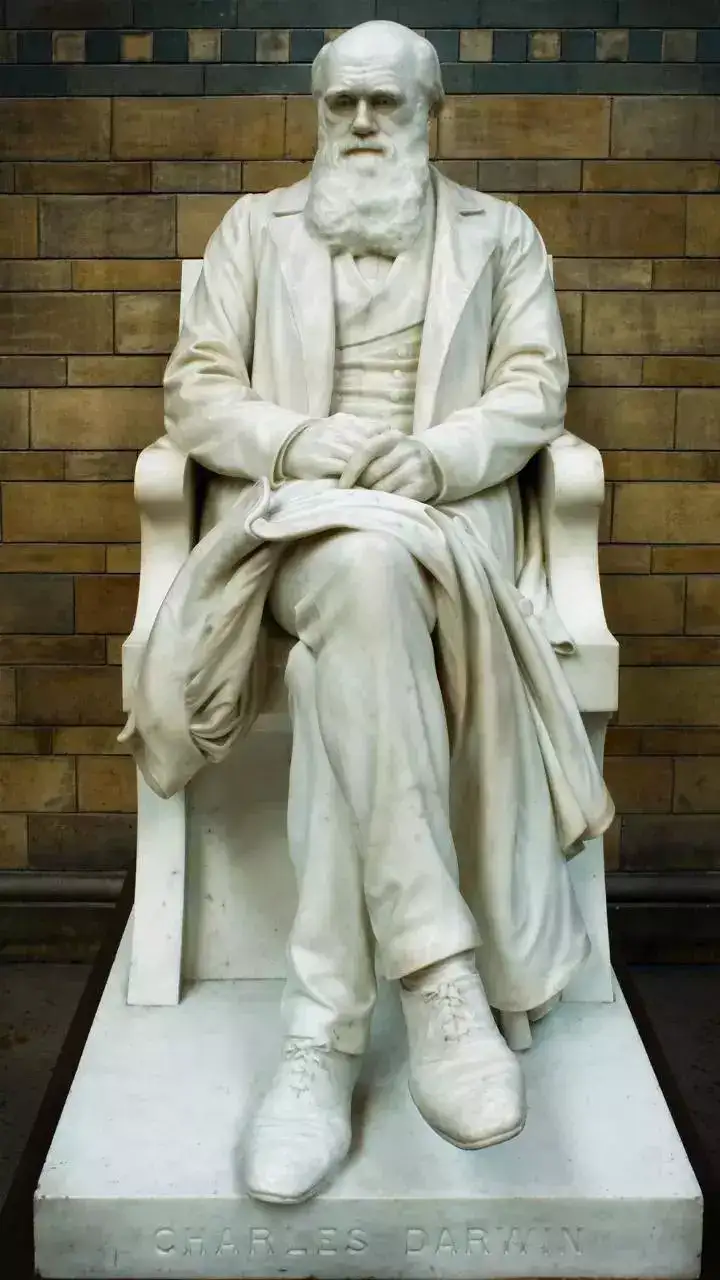
Best quote of the day by Charles Darwin: "Intelligence is based on how efficient a species became at doing the things they need to..." - Eye-opening life lessons on why surviving life's challenges begins with learning, adapting, and growing continuously

In 1859, Charles Darwin published a book that changed how humanity understood itself. Yet one of his sharpest insights—about the nature of intelligence itself—has been almost completely misread ever since. "Intelligence," Darwin observed, "is based on how efficient a species became at doing the things they need to survive." Not the biggest brain. Not the highest IQ. Not the most sophisticated tool. Efficiency at what's necessary. That's the definition that challenges almost everything modern culture tells us about being smart.

We live in a world that worships a narrow kind of cleverness. Academic scores. Verbal fluency. The ability to solve abstract puzzles. These are useful things, but Darwin's framework invites a harder question: useful for what, and for whom? When you strip intelligence down to its evolutionary core, the concept transforms into something far more humble—and far more honest.

"Intelligence is based on how efficient a species became at doing the things they need to survive."

— Charles Darwin

What does Quote of the Day by Charles Darwin really mean by intelligence and survival?

At first glance, Darwin's quote seems to describe animals competing in nature. But its meaning reaches much further. Every living species faces one central challenge: survive long enough to reproduce and pass on useful traits.

In nature, intelligence is valuable only if it helps solve real problems. A bird that learns where food appears during changing seasons gains an advantage. An octopus that quickly escapes predators survives another day. Even tiny insects display remarkable behaviors that improve their chances of living longer.

This practical view of intelligence was revolutionary. Darwin argued that evolution rewards useful adaptations rather than perfection. Intelligence, therefore, becomes another adaptation—a tool shaped by millions of years of natural selection.

Humans often mistake knowledge for intelligence. Yet someone may possess vast information but struggle to adapt when circumstances change. Darwin reminds us that true intelligence reveals itself through action, flexibility, and problem-solving rather than accumulated facts alone.

Many assume Darwin believed only the strongest survive. Ironically, that oversimplifies his work.

One of the biggest misunderstandings surrounding evolution is that physical strength determines success. Darwin's broader theory showed that survival depends on fitness—how well an organism matches its environment.

Fitness can mean cooperation instead of competition.

It can mean learning instead of overpowering.

It can mean changing behavior instead of resisting change.

Modern science repeatedly supports this view. Animals capable of adjusting to changing habitats often outlast species that cannot. Likewise, businesses that embrace innovation frequently survive market disruptions better than those relying solely on past success.

Who was Charles Darwin, and why does his voice still matter?

Charles Robert Darwin was born in 1809 into a wealthy English family with a tradition of intellectual ambition. His grandfather Erasmus Darwin had already speculated about evolution decades earlier. But it was Charles—awkward, devoted, endlessly observant—who would spend five years aboard HMS Beagle cataloguing the natural world and return with an idea that would take him twenty more years to summon the courage to publish.

Darwin was not a philosopher by training. He was a naturalist. He watched. He counted. He compared. And the genius of his work was precisely that he let the evidence lead him somewhere uncomfortable rather than confirming what he already believed. In an era when most European thinkers placed humans at the pinnacle of a divinely ordered universe, Darwin proposed something more unsettling: that every living creature—from barnacles to primates—was simply a solution to a set of environmental problems. Humans were not the crowning achievement of creation. We were just another contestant, shaped by pressures we didn't fully understand.

That humility is baked into his statement on intelligence. He wasn't ranking species. He was describing a process.

Why does this definition of intelligence feel so different from ours?

Modern intelligence is usually treated as a fixed, measurable quantity—something you either have or don't. The IQ test, invented more than a century ago, promised to capture it in a single number. Schools rank students. Employers screen with cognitive assessments. The word "smart" functions almost as a moral judgment.

Darwin's definition cuts across all of this. In his view, the octopus is extraordinarily intelligent—because it can camouflage itself in milliseconds, hunt with precision, and solve complex physical problems using arms that operate with near-independent nervous systems. It has no prefrontal cortex, no language, no algebra. And yet it is supremely efficient at surviving in its environment. By Darwinian logic, that counts.

The crow that drops a walnut onto a pedestrian crossing and waits for a car to crack it open—then retrieves it with the green light—is demonstrating intelligence at its most elegant. It has learned to use the city as a tool. That's efficiency in action. That's exactly what Darwin described.

Meanwhile, a human capable of solving differential equations might be entirely incompetent at reading social situations, managing stress, or finding food without a delivery app. The question isn't whether we're smarter. It's whether we're well-matched to the demands we actually face.

What this means for how we live—and think—today

There's a life lesson buried in Darwin's observation, one that becomes sharper the longer you sit with it. Intelligence isn't a trophy. It's a relationship between a mind and its context. The same person can be brilliant in one environment and utterly lost in another. We've all felt this—the expert who thrives in their domain and freezes outside it, the quick learner in a new role who suddenly struggles when the job changes around them.

Darwin's words offer practical wisdom that extends well beyond science.

First, adaptability often matters more than perfection. Waiting until conditions are ideal can leave opportunities behind, while small adjustments made consistently create lasting progress.

Second, continuous learning becomes a survival skill. Every new experience expands our ability to respond to future challenges.

Third, resilience grows through change rather than comfort. Difficult situations frequently develop abilities that easier circumstances never could.

Fourth, intelligence includes emotional awareness. Understanding ourselves and responding thoughtfully to others often proves just as valuable as solving technical problems.

Finally, humility is part of wisdom. Darwin spent years testing his own ideas before sharing them with the world, reminding us that genuine understanding requires patience, curiosity, and openness to new evidence.

Evolutionary psychologists call this domain specificity. Our minds didn't evolve as general-purpose thinking engines. They evolved to handle particular kinds of problems—social dynamics, threat detection, foraging decisions—that our ancestors faced on the African savanna. Many of the cognitive shortcuts that kept early humans alive now produce systematic errors when applied to stock markets, nutrition labels, or public health crises. We are, in the most literal sense, sometimes using the wrong intelligence for the wrong environment.

Darwin's framework suggests the remedy isn't to become "smarter" in the abstract. It's to become more honest about what we're actually trying to do, and whether our current abilities are well-suited to it. Adaptability, not raw intelligence, is what natural selection has consistently rewarded. Species that could adjust to shifting conditions outlasted those that were merely powerful in a stable one. The most dangerous thing for any organism is to be exquisitely adapted to a world that no longer exists.

For humans navigating rapid technological change, economic disruption, and ecological uncertainty, that danger is not theoretical. The environments we built our careers around, our social structures, our educational systems—these are all shifting faster than our brains naturally adapt. What Darwin's insight offers isn't consolation. It's a prompt: Look carefully at what you actually need to survive and flourish in the world as it is, not as it was. Then ask honestly whether you're doing that well.

That question, more than any exam score or credential, might be the most intelligent one we can ask.

Sign up to read this article
Read news from 100's of titles, curated specifically for you.
Already a member? Sign in here
Related Stories
Top stories on inkl right now
One subscription that gives you access to news from hundreds of sites
Already a member? Sign in here
Our Picks
Fourteen days free
Download the app
One app. One membership.
100+ trusted global sources.