Get all your news in one place.
100’s of premium titles.
One app.
Start reading
Radio France Internationale
World
Melissa Chemam

Benin and Nigeria join forces to fight growing cross-border terrorism

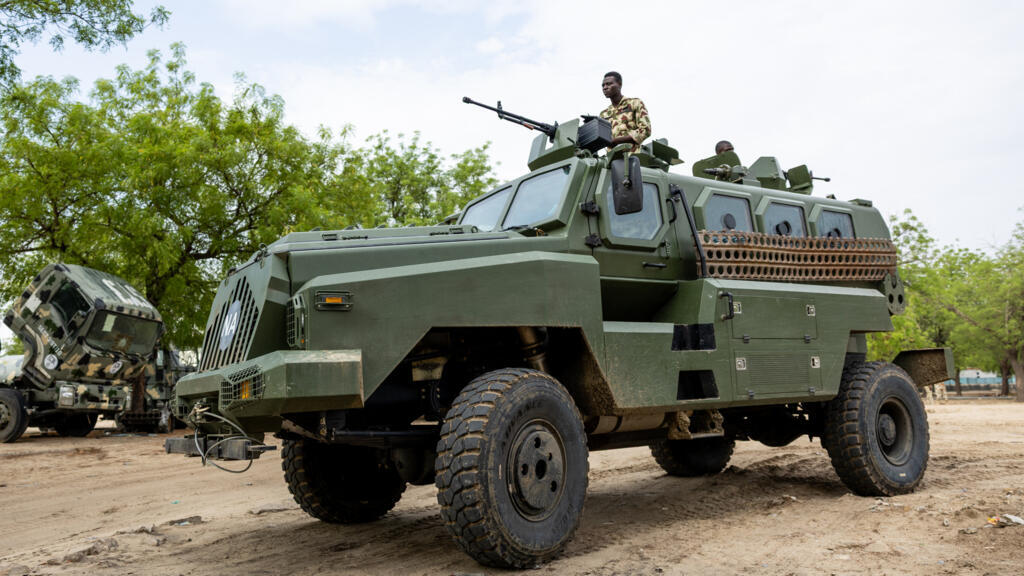
Nigerian soldiers from the Multinational Joint Task Force drive an armoured truck in Monguno, Borno state, Nigeria, on 5 July, 2025. © AFP - JORIS BOLOMEY

Authorities in Benin and Nigeria this week announced plans for a joint security operation to combat terrorist groups along their shared border. It comes amid an increase in jihadist attacks, which have spread further afield to coastal states like Benin, Togo and Côte d'Ivoire, prompting countries to seek cross-border cooperation.

High-ranking military officials in charge of counterterrorism operations in Benin and Nigeria met in Cotonou on 27 February to discuss future cooperation, alongside French representatives.

The plan includes the coordination of border patrols, joint operations, intelligence sharing and increased monitoring of cross-border flows, which are to be discussed further later this month.

For Héni Nsaibia, senior West Africa analyst at the Armed Conflict Location and Event Data group (ACLED), the collaboration is "a step in the right direction" for tackling the rise in violence.

The border area between Benin, Niger and Nigeria has become a new focus of jihadist violence since 2025, Nsaibia said.

"Due to very weak border security and coordination between concerned states, seeing Benin and Nigeria reinforcing their cooperation is particularly relevant," he told RFI.

According to his research for ACLED, the number of incidents involving jihadist groups in Benin's Alibori and Borgou departments, Dosso in Niger, and Nigeria's Sokoto, Kebbi, Niger and Kwara states rose by 86 percent between 2024 and 2025. Resulting deaths soared by 262 percent.

Growing footprint

Jihadist groups Jama’at Nusrat al-Islam wal-Muslimin (JNIM) and the Islamic State in the Sahel have long been concentrated in the Sahel countries of Mali, Burkina Faso and Niger, but are now spreading to West Africa's coastal countries.

"Sahelian jihadist militants have escalated, entrenched and increasingly broadcast their footprint," Nsaibia wrote in a recent analysis.

Founded in Mali in 2017, JNIM is now the main jihadist group in the central Sahel. Since 2019, the al-Qaeda affiliate has also been carrying out attacks in countries along the Gulf of Guinea, including Côte d’Ivoire, Benin and Togo.

Last year, JNIM also claimed responsibility for the first time for an attack on Nigerian soil, Nsaibia noted.

This increase in violence can be blamed on "limited state presence", he said, as well as weakened regional cooperation since Mali, Burkina Faso and Niger withdrew from the Ecowas bloc following coups in all three countries.

According to Nsaibia, jihadists are consolidating their presence in the border area through recruitment across ethnic and linguistic lines, by co-opting local bandits and taking control of smuggling routes – particularly of fuel from northern Nigeria to the Niger river and Benin.

Mali under pressure to end fuel crisis as negotiations with jihadists stall

Pursuit across borders

Cooperation across borders is seen as key to tackling the problem.

Due to "the porosity of the borders, we've had armed trafficking, we've had criminal gangs, we've had Boko Haram, we've had ISIS and other groups", said Sunday Dare, senior advisor to Nigeria's President Bola Ahmed Tinubu.

The Nigerian president is committed to fostering close relations with Benin and its other neighbours, Dare told RFI, with an eye to both security and economic benefits. "Just last month he opened the borders to not just Benin, but also Niger, and that has improved relations," the advisor said.

Another meeting is scheduled to take place in Benin before the end of March to make progress on this week's draft military memorandum.

The Court of Repression of Economic Offences and Terrorism in Porto-Novo, Benin, on 10 December, 2021. © Yanick Folly / AFP

US strikes on Nigeria set 'deeply troubling precedent' for African governance

According to Nsaibia, the plan is likely to include measures allowing authorities to track terrorists even into neighbouring territory.

"As I understand it, it relates to preventing militant activity and by doing so, trying to mitigate the threat through joint patrols and increased intelligence sharing," he said, "but also the right of pursuit – that is, to the respective country being able to pursue militants that often flee and jump the border in order to escape the intervening forces."

Nsaibia says other countries in the region are also reinforcing their military cooperation.

"We have also seen in the past weeks that Ghana and Burkina Faso have taken similar steps. From a regional perspective, these borders are most exposed to jihadist violence, and I think it makes sense for these countries to have these types of rapprochement between each other."

Sign up to read this article
Read news from 100’s of titles, curated specifically for you.
Already a member? Sign in here
Related Stories
Top stories on inkl right now
One subscription that gives you access to news from hundreds of sites
Already a member? Sign in here
Our Picks
Fourteen days free
Download the app
One app. One membership.
100+ trusted global sources.