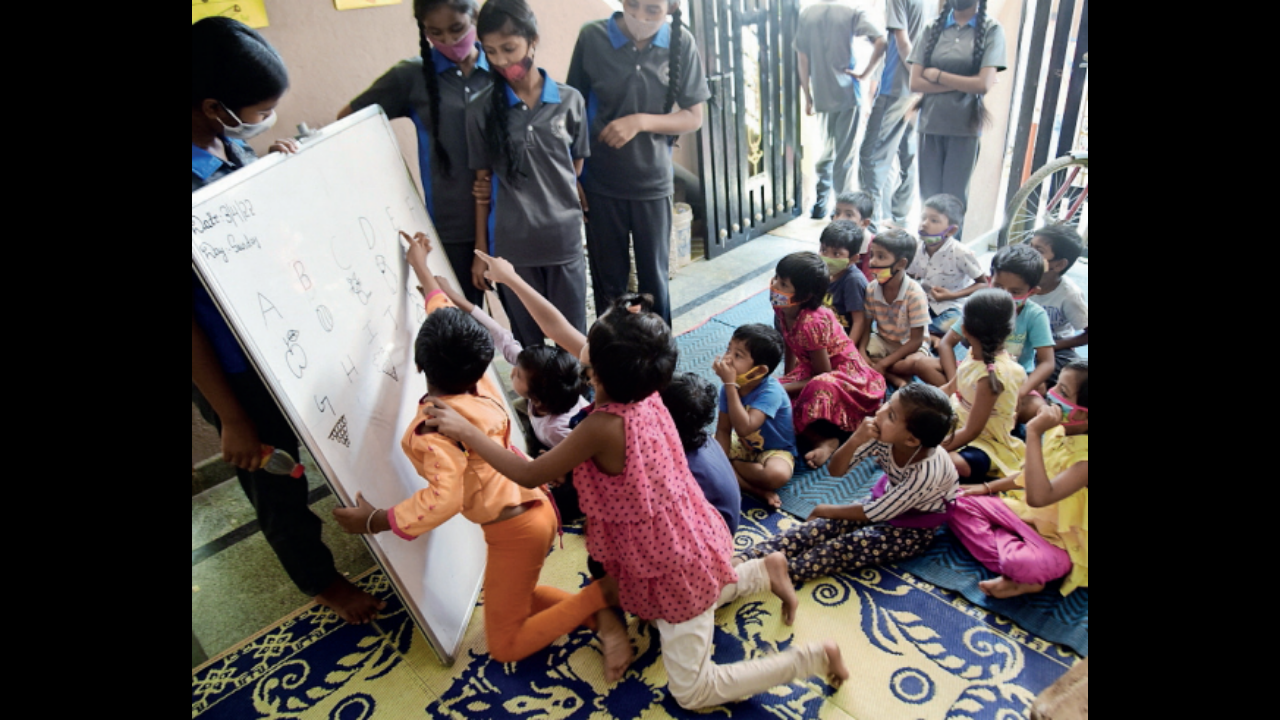
BENGALURU: On Sunday morning, under a huge banyan tree, the men in the Kundanahalli village, Brookefield, were busy playing cards, a tradition they follow after every Ugadi. A little ahead, down a narrow lane crammed by small huts on both sides, a group of small children were walking in a line, chattering continuously, guided by a handful of 14-year-olds.
The latter led the children to the ground floor of a three-storey house, which would otherwise have been a parking space. Like a bunch of experienced teachers, the teens led the class teaching the alphabet and numbers.
This, in short, is a scene from a weekend class happening in a slum in Brookefield, the outskirts of the IT corridor. The 14-year-olds are students of grade 8 of government school in Ramagondanahalli. The students, who are themselves from the slums, have identified 36 out-of-school children from their community. “We have been out-of-school children ourselves. We know how it is and what are the advantages we get when we go to a school. We want to gift them to those children from our area who are not going to school,” said Rakshitha Bhandari, 14, one of the core team members.
The students were struck by an idea when they had to identify a social problem for an inter-school competition. The students not only presented the idea of identifying out-of-school children and mainstreaming them, but also went ahead with implementing it. The nine students involved are from three different slums, which makes it easier for them to identify the children in need from their communities. “Many out-of-school children have been left out of various government surveys. These children live in these very communities and know exactly which kids are not in schools. We believe this might be the case in several other communities too. So if school-going kids living in these communities can start such initiatives, we can bring many children back to schools,” said Vaibhav Mishra, a teacher at Ramagondanahalli school appointed by Inventure Academy that has adopted the school.
“Most parents and children speak Bengali. We had friends who speak Bengali. So it was easier to get them in. With our presence, the children feel equal and more comfortable,” said Paayal Kumari, another student-volunteer.
The classes are held in two batches — one for 5-6 year olds and the other for 7-12 year olds. The children are taught basic numeracy and literacy for one hour each. The ‘teachers’ pick up the students and drop them back to their houses themselves. During summer holidays, the students plan to teach them every day. By June, they hope to have students enrolled in a government school or for bridge courses if the gaps are too large. The student volunteers hope to enlarge their team and also pilot it within other communities. The students have been given teacher training by their own teachers in Ramagondanahalli on how to handle small children and make classes interesting. Nikhil Kumar, Heena K and Mehenurhaqui are the other core team members.