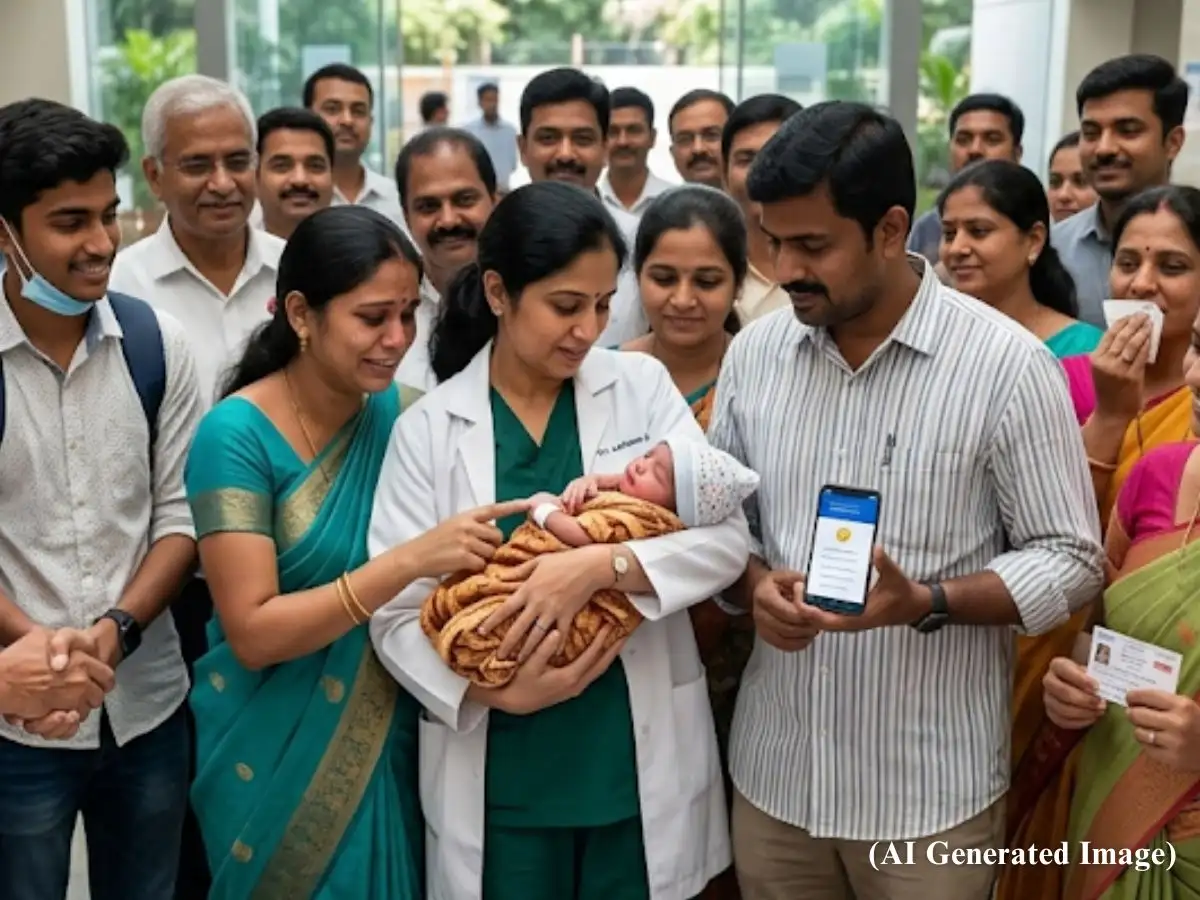
In December 2024, Pavan, a 3D visualiser from Bengaluru, spotted a small reddish patch on his newborn daughter's right hand. It was about 3 cm across. Easy to miss. Easy to assume it would go away on its own.
It did not go away. Within weeks, it had grown into a tumour larger than 11 cm, roughly the size of the baby's own head.
His daughter was 28 days old.
A diagnosis most doctors had never seen
The swelling was identified as infantile fibrosarcoma, or IFS, one of the rarest soft-tissue cancers known to occur in newborns. Fibrosarcoma affects just 0.3 in every 100,000 people globally, and IFS accounts for less than one per cent of all soft-tissue sarcomas.
Hospital after hospital told the family the same thing. The tumour was growing too fast. Surgery on an infant this young carried enormous risk. Amputation of the hand was likely the only viable option.
For Pavan, the word landed like a blow.
"People say 'amputation' as though it is just another medical term," he told the Times of India. "But for a parent, it's a small word that carries an unimaginably heavy weight."
The doctor who said not yet
When the family reached HCG Cancer Centre in Bengaluru, Dr Pramod S Chinder, director and head of musculoskeletal oncology, took a different position.
In 16 years of practising orthopaedic oncology in India and abroad, he said he had never seen a tumour of this size in an infant so young. But he believed a small chance remained, and he felt the family deserved to have it explored.
What followed was, by most measures, one of the most complex procedures ever attempted on an infant of this age in India.
What it took to save her hand
The treatment brought together more than 14 specialists and involved genomic testing, digital twin-assisted 3D surgical planning, super-selective micro-embolisation to cut off the tumour's blood supply, high-precision tumour removal, neonatal microvascular reconstruction, and NTRK-targeted therapy.
The plan was also reviewed in consultation with experts at Italy's Rizzoli Orthopaedic Institute, one of the world's leading centres for bone and soft-tissue oncology.
Doctors say comparable limb-preservation cases have so far largely involved older infants, which makes this one of the youngest reported cases of successful limb salvage anywhere in the world.
Then came the bill
The estimated cost of the treatment was between Rs 30 lakh and Rs 35 lakh. The family could not afford it.
What happened next is the part of this story that is harder to explain.
Through the HCG Foundation, the doctor's own family foundation, and an informal network that spread entirely through word of mouth, more than 300 people came forward. Schoolchildren collected money in their classrooms. Doctors made quiet personal donations. Hospital staff put in what they could. Friends, strangers, and philanthropists who had never met the family and likely never will, contributed anyway.
Together, they raised close to Rs 30 lakh.
One year on
Nearly a year after that first small swelling appeared on her hand, the baby girl is cancer-free. She has full use of her right arm and is growing up, by all accounts, like any other healthy child.
Her father told the Times of India that she recently tried to lift a watermelon with that hand.
"We are happy she can now grow up like any other child," he said.
(With TOI inputs)