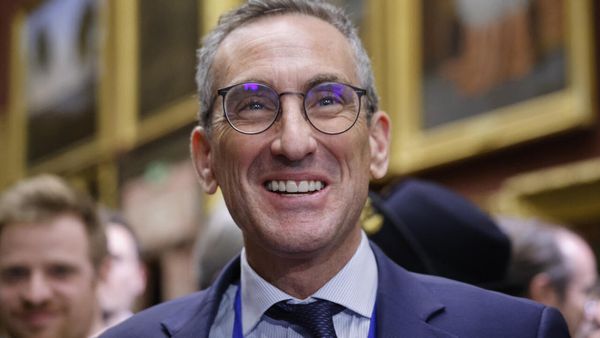
Simon Smith spent his 55 years building a life his friends described as "a tapestry with many chapters," from navigating life as a young gay man in the 1980s to planning a dream retirement in Spain.
It was a life defined by an ability to connect with people, the ACT Supreme Court heard on Monday, July 13.

"With a simple 'Hi darl,' Simon could make anyone feel like a million bucks," Mr Smith's close friend, Jeff Street, told the court.
But that journey was cut short in the early hours of May 23, 2024, when a Mitsubishi Outlander driven by Julie Elizabeth Fallon, 54, crossed onto the wrong side of the road in Wanniassa and crashed into his motorcycle.
The 55-year-old was taken to hospital in a serious condition and died two days later.
In May 2026, Fallon was found guilty by a jury of culpable driving causing death.
A point of contention in the trial was how much fog and sunlight was impairing Fallon's view at the time, and whether she looked away from the road moments before the fatal crash. This is set to be determined by Justice Lucy McCallum when Fallon's sentence is handed down.

On Monday, the victim impact statements had to be paused multiple times as Fallon grew increasingly distressed. She was eventually moved to a different room to watch the proceedings via an audio-visual link, where she was seen rocking back and forth.
The court heard Mr Smith was a public servant and had been planning to retire to Spain before his death, having already fulfilled many of his lifelong dreams, including travelling to Switzerland to see the Matterhorn and to Norway to witness the Northern Lights.
Mr Street, who met Mr Smith in 2011, told the court that his friend had "faced many challenges" and became one of the most influential people in his life.
"Simon came into my life when I needed it the most," he told the court. "He left before either of us was ready."
Mr Street said his friend's experiences as a young gay man in Sydney during the late 1980s had helped define who he became.
"There's no doubt that being in Sydney in the late 80s came with some big challenges, but Simon was a part of defining what it meant to be a young gay man at the time," he said. "To make it through meant Simon had his armour - he was strong, but vulnerable with those he loved."
Remembering Mr Smith, he described him as a principled man who advocated for vulnerable people and had a gift for making others feel welcome.
The court heard of Mr Smith's love of motorcycling and the close bond the pair shared on the road.
"Simon and I rode together, whether it was day trips to Jindabyne or up to Sydney to ride with the Boys on Bikes in the Mardi Gras Parade, I would follow him anywhere," Mr Street said.
"I don't think I will ever ride again."
Mr Street also spoke of the difficulties he faced navigating the aftermath of the crash, saying the system was geared towards conventional families and often failed to recognise the importance of single people who found a "chosen family and friends".
Although he was the administrator of Mr Smith's estate and listed as his emergency contact at work, he said those roles "meant nothing" in healthcare and police settings.
"At every step, I was an imposter - for we weren't partners, so who was I?" he said.
Mr Street said he was not recognised as family when he tried to visit Mr Smith in intensive care, despite being one of the people closest to him, and described the experience as having a profound impact on his grief.
The coroner told him someone would contact him and Donate Life advised counselling would be available, but "because my bond with Simon was unconventional, I never heard from anyone again", he told the court.
He said he only learned Fallon had been charged through The Canberra Times.
"My heart broke again," he said.

While acknowledging those issues were beyond the court's power to resolve, he added: "There is so much we can improve."
The other victim impact statements were read aloud by prosecutor Marcus Dyason, including one from a family Mr Smith became close to after moving to Canberra.
They told the court Mr Smith was a selfless man who gave so much to his community.
"His life should be measured by the very real and positive impact he had," they said.
The family said they were reminded of their loss every day.
"Every day we drive past the spot where Simon was killed. It's right near our home, a constant reminder of our loss."
Justice McCallum said the victim impact statements were among the most powerful she had encountered.
"I'm not sure I've ever seen such a thought-provoking collection of victim impact statements in any previous case," she said. "Quite extraordinary."
The judge is set to hand down Fallon's sentence later this month.