Get all your news in one place.
100's of premium titles.
One app.
Start reading
The Economic Times
The Economic Times
Kai Xue

Behind tariffs and tech curbs, US and China are learning to coexist as rivals

Beijing: Donald Trump arrives tomorrow in Beijing for a 2-day summit after being delayed by a war against Iran he did not expect to still be fighting. Alongside the West Asian crisis is another one in trade and technology between China and the US. Two cycles of escalation and truce last year have given both sides a clearer sense of its contours.

The economic relationship between the two countries generates constant headlines, ranging from sanctions on Chinese refineries to the Meta AI deal reportedly unwound after Chinese regulators ordered its reversal over the past few weeks. However, the main pattern is better understood through two US-initiated exchanges in 2025, each met by Chinese countermeasures, which together outline the boundaries of a managed economic competition.

Liberation Day and counter-tariffs

The first exchange came on April 2, when Trump unveiled sweeping 'Liberation Day' tariffs. China faced a 34% tariff across major categories, alongside additional duties including a 20% fentanyl-related tariff and residual 7.5-25% tariffs from the 2018- 19 trade actions. India, by comparison, faced a 25% tariff, later supplemented by a further 25% duty tied to Russian oil imports, with carve-outs in sectors such as electronics.

Beijing responded within days with counter-tariffs and export controls on seven rare earth elements, tightening global supply of materials critical to automotive and defence manufacturing. The effects were immediate. Ford was forced to halt production at its Chicago assembly plant due to magnet shortages. The controls also created knock-on disruptions across global supply chains, extending beyond the US to other countries, including India.

Escalation briefly intensified when an irate Trump raised tariffs on Chinese imports to a minimum of 145%. Yet, rather than producing a rupture, the confrontation settled into a temporary truce reached in Geneva weeks later.

Export controls and extraterritorial reach A second exchange followed in September, when Washington introduced the Affiliates Rule, extending export controls to entities 50% or more owned by firms already under restriction. This was built on the dramatically expanded version of Foreign Direct Product Rule (FDPR) from December 2024, pushing US jurisdiction well beyond its borders by covering chips made anywhere in the world using US-origin software or equipment. The implication was striking: a Chinese chip fab could require a US licence to sell chips to a Chinese customer inside China.

Beijing's response on October 9 mirrored this logic. China imposed export controls not only on rare earths but also on technologies and processes used to produce them. These measures were structurally modelled on the logic of FDPR and the Affiliates Rule, extending regulatory control beyond China's borders to products made using Chinese-origin technology.

The aim was to regulate not just raw rare earth exports but also the transfer of processed materials, including rare earth magnets and other downstream products, even when they are manufactured abroad through supply chains linked to Chinese inputs, equipment or IP.

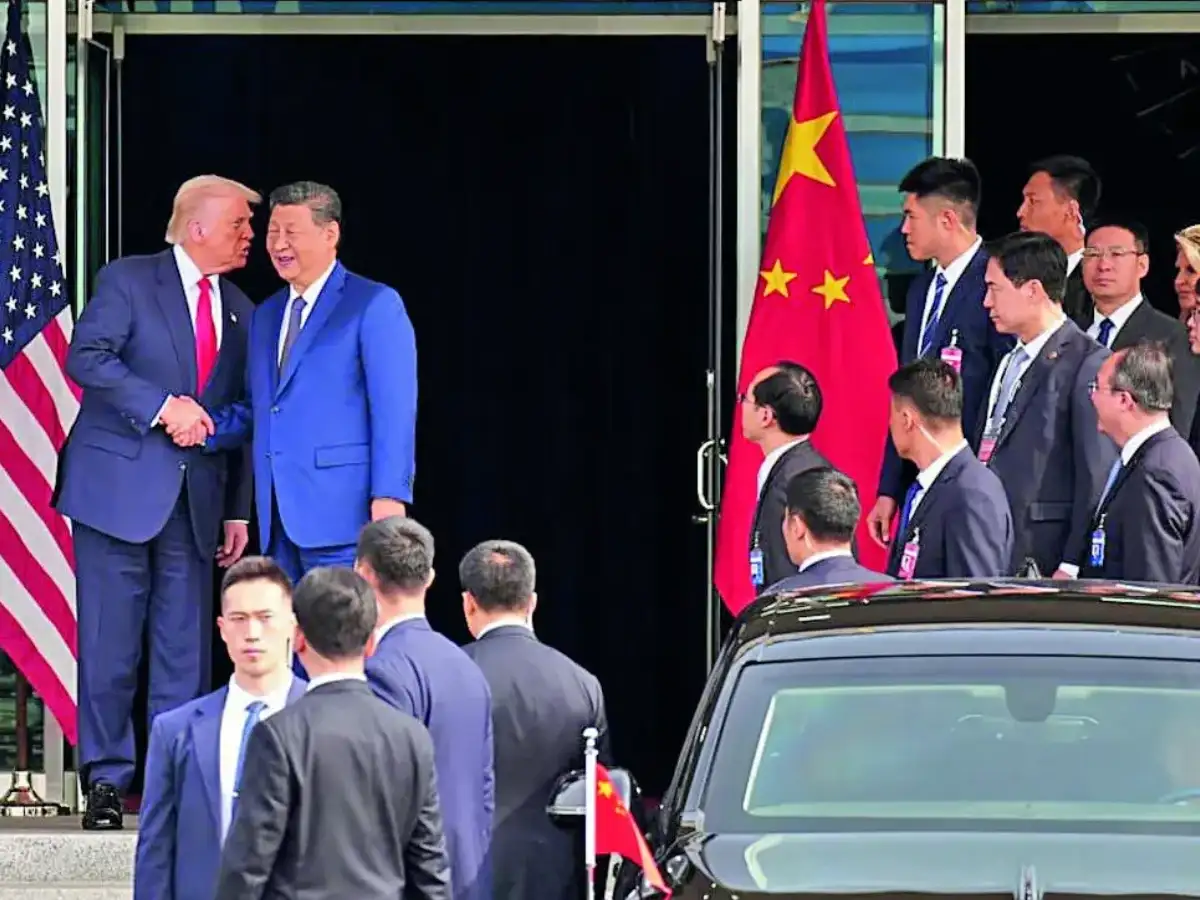
As in the earlier cycle, escalation did not lead to rupture but to another pause. The US agreed to suspend Affiliates Rule for a year, while China held back implementation of its October 9 export controls, in an understanding reached on the sidelines of the Xi-Trump meeting in South Korea at the end of October, another truce reached within weeks.

Following the two episodes, both sides have a shared objective: reducing dependence on the other, while keeping the economic relationship stable.

For the US and its partners, this has meant a race to loosen reliance on China's dominance in rare earth processing. For China, it has meant narrowing remaining external dependency in advanced technologies, particularly semiconductor manufacturing equipment, high-end AI chips and aircraft engines.

What remains are a few, but significant constraints. China's commercial aircraft programme remains dependent on foreign engine suppliers, while the semiconductor sector continues to rely on advanced lithography equipment produced by ASML, considered to be the most advanced machine in the world, whose Dutch export licensing is closely aligned with US policy.

If, by 2040, China closes remaining technology gaps while the US and its partners scale alternative supply chains, the outcome may resemble a draw.

Sustained economic competition could drive parallel self-sufficiency on both sides. Within limits, external pressure may accelerate China's domestic innovation if strong enough to force adaptation, but not so overwhelming as to be debilitating. Under such conditions, pressure may bring out the best in Chinese ingenuity, allowing ingenuity to harden into capability and capability into technological parity.

The writer is a Beijing-basedcorporate lawyer.

Sign up to read this article
Read news from 100's of titles, curated specifically for you.
Already a member? Sign in here
Related Stories
Top stories on inkl right now
Our Picks
Fourteen days free
Download the app
One app. One membership.
100+ trusted global sources.