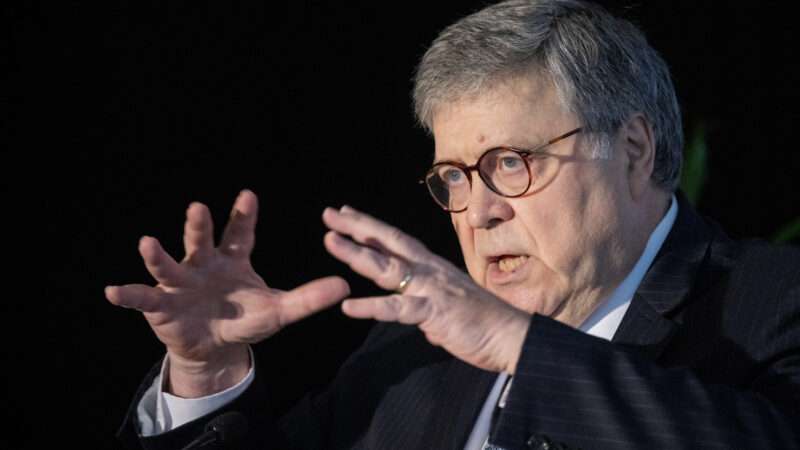
It will surprise no one to learn that William Barr, who made it clear when Donald Trump picked him to succeed Jeff Sessions as attorney general that he favored strict and uniform application of federal pot prohibition, and John Walters, who ran the Office of National Drug Control Policy during George W. Bush's administration, think "legalizing recreational marijuana" has been "nothing short of a disaster." Reason's Katherine Mangu-Ward already has ably rebutted their recent Free Press piece making that case. I'd like to add a few points about their approach to the subject, which combines valid concerns with strawman arguments, cherry picking, illogical inferences, reliance on dubious estimates, and tendentious interpretations of contested research.
Barr and Walters complain that marijuana legalization has "created the false perception that the drug is 'safe.'" They think refuting that false perception is enough to justify a return to prohibition. Because "marijuana is dangerous," they say, "legalizing it was a mistake." But the question is not whether marijuana is "safe"; it is whether marijuana's hazards justify the use of force to stop people from consuming it. Barr and Walters fail to seriously grapple with that question even in utilitarian terms, and they completely ignore moral objections to criminalizing conduct that violates no one's rights.