Get all your news in one place.
100's of premium titles.
One app.
Start reading
TechRadar
TechRadar
Wayne Williams

'Battery-free, quiet, and inherently private' — These 3D-printed metal tags could change home and office tracking, turning penny-sized discs into smart devices using ultrasonic tech for maintenance-free monitoring without charging

Smart home tags.
  • Battery-free metal tags generate ultrasonic signals when objects move nearby
  • Different disk shapes create unique sound signatures that identify tracked actions
  • Simulation tools produced hundreds of tag designs for varied real-world tracking uses

Researchers at Georgia Tech have built tiny metal tags that record everyday actions without needing batteries, charging cables, or wired power - instead relying on simple motion and sound rather than electronics inside each tag.

Most smart home sensors rely on batteries or wall power, which requires maintenance over time. These tags work differently, using mechanical contact to generate a brief ultrasonic signal whenever something moves.

Each tag sits on a small 3D-printed base attached to a fixed surface such as a cabinet frame. A matching tab sits on the moving object. When that object opens or closes, the tab strikes the metal disk and creates a short ultrasonic pulse.

Each frequency a unique identifier

That pulse is too high in frequency for people to hear, but nearby microphones can detect it. A wearable device records the signal and logs what happened, such as opening a drawer or closing a door.

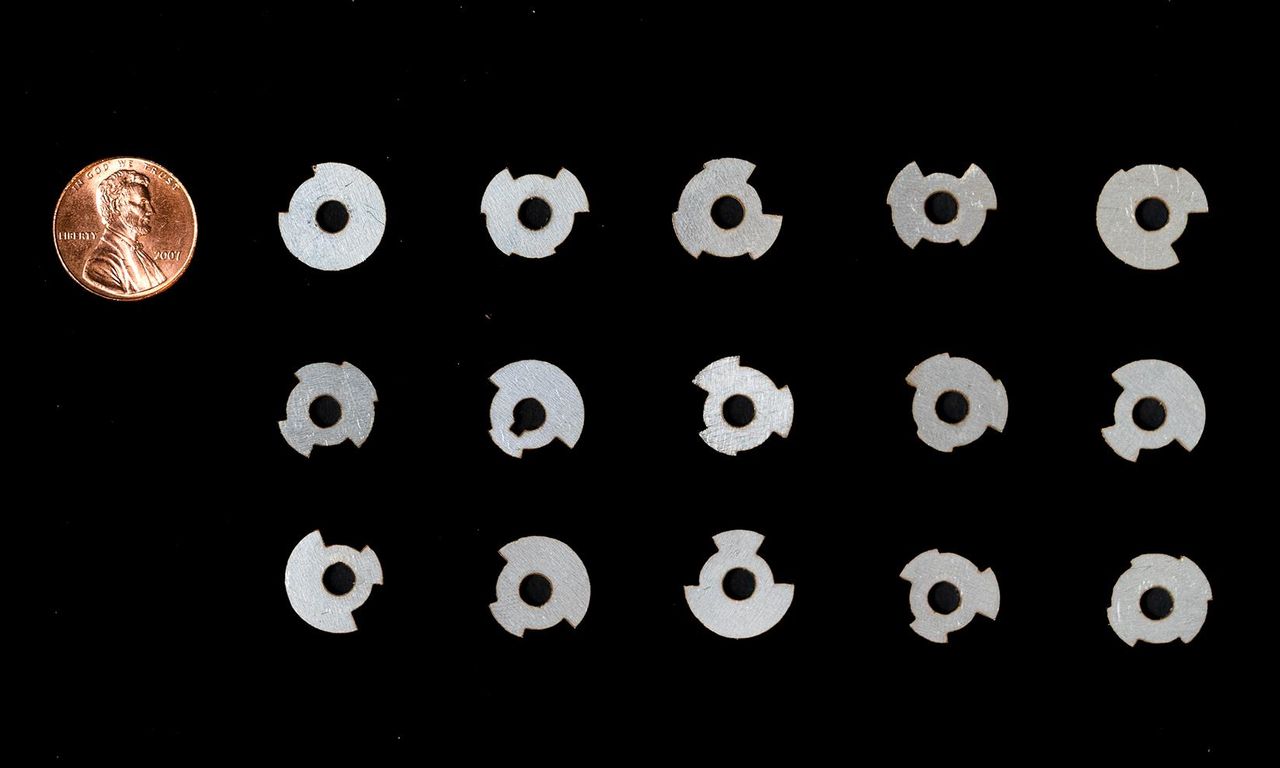
Shape plays a key role in how the tags work, since different cutouts along the metal edge produce different ultrasonic frequencies.

Each frequency acts like a unique identifier, allowing a lot of tags to operate in the same area without problems.

“Those unique fingerprints can be used for smart home sensing, or what we call ‘activity recognition,’” said Yibo Fu, a robotics Ph.D. student who led development of the tags.

Possible uses range from tracking cabinet access to monitoring water use or counting exercise repetitions. Fu suggested tags attached to toilet lids or faucets could help caregivers monitor daily routines for elderly relatives without installing complex hardware.

Interest in the concept grew after Fu shared a video on Instagram (which you can watch below) that went viral with over 2 million views.

“There are some pretty interesting comments from people in other fields,” Fu said. “One mentioned using the tags in archiving systems where you have huge shelves and libraries of boxes. When you remove a box or store a new box, there's a rapid motion, and you would trigger the tags and know exactly what thing you just opened, closed, or archived.”

“Someone else mentioned tracking locations for thousands of garbage and recycling bins in waste management systems.”

Engineers also built simulation tools to design disks that produce specific ultrasonic tones when struck.

Early modeling identified roughly 1,300 workable designs, and testing used 15 of them to confirm performance.

Ultrasonic signals also stay localized, which limits how far the sound travels. Nearby microphones detect activity, while distant devices remain unaware, helping keep the system private and focused on specific areas.

A post shared by -1Pt (@yibob_fu)

A photo posted by on

Sign up to read this article
Read news from 100's of titles, curated specifically for you.
Already a member? Sign in here
Related Stories
Top stories on inkl right now
One subscription that gives you access to news from hundreds of sites
Already a member? Sign in here
Our Picks
Fourteen days free
Download the app
One app. One membership.
100+ trusted global sources.