
Get all your news in one place.
100's of premium titles.
One app.
Start reading
Digital Camera World
Alistair Charlton

Baseus PrimeTrip VD1 Pro review – could this solar-powered dash cam be a game changer?

Baseus PrimeTrip VD1 Pro dash cam.

Until now, almost all dash cams with a parking mode have required a more involved installation than simply being stuck to the windshield and connected to a power socket. These modes, which wake the dash cam up when a collision is detected while your car is parked and switched off, usually draw power from your vehicle’s fuse box or, more recently, from the OBDII port. Either way, that requires running a cable and, in the case of the former, often a professional installation.

This dash cam hopes to change all that with the simple addition of a solar panel. It’s called the Baseus PrimeTrip VD1 Pro, and it has a parking mode that works just like any other – but, crucially, it doesn’t require power from the fuse box or OBDII port.

It isn’t entirely solar-powered, despite Baseus misleadingly describing it as featuring a “solar panel for cable-free use,” since it still connects to your vehicle’s 12-volt socket or compatible USB port in the normal way. But what it does offer is parking protection without the faff. It also boasts 4K video, a compact design, Wi-Fi 6 with 5GHz video transfer speeds, a rear camera recording at 1080p, and strong night vision thanks to its Sony Starvis sensor.

It sounds great on paper, but does it work in the real world? I’ve had the VD1 installed in my car for a couple of months now, so read on to find out.

Baseus PrimeTrip VD1 Pro: Specifications

(Image credit: Alistair Charlton)

Resolution

4K (front), 1080p (rear)

Frame rate

30 fps

Field-of-view

140 degrees (front), 120 degrees (rear)

HDR

Yes

WiFi

Yes, 5GHz Wi-Fi 6

GPS

Yes

Display

Yes, 1.4 inches

Battery

Yes, for parking mode

Parking mode

Yes, solar-powered

Baseus PrimeTrip VD1 Pro: Price

At the time of writing, the VD1 is available from Baseus’ US website for $109.99, which is a percent reduction from the usual price of $179.99. It is currently unavailable from Amazon in the UK, but can be bought elsewhere, such as AliExpress - but prices fluctuate significantly from around £90 to £190. European pricing is from €169.99.

Unusually these days - but very welcome - is how the VD1 comes with a microSD card in the box. The sample reviewed here came with a 64GB card, while a 32GB card is included from Baseus’ US website.

Baseus PrimeTrip VD1 Pro: Design & Handling

(Image credit: Alistair Charlton)

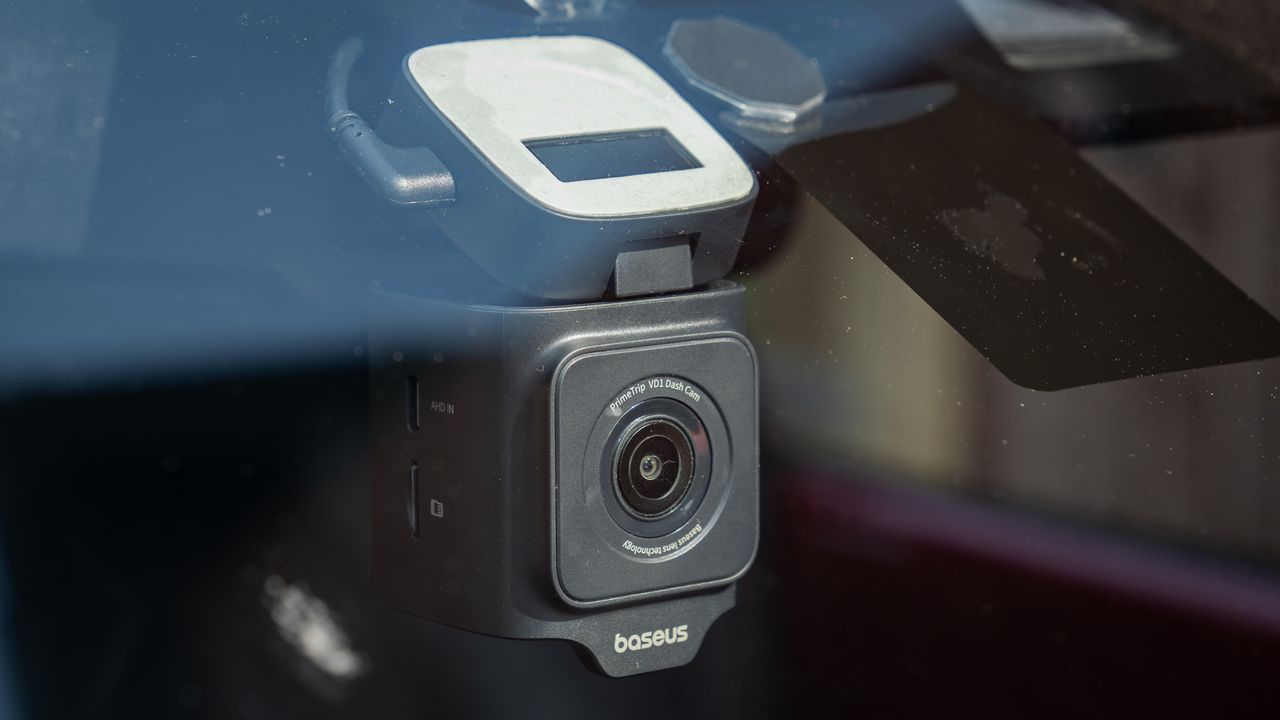
The VD1 is impressively compact and, unlike most other dash cams, almost cuboid in shape. Excluding the windshield mount, the main unit is a cube measuring approximately 50mm across every surface; it attaches to the windscreen with an adhesive pad attached to the top-mounted solar panel housing. This then pivots to allow for vertical adjustment, and rotates by 15 degrees in each direction to adjust the camera’s view left and right.

Even in my small car (and its even smaller windshield), I found the VD1 to be one of the less invasive dash cams I’ve tested. It practically disappears from your peripheral view while driving.

There are buttons for navigating through the simple menu system, plus a pair underneath the unit for power/resetting and controlling the Wi-Fi connection; that’s used in conjunction with the Baseus smartphone app, and is how recordings are transferred from the dash cam to your phone. Alternatively, you can take out the microSF card to transfer videos manually, or plug it into your computer with a USB-C cable.

My review kit included a rear camera that connects to the side of the main unit with a long cable, and this also fires into life when a collision is detected while parked. Baseus includes a sheet of static cling film in the box, which makes it easier to fix and remove the VD1 from your car or switch it between multiple vehicles.

Overall, it feels like a high-quality piece of hardware that is pleasantly compact and nicely designed.

Baseus PrimeTrip VD1 Pro: Performance

(Image credit: Alistair Charlton)

Although the VD1’s Sony Starvis imaging sensor doesn’t technically record natively 4K, since it’s a 5MP sensor and not 8.3MP – a marketing sleight of hand played by a lot of dash cam companies – the footage is upscaled to 4K resolution and looks very good indeed.

As you can see from my sample recordings below, footage captured during daylight is particularly sharp. There’s plenty of detail, like road markings and license plates of other vehicles, while exposure levels are handled very well. It’s also relatively smooth – as far as dash cam footage needs to be, at least – and the 140-degree lens, while not the widest, does a perfectly decent job of capturing a good view of the road ahead.

Quality takes a dip after sunset, but that’s to be expected from any camera, let alone a dash cam. While license plate details are mostly lost, the VD1 continues to impress with practically zero grain, and road signs remain legible. Visibility fell during nighttime rainfall, and when driving on unlit roads after dark, but that’s to be expected. The fact remains that, had I been in an accident, evidence would have been captured in adequate detail.

(Image credit: Alistair Charlton)

The rear camera, while small and with unlimited vertical adjustability, isn’t as good as it should be. It only records at 1080p (Full HD), which is towards the lower end of what’s expected from dash cams in 2026.

Now, to the solar-powered parking mode. Is this a dash cam game changer? It would have been a couple of years ago, before models from Nextbase, BlackVue, Thinkware and Viofo started drawing power from the OBDII socket, even while parked. Baseus still deserves credit for its solar-powered approach, since this enables parking protection from a dash cam powered from the 12-volt socket in a more conventional way – and side-steps the hassle, and extra installation costs, or tapping into the fuse box.

Make no mistake – the solar panel is about the size of those found on pocket calculators, and can’t actually power the dash cam during normal use. Instead, it acts as a trickle charger, topping up the integrated lithium battery with enough juice so it can fire up and record some video when a collision is detected.

Baseus says the VD1 can record up to 20 incidents (producing 40 video clips if the rear camera is also connected), each 30 seconds long. It also says the dash cam can stay in a sleep state for up to 14 days at a time before the battery is fully depleted. In my testing, I found it woke up quickly from this sleep state and began recording in just a couple of seconds – so if someone hit your parked car, it’d likely capture footage from right after the collision was detected.

This is all exactly like the parking mode of other dash cams, but here the VD1 is using its own battery – topped up a little by the solar panel – instead of drawing power from your car’s battery via the fuse box or OBDII port.

Naturally, the solar panel is of no use if you park in a garage or shaded area, and will likely work less well during cloudy and overcast weather. While driving, the VD1’s battery is charged from its connection to your car’s 12-volt socket.

Lastly, the Baseus smartphone app is fine but nothing to write home about. Despite boasting Wi-Fi 6, video transfer speeds are unremarkable, with a three-minute clip (measuring 600MB) taking about the same amount of time to land on my iPhone. The app is handy for adjusting settings – and, bizarrely, parking protection is switched off by default – but ultimately it’s an app that your phone will automatically delete due to lack of use.

Baseus PrimeTrip VD1 Pro: Video

Above: some sample video clips shot using the Baseus dash cam during the day and night

Baseus PrimeTrip VD1 Pro: Verdict

(Image credit: Alistair Charlton)

The Baseus VD1 isn’t quite the groundbreaking new dash cam I thought it might have been. But don’t let that put you off, because even if the solar panel is a bit of a gimmick – and other dash cams neatly get around the power issue via the OBDII port – it still performs well. Footage from the front-facing camera is especially good during both day and night, thanks to that Sony Starvis sensor, and the VD1 is pleasingly compact. I wish the rear camera recorded at 2K instead of just 1080p, but at least it’s included as standard and takes up very little space. Despite the eye-catching solar panel, the biggest feature here is the VD1’s battery. Very few dash cams have an internal power source, but here is an example that proves precisely why they should. It unlocks parking protection with zero effort, meaning you’re more likely to have a recording of the aftermath of any incident.

Features

★★★☆☆

Its solar panel might sound interesting, but the more significant feature of the PrimeTrip VD1 Pro is its battery. Solar energy acts as a handy trickle charger to keep it topped up, but it’s the battery itself that enables a parking mode with no hardwiring required.

Design

★★★★☆

The VD1 Pro is a fairly compact dash cam, which when installed next to your vehicle’s central mirror is barely visible while driving. It also manages to house a small screen giving quick access to recordings and settings menus – and of course the solar panel, too, which fits neatly in the windshield mount.

Performance

★★★★½

All dash cams with this Sony Starvis imaging sensor perform well, so it’s no surprise that the VD1 Pro shoots excellent, detailed footage. It isn’t true 4K, but a lot of other dash cam makers use the same sleight of hand and, either way, the recording quality speaks for itself. The all-important parking mode works well too, with the dash cam quickly firing up using its internal battery to record the aftermath of a parking bump.

Value

★★★★★

The VD1 Pro’s regular US price of $180 feels about right considering the design, features and performance. But at $110, which I saw while writing this review, it’s genuinely good value – just so long as your car sees enough sunlight to keep the battery topped up between drives.

Alternatives

Also check out our guide the best front and rear dashcams

Sign up to read this article
Read news from 100's of titles, curated specifically for you.
Already a member? Sign in here
Related Stories
Top stories on inkl right now
One subscription that gives you access to news from hundreds of sites
Already a member? Sign in here
Our Picks
Fourteen days free
Download the app
One app. One membership.
100+ trusted global sources.