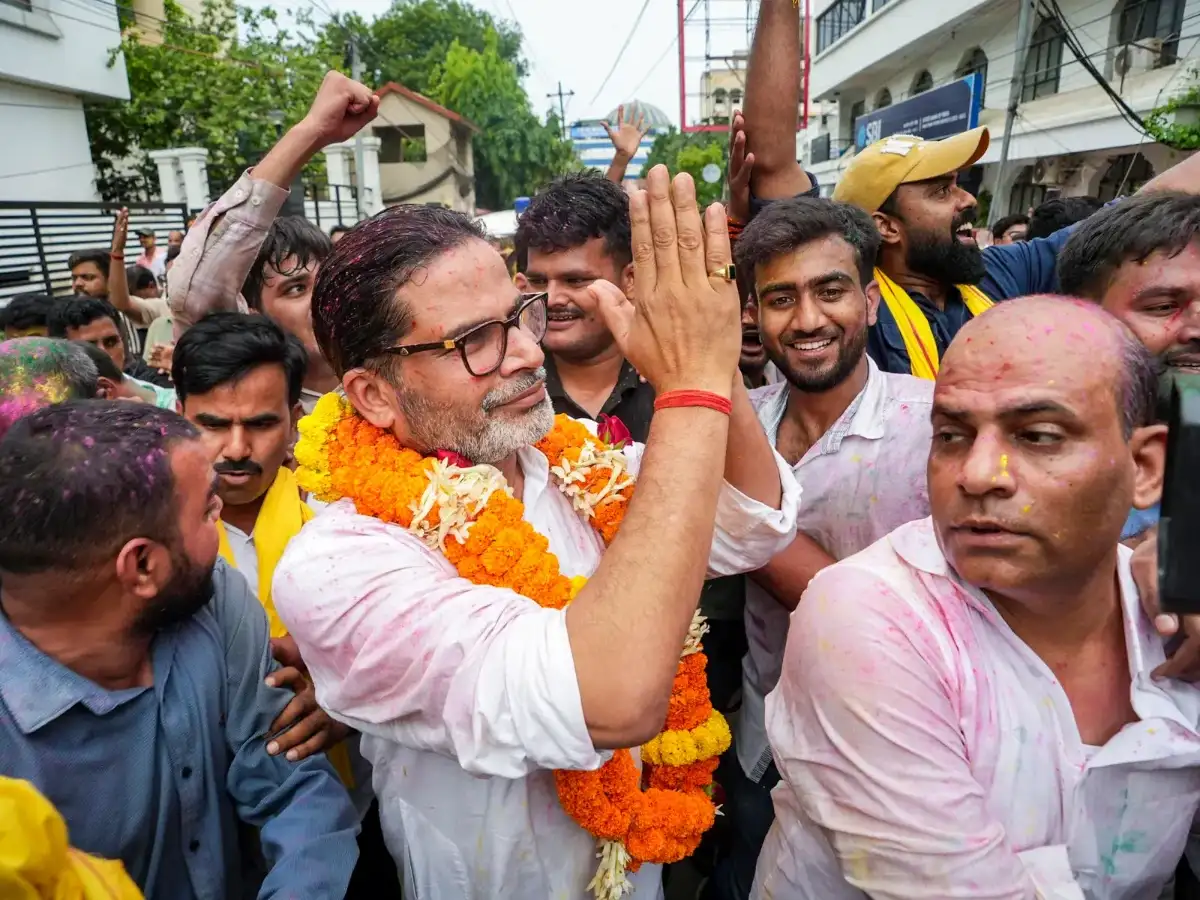
For more than a decade, Prashant Kishor occupied a peculiar place in Indian politics. He was often the man behind the curtain, the backroom strategist who shaped campaigns, decoded voters and helped leaders win power, yet remained unelected himself. His name became a political brand long before he ever appeared on a ballot paper. That paradox has ended in Bankipur today.
By winning the Bankipur Assembly byelection in Patna, Kishor has delivered the first electoral victory of his own political career and the first-ever legislative seat for his Jan Suraaj Party (JSP). The symbolism is impossible to miss because Bankipur was not just another constituency. It was a BJP bastion represented for years by BJP national president Nitin Nabin and his family. Kishor's victory over the ruling party in the capital city of a BJP-ruled state has given him something that all his celebrated campaign victories never could -- a democratic legitimacy of his own. The strategist who once helped others write their success stories has finally authored one for himself.
Also Read: Prashant Kishor secures maiden electoral win with commanding lead in BJP bastion Bankipur
Before politics, public health
Long before television studios turned him into a political celebrity, Prashant Kishor was a public health professional. Trained in public health and associated with United Nations-linked health programmes, he spent years working on development and policy issues. Friends and former colleagues who encountered him during that phase often described him as data-driven, restless and unusually interested in governance.
That background mattered because it shaped the way he would later approach elections. Unlike traditional political operatives who emerged from party structures, Kishor entered politics through research, field surveys and behavioural analysis. He viewed voters not merely as caste blocs or ideological camps but as citizens responding to incentives, aspirations and administrative performance. When Indian politics began embracing professional campaign management, he was perfectly positioned to ride the wave.
The Modi years and the birth of a strategist
Kishor first entered the national spotlight during Narendra Modi's prime ministerial campaign for the 2014 Lok Sabha election. Working through Citizens for Accountable Governance (CAG), he helped create a campaign machinery that was more sophisticated than anything Indian politics had previously seen. The famous "Chai Pe Charcha" outreach programme, extensive voter data analysis and highly targeted messaging became associated with a new style of campaigning. It was a moment when politics began borrowing heavily from marketing, technology and corporate management.
Also Read: Prashant Kishor in the house! Strategist's big political gamble may finally be paying off
The BJP's sweeping victory transformed Modi into a national phenomenon. It also transformed Kishor into the most sought-after election strategist in the country. Yet there was a contradiction embedded in that success. Kishor was becoming famous without having the favour of voters. He was acquiring influence without possessing a political base. His power depended entirely on his clients. That limitation would define the next stage of his career.
The consultant everyone liked to hire
After parting ways with the BJP ecosystem, Kishor built the Indian Political Action Committee, or I-PAC, and reinvented himself as an election consultant. What followed was one of the most remarkable runs in contemporary Indian politics. He worked with Nitish Kumar in Bihar. He helped shape Amarinder Singh's campaign in Punjab. He joined forces with the Trinamool Congress during Mamata Banerjee's fierce battle against the BJP in West Bengal. He later advised parties across the ideological spectrum. Supporters saw proof of extraordinary political skill while critics saw a businessman selling campaign expertise to whichever party hired him.
Both assessments contained some truth. By the end of the 2010s, Kishor had become perhaps the only strategist who had worked with leaders as different as Narendra Modi, Nitish Kumar, Mamata Banerjee, Jagan Mohan Reddy and others. Few people in Indian politics had studied electoral behaviour across so many states from such close quarters. He accumulated knowledge, networks and credibility, but what he did not accumulate was a mass political constituency of his own.
The Nitish Kumar detour
The first serious attempt to cross from consultancy into politics came through Nitish Kumar. Kishor joined the Janata Dal (United) and was elevated rapidly within the party. For a brief period, it appeared he might evolve into a major organisational figure in Bihar politics. Instead, the experiment collapsed. Differences over his opposition to the CAA and other political disagreements led to a public rupture. Kishor's expulsion from JD(U) was significant because it stripped away any illusion that he could simply inherit a political platform through proximity to established leaders.
The episode also revealed something about his personality. He was willing to challenge allies publicly, even at the cost of organisational comfort. That tendency would later become central to his political identity.