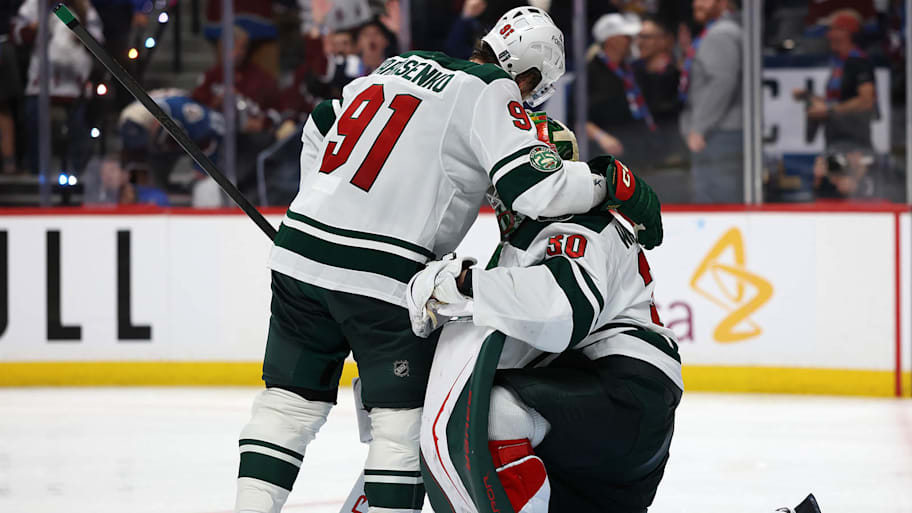
The Minnesota Wild have nobody but themselves to blame for how their season ended Wednesday night.
In a stunning collapse that is all-too-familiar over the franchise’s 25-year history, the Wild, trailing 3–1 in the series, jumped out to a 3–0 lead in Game 5 at Ball Arena. They had another first-period goal taken off the scoreboard once it was ruled it bounced off Michael McCarron’s hand into the net. Regardless, it appeared the rout was on and the highly entertaining series would see a Game 6 in St. Paul on Friday night.

The Avs, however, had other ideas.
Colorado scored its first goal in the second period and added two in the third—including one from Nathan MacKinnon on a nearly impossible angle. Brett Kulak scored the game-winner less than four minutes into overtime to send Colorado to the conference finals and Minnesota packing. According to Opta Stats, the Wild became the first team in NHL playoff history to have a three-goal lead after the first period but then have fewer than 10 shots on goal the rest of the game and lose.
There’s no excuse for allowing the Avs to come back. But as they clean out their locker room and head into the offseason, the Wild certainly weren’t helped out by the NHL’s playoff format that is becoming more and more of an issue.
As Sports Illustrated’s Karl Rasmussen pointed out last month, the NHL’s current playoff format is a problem and it needs to change. The way the 2026 postseason bracket has unfolded so far is only proving Mr. Rasmussen even more correct.
As a quick refresher, how it works: Each of the four NHL divisions (Atlantic, Metropolitan, Central, Pacific) send their top three teams to the playoffs. The final two playoff seeds in each conference are then decided by the top two remaining teams in the East and West.
In the opening round, the top seed in each division faces one of the wild cards, and the No. 2 and No. 3 seeds in each division battle it out regardless of how they stack up to the rest of the conference.
No team had worse luck than the Wild in the way the playoff bracket lined up. After finishing the regular season with 104 points—the third-most in the Western Conference—Minnesota was treated to a matchup against the rival Stars, who tallied the second-most points in the West (112). And after taking down Dallas in six games, the Wild earned a second-round matchup against the Avs, the best team in hockey.
In most other playoff formats around the world, the Wild would’ve matched up against the team with the sixth-best record in the West, the Utah Mammoth. Then in the second round, Minnesota would’ve faced the winner of the series between the No. 2 Stars and No. 7 Ducks. Assuming the Avalanche would cruise through the first two rounds of this alternate-universe bracket, the Wild-Avs series that packed a ton of star power and averaged 8.4 goals per game would be featured in the conference finals—a stage it truly deserved.
On the flip side over in the East, the Hurricanes have benefitted too much from the NHL’s odd playoff format. Carolina, after earning the top seed in the conference with 113 points, easily swept the Ottawa Senators in the first round. But instead of facing the No. 4 or No. 5 overall seed in the East like in our alternate-universe bracket, the Hurricanes were gifted a second-round matchup against the Flyers, who would’ve been the No. 8 seed in the East in a normal playoff format.
Sure enough, the Hurricanes took care of business by sweeping Philadelphia. They roll into the Eastern Conference finals with an 8–0 record, not having played a single game against a team who notched over 100 points in the regular season.
While the playoff format remains a big issue among NHL teams and fans, commissioner Gary Bettman doesn’t appear motivated to do anything about it.
"More than comfortable [with it]," Bettman said of the playoff format back in March. "It gives us a sensational first round. Probably the best playoff first round in any sport. We get more games and longer series as a result of the format.
"And you can always pick at certain situations in any given year and say, 'Well, I'd like it to be different that year.' But if you look at the body of work that our playoffs represent over time, what we have now works extraordinarily well."
The NHL does have a great first round. But its current playoff format robs the league of the best possible matchups when the games begin to stand alone each night in the conference finals and beyond.
No need to turn back the clock—here’s how to make the NHL’s playoff format even better
Even though it doesn’t appear the NHL will be changing the format any time soon, they should. And while returning to the classic No. 1 through No. 8 conference-wide seeding would be an improvement, the NHL should take notes from the PWHL.
In the PWHL’s Walter Cup playoffs—which are ongoing right now, by the way—four of the league’s eight teams advance to the postseason. But instead of the typical No. 1 vs. No. 4 and No. 2 vs. No. 3 matchups, there’s a fun twist—the No. 1 seed gets to select its first-round opponent.
This year, the No. 1 seed Montreal Victoire chose to face Minnesota in the opening round—a bit of a surprise because the Frost are the PWHL’s back-to-back reigning champions and logged the third-most points during the regular season. But it worked. Montreal defeated Minnesota in the five-game series and earned a matchup in the Walter Cup Finals against Ottawa—who tallied the fourth-most points in the PWHL this season and would’ve been the Victoire’s first-round opponent without the playoff draft.
Imagine this format in the NHL. Right after the regular season ends, the league would get to air a playoff draft where the No. 1, No. 2 and No. 3 seeds in each conference get to select the team it wants to match up against in the first round.
One of Bettman’s biggest arguments in maintaining the current playoff format is that he believes it builds divisional rivalries. That may be true, but imagine the bulletin board material in the locker room of a team that finished fifth in the standings who was selected as the No. 1 seed’s first-round opponent.
Now that’s how you punch up rivalries.
More from Sports Illustrated
- Photos Leaked of Tiger Woods’s Return to U.S. After Treatment in Switzerland
- Brooks Koepka Is in ‘Own Little World’ While Rounding Into Form After LIV Golf Departure
- Inside Garrick Higgo’s Bizarre Penalty at PGA Championship: ‘I Wasn’t That Late’
- Rory McIlroy Had One Word to Describe Abysmal Opening Round at PGA Championship
- Chris Mannix: There’s Only One Decision for LeBron James
This article was originally published on www.si.com as Avs Eliminating Wild This Early Is More Proof the NHL’s Playoff Format Needs to Change.