Get all your news in one place.
100’s of premium titles.
One app.
Start reading
AAP
AAP
Jennifer Dudley-Nicholson and Dominic Giannini

Australian social media ban both a success and failure

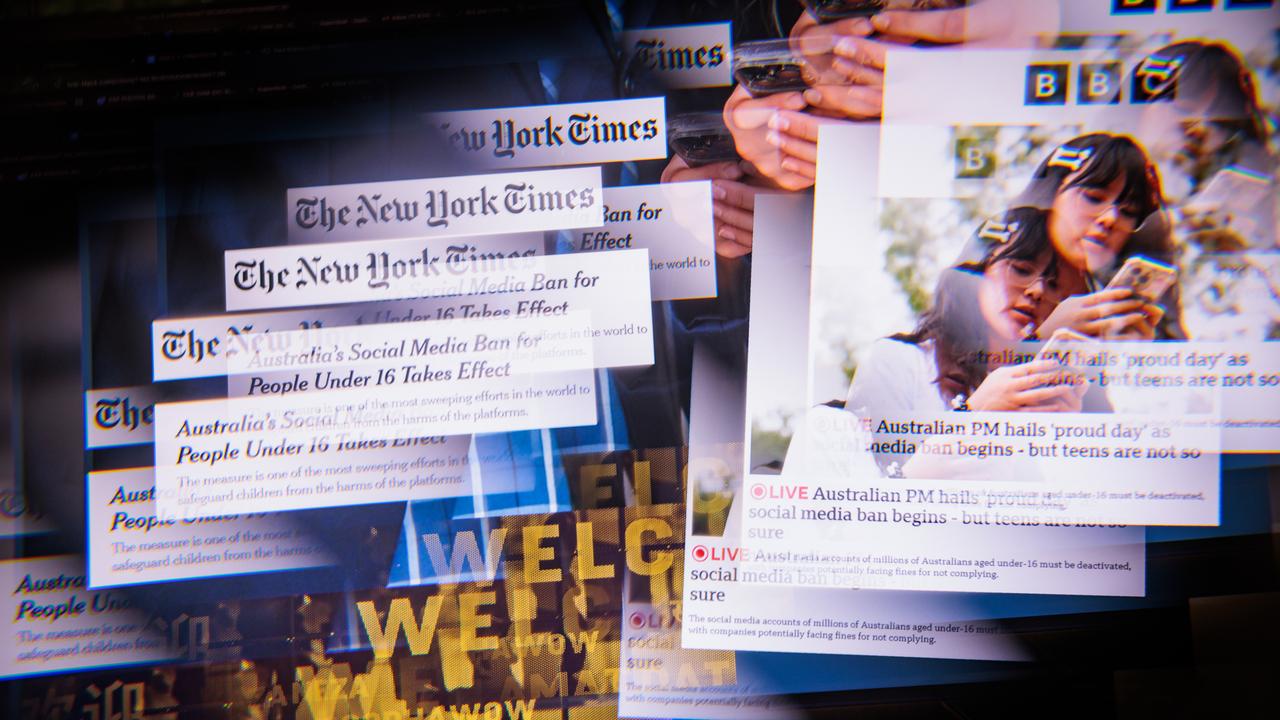
While gaining global traction, Australia's social media ban might not be ideal in addressing harm. (Nadir Kinani/AAP PHOTOS)

When Spanish Prime Minister Pedro Sanchez revealed plans to ban children younger than 16 from social media, he did so based on a precedent set in Australia. 

His announcement at the World Governments Summit came two months after an Australian law directing tech giants including Google, Facebook and TikTok to take "reasonable steps" to prevent children from holding accounts on platforms. 

Other nations including the UK, Canada, Greece and New Zealand have signalled their intention to join the trend, while Spain and France will lead what Mr Sanchez called "a coalition of the digital willing" in Europe.

While having an impact around the world, though, Australia's initiative might not be an ideal example of how to comprehensively address online harm. 

Almost five million accounts held by underage users have been removed or restricted under the ban but experts say millions more remain untouched and many children are evading the restrictions. 

The law succeeds in some areas and fails in others, they say, and restrictions might need to be tweaked and boosted before they are used as an international example. 

Australia's Social Media Minimum Age restrictions came into effect on December 10 and require digital platforms to verify users' ages and lock accounts for those younger than 16. 

Ten digital platforms were asked to comply with the law, including Google's YouTube, Meta's Facebook, Instagram and Threads, as well as Snapchat, Reddit and TikTok.

Platforms that decline to comply face fines of up to $49.5 million. 

Early signs indicate the law has made an impact, with the office of eSafety Commissioner Julie Inman Grant revealing 4.7 million accounts were removed in the first half of December. 

Snapchat announced on February 2 that it had locked or disabled more than 415,000 Australian accounts in January and Roblox, which is not named under the law, revealed 60 per cent of its Australian daily active users had undertaken age checks.

Julie Inman Grant
eSafety Commissioner Julie Inman Grant's office is tracking the number of online accounts removed. (Dominic Giannini/AAP PHOTOS)

The eSafety Commission is actively monitoring progress, a spokesman says, and assessing the use of age-assurance technology and compliance with the rules. 

"Early actions taken by platforms, including the deactivation of millions of accounts, show that positive action is possible," the spokesman says. 

"The more challenging task is preventing recidivism and circumvention of platform systems, which is where sustained systems and effective processes matter most."

The commission will focus on fixing weaknesses in the ways companies enforce the law, the spokesman says, rather than simply issuing penalties.

"Where platforms are deliberately or repeatedly failing to meet their obligations, eSafety will take action," he says.

"At this early stage, it is too soon to draw firm conclusions about breaches."

The impact of the ban will be clearer after six months in operation, Swinburne University media senior lecturer Belinda Barnet says, but it has obviously not affected all underage users. 

About one in three children younger than 16 have had their accounts locked under the changes, she estimates, with no clear reason why some accounts have been removed while others remain active.

A teenager uses his mobile phone
Almost five million accounts held by underage users have been removed or restricted. (Dean Lewins/AAP PHOTOS)

"There are kids who seem to be under the umbrella of it and then others who get around it," Dr Barnet tells AAP. 

"To me, it seems to be making a difference but it's obviously not foolproof."

The ban has already encouraged some teens to swap social networks for messaging groups on platforms such as WhatsApp, Dr Barnet says, but more research will identify its results.

"There's part of me that is very skeptical the platforms have enough incentive to get rid of some of their own user base," she says.

"I'm worried that what they're doing is a token effort."

A different approach, such as one targeting hateful language and harassment, might have provided a better outcome, conservative federal MP Barnaby Joyce says.

It could also have locked down some of the loopholes children are using to dodge the ban. 

"Where we are at the moment, I have a six-year-old and a seven-year-old son and they manage to get around it," he says.

"So imagine teenagers are even more competent than them."

Barnaby Joyce (file)
Barnaby Joyce says an approach targeting hateful language and harassment might have worked better. (Mick Tsikas/AAP PHOTOS)

The outcome of Australia's attempt to address online risks is complicated, RMIT University information sciences professor Lisa Given says.

The ban has not removed all children younger than 16 from big social networks but that does not mean it has not enjoyed some success.

"If success means we have people talking about it, if success means we're attempting to do something to address harm on social media, then ... we've succeeded in that," she says.

"I don't feel it's been a success in terms of how it's been sold to parents or to the public."

Parents cannot abdicate their responsibilities as a result of this law, Prof Given says, and it does not address emerging risks such as disinformation from AI-generated content and chatbots. 

Some countries considering social media bans for children are using Australia's example, but taking a different approach.

In addition to age verification, the Spanish government will weigh up plans to criminalise the spread of disinformation on social networks and penalise platforms that profit from it. 

Laws being considered in Denmark will provide ways for parents to authorise their teens to access social media.

Online Safety Code' inquiry at Parliament House in Canberra
Despite exhaustive consideration, the ban has not removed all children from big social networks. (Lukas Coch/AAP PHOTOS)

The novel approaches could create a more comprehensive means of tackling the problem, Prof Given says, and keep more children safe.

"If they implement similar legislation and they haven't been paying close attention to the kinds of challenges that we've had, they could end up replicating that," she says.

"I would hope other countries learn from our mistakes."

Sign up to read this article
Read news from 100’s of titles, curated specifically for you.
Already a member? Sign in here
Related Stories
Top stories on inkl right now
One subscription that gives you access to news from hundreds of sites
Already a member? Sign in here
Our Picks
Fourteen days free
Download the app
One app. One membership.
100+ trusted global sources.