
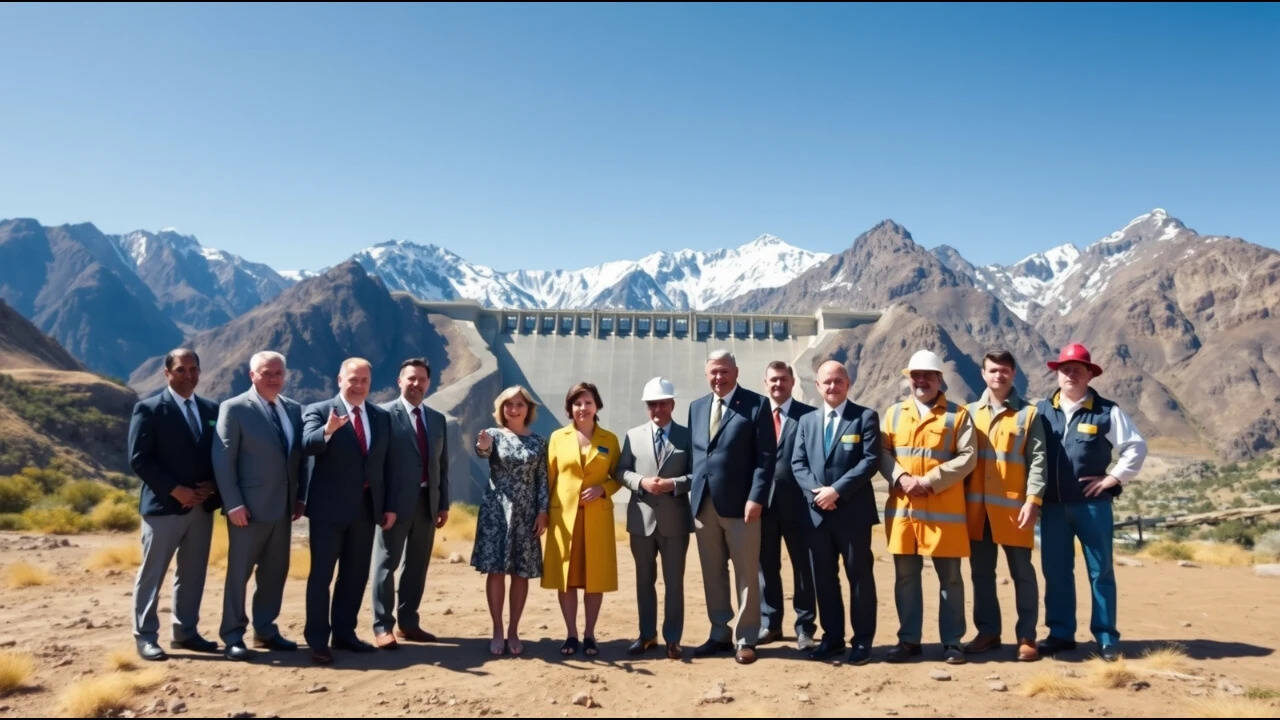
On 17 October 1949, Australia's governor-general, prime minister and the newly appointed head of the Snowy Mountains Hydro-electric Authority fired the first construction blast at Adaminaby, in the New South Wales high country, launching what would become the largest engineering project ever undertaken in Australia. The Snowy Mountains Scheme set out to do something that sounds almost implausible on paper: capture water from rivers flowing east off the Snowy Mountains toward the Pacific Ocean and redirect it inland instead, through a network of tunnels and dams, to generate hydroelectric power and irrigate the dry farmland of the Murray and Murrumbidgee river valleys. By the time construction officially finished in 1974, twenty-five years after that first blast, the completed scheme included 16 major dams, seven power stations and 145 kilometres of interconnected tunnels.
Get breaking news anytime, anywhere. Download the TOI app now!

What the Snowy Mountains Scheme was actually built to achieve
According to Snowy Hydro's own official history, the company that now operates the scheme, the project was designed to divert water that would otherwise flow naturally into the Tasman Sea, instead channelling it westward through tunnels cut beneath the Snowy Mountains into the Murray and Murrumbidgee river systems. This reversal of natural water flow allowed the scheme to serve two purposes simultaneously, generating hydroelectric power as water dropped through a series of underground and surface power stations, while also supplying additional irrigation water to farmland across inland New South Wales and Victoria.
According to the National Museum of Australia, the scheme was framed at the time as a genuinely national project, one prime minister Ben Chifley described as belonging to no single state or interest group but to the country as a whole, reflecting the scale of ambition behind an undertaking launched only a few years after the end of the Second World War.
How large the completed scheme actually was
Over the 25 years of construction, the completed Snowy Mountains Scheme grew to include seven power stations, 16 major dams, roughly 80 kilometres of aqueducts and 145 kilometres of interconnected tunnels, alongside 1,600 kilometres of new roads and railway tracks built specifically to support the remote, mountainous construction effort. According to Snowy Hydro, the total project cost was around 820 million Australian dollars by the time it was completed in 1974, a substantial sum for a country still rebuilding its economy in the postwar decades.
Remarkably, only around two per cent of the scheme's total infrastructure is visible above ground, according to the National Museum of Australia, since the vast majority of its tunnels, power stations and aqueducts were built underground or embedded directly into the mountainous terrain, a deliberate engineering choice suited to the scheme's rugged alpine setting.
Who actually built the Snowy Mountains Scheme
The scale of labour required to build the scheme was immense. According to the National Archives of Australia, more than 100,000 people worked on the project between 1949 and its official opening in 1972, with migrants from more than 30 countries making up roughly 65 per cent of the total workforce. Many of these workers had arrived in Australia after fleeing the devastation of postwar Europe, and Snowy Hydro notes that people who had previously fought on opposing sides during the war often found themselves working side by side on the same tunnels and dams, an unusual byproduct of the scheme's reliance on large-scale immigrant labour.
To house this enormous workforce in such a remote region, more than 100 temporary construction camps and seven purpose-built townships were established across the Snowy Mountains region over the course of the project, according to the National Museum of Australia.
Why the scheme required new engineering techniques
Because nothing on this scale had previously been attempted in Australia, engineers working on the Snowy Mountains Scheme had to develop new tunnelling, construction and electricity transmission methods as they went. According to the NSW Migration Heritage Centre, these innovations went on to influence tunnelling and construction practices well beyond Australia, while the project also helped establish new occupational health and safety standards for large-scale infrastructure work at a time when such standards were far less developed than they are today.
The scheme reached its full designed output capacity of 3,740 megawatts in 1974, and continues to supply an average of 2.36 million megalitres of water annually for irrigation and other purposes across the Murray and Murrumbidgee valleys.
Why the project remains both celebrated and contested
Despite its status as a landmark of Australian engineering, the Snowy Mountains Scheme has never been without controversy. According to the National Museum of Australia, permanently redirecting the natural flow of the Snowy River and other alpine waterways has raised long-running environmental concerns, particularly around reduced downstream flow rates and the broader ecological impact of rerouting entire river systems. Records from the National Archives of Australia also note that by the time construction began in 1949, the region's original Indigenous custodians, the Ngarigo, Walgalu and Southern Ngunnawal peoples, who had used the high country for generations, including seasonal gatherings tied to the annual bogong moth migration, had already been almost entirely dispossessed of the land the scheme was built on.
More than seventy years after the first blast at Adaminaby, the Snowy Mountains Scheme remains central to Australia's electricity and irrigation infrastructure, and its legacy now extends into a new chapter, Snowy 2.0, a major pumped hydro expansion announced in 2017 that links two of the original scheme's dams through 27 kilometres of new tunnels, intended to support Australia's transition toward renewable energy for decades to come.







