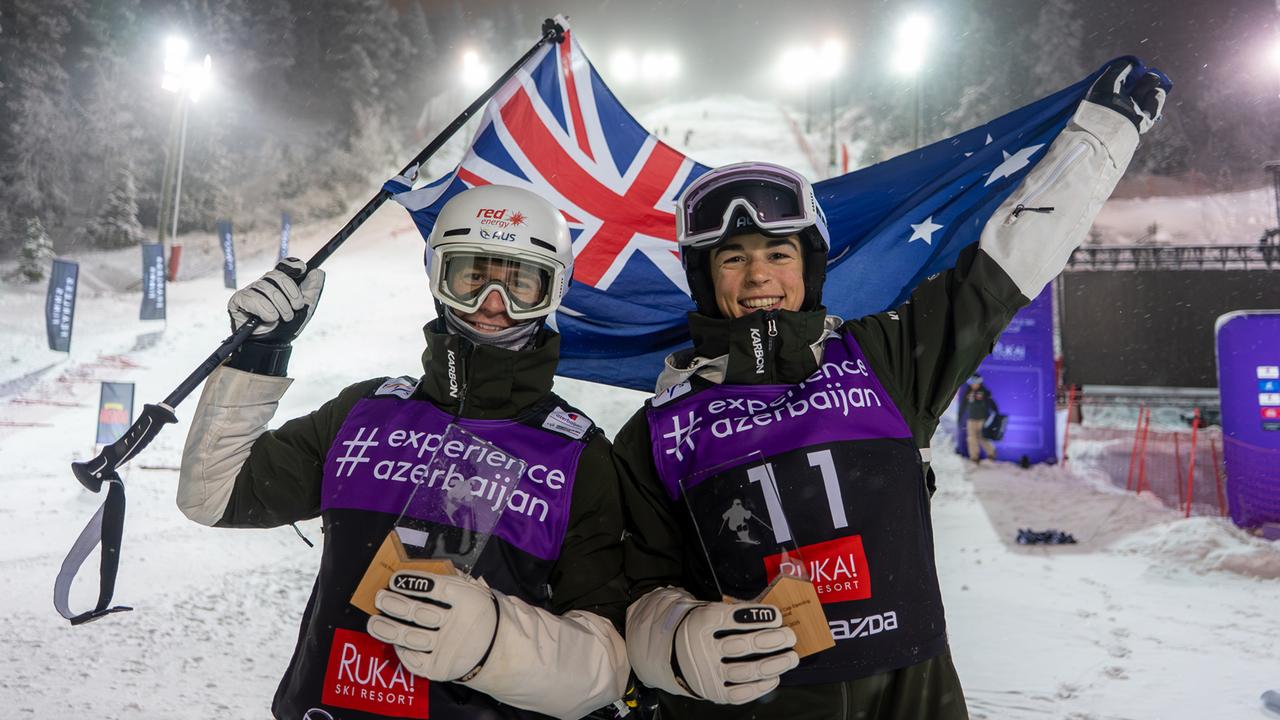
With World Cup podiums now more of a regular occurrence than rarity, Australia's winter athletes are primed for a record-breaking Olympic medal haul at the Milan-Cortina Games.
Spread across Italy, the 2026 Olympics start in a month's time, with Jakara Anthony looking to become the first Australian to win successive winter gold medals.

But the superstar mogul skier will be well supported, with recent performances suggesting Australia could top their previous best medal haul of four at Beijing 2022, including Anthony's gold.
Matt Graham, who won silver in 2018 but was impacted by injury in China, joined Anthony on top of the podium at last month's World Cup event in Finland.
A dual moguls event has also been added to the Olympic program, doubling medal chances, with rookie Charlotte Wilson taking gold at the Olympic test event last year.
Four-time world champion snowboarder Scotty James is hunting elusive gold to complete his Olympic medal collection while young gun Valentino Guseli showed he's also a halfpipe force, winning the most recent World Cup event in Calgary.
Guseli, 20, is attempting to become the first male snowboarder to enter three events at the Olympics.
Others to claim World Cup titles this season include bobsled ace Bree Walker and 15-year-old Indra Brown, who has stunningly won a medal, including gold, in all of her first three World Cup freeski halfpipe competitions.
Beijing slopestyle bronze medallist Tess Coady has made a successful return following shoulder surgery to claim a World Cup medal, as have snowboard cross stars Josie Baff and Adam Lambert.
Australia's aerial skiers, led by two-time world champion Laura Peel and Danielle Scott, are usually among the leading contenders.
Team chef de mission Alisa Camplin-Warner, who won aerial gold at the 2002 Games and bronze four years later, is reluctant to declare a medal target.
With the selection hopes of young skiers Abi Harrigan and Daisy Thomas dashed by serious knee injuries and former world No.1 curling duo Tahli Gill and Dean Hewitt suffering qualification heart-break, Camplin-Warner acknowledged there were no certainties.
"I am full of optimism but the reality of winter sport is, particularly with the outdoor nature and danger of the sport, is that in the lead-up to the Games and through the Games, anything can happen," she told AAP.
"So as much as I'm optimistic and hopeful for every single one of our athletes to have a successful Games campaign, I know that there will be ups and downs within the team and I'm just really hoping that the fragility of every dream can be protected.
"I'm really not at all looking at medals - my hope is that every member of the team can walk away satisfied."
While qualification will be finalised by World Cup events before the February 6 opening ceremony, Australia is set to send around 60 athletes, matching the largest ever team, which competed in Sochi 2014.
Almost 3000 athletes from more than 90 nations will compete in eight different locations, making this the most geographically widespread Winter Olympics ever.
As well as dual moguls, three other new events will also debut across existing sports - skeleton mixed team, luge women's doubles and women's large hill ski jumping.
A new sport on the schedule is ski mountaineering (ski mo) with three new events - men's sprint, women's sprint and mixed team relay.
Ticket sales have been sluggish, particularly among Italians, and the hosts have been in the firing line for slow construction of the sliding venue, main hockey arena and artificial snow production in Livigno, which will host freestyle skiing and snowboarding.
But with National Hockey League (NHL) players returning to the Games for the first time since 2014 and with the Olympic torch making its way to Milan, organisers are confident locals will embrace the event.
Camplin-Warner expected the Games to also resonate back in Australia.
"We're predominantly a summer sport nation," she said.
"But more and more our winter teams are, not only growing in size, but depth and breadth of sports that we're involved in and our competitiveness in those sports.
"We've built our performance results Games to Games in winter and so we like to think we're no longer the little brother or sister, we're no longer the alternate Games.
"We are recognised as equals, and we hope that the nation is just as proud of us and will look at the team in Milano in awe."