
Get all your news in one place.
100’s of premium titles.
One app.
Start reading
Space
Space
Science
Stefanie Waldek

Auroras on Jupiter's giant moon Ganymede look like Earth's northern lights, NASA spacecraft reveals

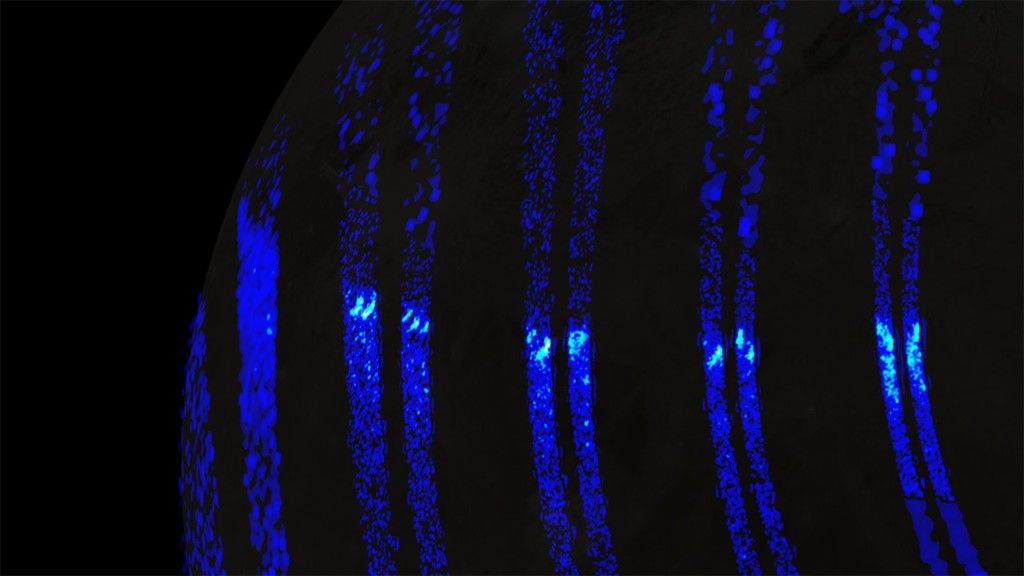
Blue stripe-like features shown in pairs going vertically against a black background.

A fleeting flyby of Ganymede has revealed that its shimmering auroras may behave far more like Earth's than scientists expected.

During a close pass on July 7, 2021, NASA's Juno spacecraft captured the most detailed ultraviolet views yet of a Jovian moon's glowing polar lights. The new analysis, completed by a team led by the Laboratory of Atmospheric and Planetary Physics (LPAP) at the the University of Liège, shows that Ganymede's auroras are not smooth, continuous ovals. Instead, they splinter into small, bright patches — structures that mirror features seen in Earth's own auroral displays.

"Similar structures, known as 'beads', have been observed in the auroras of Earth and Jupiter, where they are linked to sub-storms and dawn storms, large-scale rearrangements of the magnetosphere that release enormous amounts of energy and produce intense auroral activity," Alessandro Moirano, a postdoctoral researcher at LPAP, said in a statement.

While we know auroras aren't unique to Earth — they've been seen on Venus, Mars, Jupiter, Saturn and Uranus — Ganymede is the only moon we know of that has its own magnetic field, which is a crucial ingredient for auroras. On Earth, the aurora occurs when charged solar particles slam into the magnetosphere, which directs them toward the poles. These particles then interact with gases in the atmosphere and glow various colors, including green and red. On Ganymede, the auroras are produced via interactions with Jupiter's vast magnetosphere rather than the solar wind.

"Observations of Ganymede's auroras prior to Juno were limited by the spatial resolution of ground-based observations, and they could not resolve the small-scale structures typical of planetary auroras," said Philippe Gusbin, whose master's thesis inspired the study. Juno's ultraviolet spectrograph resolved details just a few kilometers across, revealing the "beads" in the aurora.

Because Juno's encounter with Ganymede lasted less than 15 minutes — and the spacecraft will not return — researchers cannot yet determine how often these "bead" features appear. That task may fall to JUICE, the European Space Agency mission en route to Jupiter, which is expected to begin extended studies of Ganymede after its arrival in 2031.

A study about these results was published on Jan. 6 in the journal Astronomy & Astrophysics.

Sign up to read this article
Read news from 100’s of titles, curated specifically for you.
Already a member? Sign in here
Related Stories
Top stories on inkl right now
Our Picks
Fourteen days free
Download the app
One app. One membership.
100+ trusted global sources.