
Get all your news in one place.
100's of premium titles.
One app.
Start reading
Louder
Louder
Entertainment
James Grimshaw

Audio-Technica AT-LP120XUSB review: Stunningly-priced direct drive stability from a quintessential brand

Audio-Technica AT-LP120XUSB - review.

Audio-Technica is a brand with fingers in many turntable pies; there’s an AT turntable for every scenario, from the baby’s-first-turntable simplicity of the automatic LP60XBT to the proud, portable and pretty weird SB727 Sound Burger. There’s a sturdy heavyweight player in the LP7X, and there’s this.

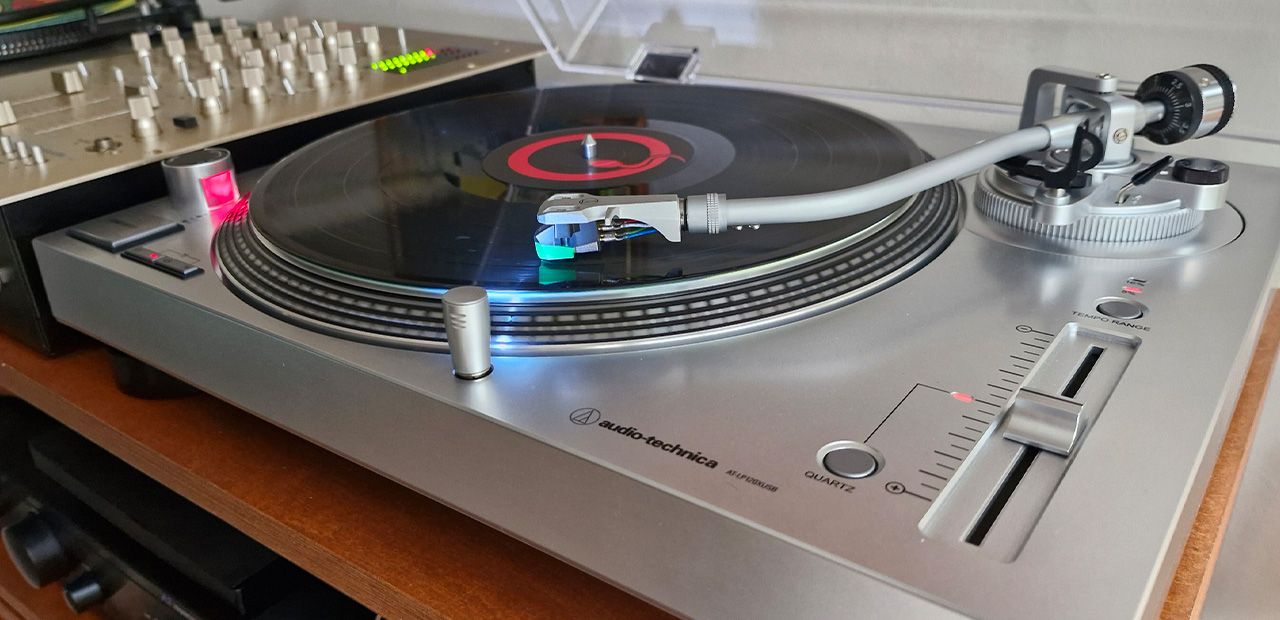
The Audio-Technica AT-LP120XUSB is, self-evidently, a DJ’s turntable. It takes very much after the industry-standard Technics 1210, right down to the tools-of-the-trade that make it a quintessential piece of gigging kit.

For the uninitiated, DJ-friendly ‘tables such as these are preferred for their direct drive motors, the higher torque of which gives better control of cueing and playing records in time with one another. It is into this pantheon that the AT-LP120XUSB very comfortably sits – and at a price far lower than many other such turntables.

But it’s not just an accessible entry-point record player for facilitating seamless 12-hour techno sets; it’s a workhorse player for the discerning vinyl accumulator, particularly if you like accumulating the Rarer Stuff. And in my opinion, it’s pretty great – barring one unfortunate discovery.

Features

(Image credit: Future/James Grimshaw)

So, what does the Audio-Technica AT-LP120XUSB itself actually offer? Beyond the ½” headshell, pre-configured with an Audio-Technica VM95E cartridge; beyond the respectively-adjustable counterweight and anti-skate mechanism, it has all the trappings of a workhorse DJ turntable, from the high-torque direct drive motor to the pitch control fader – the range of which can be toggled between +/-8% and +/-16%. There’s a quartz lock button, which enables you to disengage the pitch fader entirely and lock the motor’s speed to a precise 33 1/3, 45 or even 78 RPM.

There’s an optional LED post for illuminating where you place the needle, and it even has the stroboscopic dots around the outer rim, which work in tandem with an imperceptibly fast-flashing red LED to demonstrate the speed and stability of playback.

But why would you want any of this, as someone who isn’t a DJ? Sometimes it’s fun to play your records at odd speeds “just to see” – but for serious collectors of the older and odder records, fine pitch control can be extremely handy. Especially where wonky initial masters or slip-ups before the pressing plant make for screwed-up final products.

Besides which, the Audio-Technica AT-LP120XUSB has a toggleable built-in phono preamp, for beginner-friendly wired integration with pretty much any wired hi-fi destination. It also has quite a posh mod-con up its sleeve: a USB output for digital recording. Simply plug the provided USB cable into the turntable and your computer, and you can record the output from the turntable in your software of choice.

I tried it out with a copy of Plaid’s Peel Session 2 into digital audio workstation Reaper, and it was pretty much one-touch recording, with no need to manage levels or mess around with device recognition.

The outcome was, unfortunately, a little disappointing. There’s an ever-present, albeit quite quiet, high-pitched whine, which is all-too audible between tracks and in moments of quieter dynamics. I suspect it’s noise interference from some of the circuits that constitute the direct-drive element, but I’m guessing. At any rate, the noise isn’t there for regular playback – otherwise, this review would be taking an altogether different tone.

Design

(Image credit: Future/James Grimshaw)

It’s hard for me not to love the design of this thing – which, again, is extremely familiar. Some might not get on its size, nor with its unassumingly austere silver (or black) hue. I do, though; it’s reaching for being “professional piece of listening equipment”, over “bougie home accoutrement”. And I think it’s elegant, in its own way.

With such professional pieces of listening equipment, you can expect more tweakability than you might be accustomed to. counterweighted, ½-inch-headshell-ed turntables like this, there’s customarily a fair degree of calibration you need to engage in before you can play records as they’re meant to be heard: in short, the counterweight needs to be set for the ideal tracking force of the cartridge, the cartridge itself needs to line up with the groove, and anti-skate needs to be set to counteract the centrifugal force on the cart.

For more involved record players, some of these steps require tools – a tracking force scale, and an alignment protractor, at least. The counterweight screws onto the back, and has a detent you can feel as you screw it further in; I measured tracking force at this detent as 1.3g, which isn’t a useful weight for the VM95E cart’s recommended tracking force of 1.8-2.2g. You can approximate the 2g you need by getting the tonearm to balance on its pivot, setting the numbered dial to 0 then advancing to 2, but this isn’t as precise as using a scale. At least the cartridge is near-enough aligned out of the box, as verified by my own protractor measurements.

Of course, expecting a calibrated turntable out of the box is somewhat new – and if you’re considering getting something like this, you should also be considering getting to grips with how to do it yourself anyway. So, after all that, no complaints from me, barring – at a massive stretch – some potential missed opportunity for fuss-free beginner set-up.

From a practical-usage standpoint, there’s a lot of satisfaction to be gleaned from using the LP120XUSB. The RPM selector buttons are solid and resistive, and the start/stop button a springy, cathartic delight. The tonearm is in good hands with a responsive lift lever, though the lift itself isn’t as smooth as it might be on more expensive fare. The lights are bright, useful and pretty. I’m sometimes vapid about these things.

Sound

(Image credit: Future/James Grimshaw)

I hope you’ll understand what I mean when I say the Audio-Technica AT-LP120XUSB sounds solid. It’s an unflappable machine, with a sense of extreme sturdiness about it in both stability and sonic signature – hard to qualify in sensory terms, but I’ll certainly have a go in short order.

First, though, there’s an obvious sturdiness that comes from the mass of the thing. It’s not the heaviest record player ever, but it sits heavy enough on some clever, quintessential dampened feet. The result is a needle that simply won’t budge, even when I’m bashing around the room, or giving my aging DJ mixer some percussive maintenance on the same surface. It’s unshakeable, even with the needle set at quite a light tracking force. There is some remarkable steadiness to the speed of playback, too, thanks to that quartz-controlled speed regulator.

As for the sound: there really shouldn’t be anything especially special here. It’s an AT-VM95E cartridge, the new normal for leg-up-but-still-budget turntable cartridges – and an optional built-in phono preamp (which, historically and with other brands of budget turntable, aren’t ever much to write home about). This built-in preamp can be contentious, sound-wise, too.

And yet. That unshakeability feels part of the LP120XUSB’s DNA, through a robust representation of pretty much everything in glorious and hugely-present sonic technicolour. Even with the preamp: here, and for a cheaper turntable, I’m all for it.

Queens Of The Stone Age’s Songs For The Deaf is a go-to tester record for me, and in this case a great demonstration of the record player’s capabilities with low-end information often rendered muddily elsewhere, and high-end information often robbed of glassy urgency elsewhere. First It Giveth was rock-solid and rich; A Song For The Dead was dense, rollicking and never without its manic energy.

For something with a little more sonic range, I tried Slift’s irrepressible space-rock breakout Ummon. The title track was a bright, furious presence in the room, searing electric guitars handled firmly but fairly; rich without being overbearing. Hyperion’s punchy snares can be felt from across the room, and the chest-voice vocals have all the stature they need.

As with anything, there’s room for improvement – but those improvements are pretty much entirely couched in your choice of stylus (be it a level-up stylus for the VM95 cart, or a new cart altogether for the ½” headshell) or new phono stage. Were it not for the slightly whine-y USB output, this would be a five-star review – and even with it, this is a no-brainer direct-drive turntable for the price.

Alternatives

There aren’t many real competitors for a decent direct drive turntable at this price point – apart from a few which clearly borrow the same essential OEM architecture. Chief among these is the Reloop RP-2000 USB, which has similar specs and a similar price point; it’s only missing a 16% pitch range setting and a 78 RPM option.

If direct drive isn’t a necessity for you, you could save a bit of money and plump for Audio-Technica’s own AT-LP60XUSB; a much simpler automatic turntable with a USB recorder built-in.

Latest updates

Sign up to read this article
Read news from 100's of titles, curated specifically for you.
Already a member? Sign in here
Related Stories
Top stories on inkl right now
One subscription that gives you access to news from hundreds of sites
Already a member? Sign in here
Our Picks
Fourteen days free
Download the app
One app. One membership.
100+ trusted global sources.