
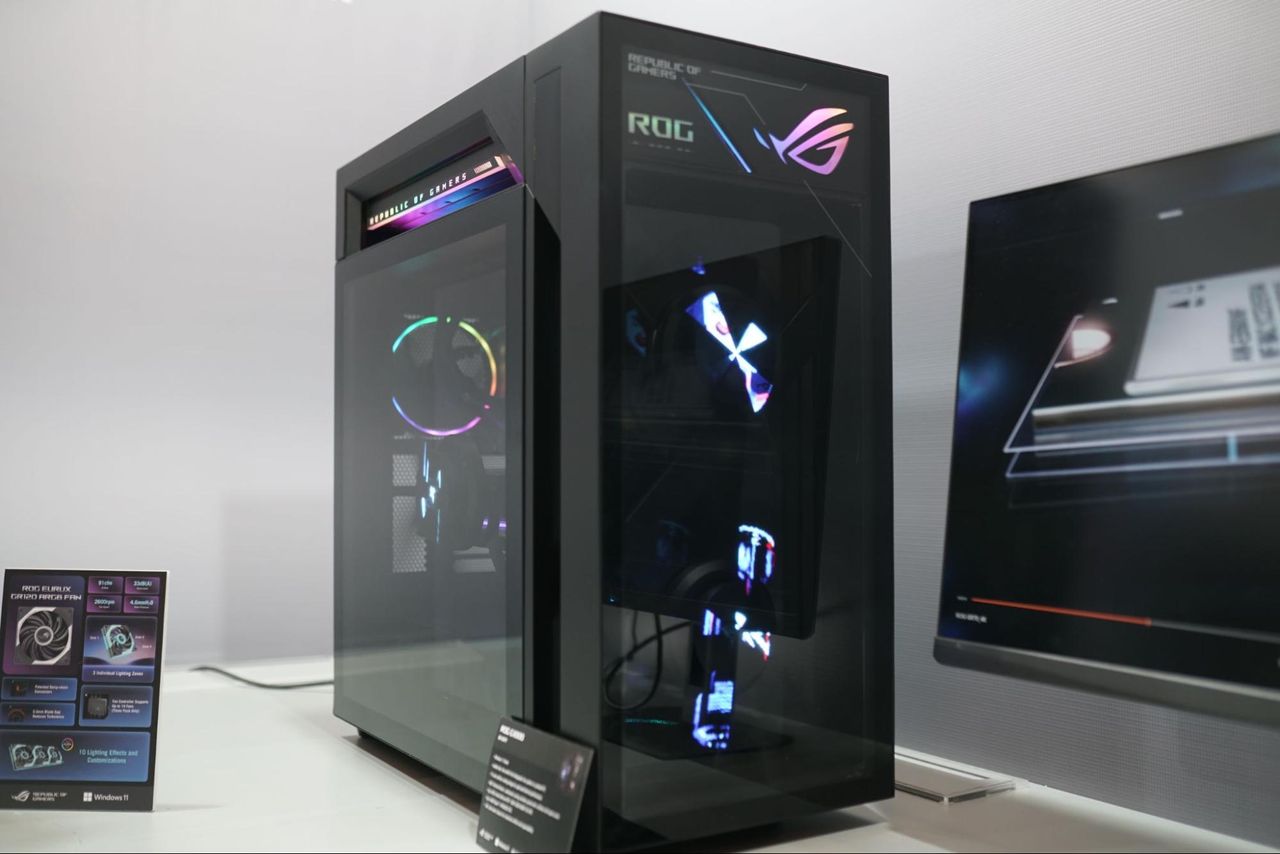
Without any new GPUs, gaming systems haven't been all the rage at CES. But Asus does have a new desktop that might be one of the most ostentatious showings in Las Vegas, and that's saying something.
Asus claims that the ROG G1000 is "built to be seen," which makes sense because the first things you're going to notice are the holograms. There are holograms both on the glass side panel of the massive 104-liter case as well as on the front of the intake fans.

The side panel's lighting is controlled by an additional 380 mm fan with 680 LEDs, while the front fans use two sets of 215 mm fans with 384 LEDs. There are three display modes that are customizable in Armoury Create (supporting MP4, PNG, JPG, and GIF files). In fact, there's even an "Anime Holo" button on the top of the case, next to the fan control to turn the lights on and off. If nothing else, they've dedicated a whole button to this.
The system isn't just about the lights, though. Asus is bulking this system up with top-end components, going up to a Ryzen 9 9950X3D and Nvidia GeForce RTX 5090.
Asus ROG G1000 |
|
Processor |
Up to AMD Ryzen 9 9950X3D |
Graphics |
Up to ROG Astral GeForce RTX 5090 (32GB GDDR7) |
Memory |
64GB DDR5-4800 (32GB x2, Supports up to 128GB) |
Storage |
2TB M.2 2880 NVMe PCIe 4.0 SSD (Supports up to 4TB PCIE 5.0) |
Case |
104-liter chassis |
Motherboard |
Asus X870 |
Cooling |
420 mm CPU liquid cooler, 2x 200 mm front intake fans, 140mm bottom intake fan, 140 mm rear exhaust fan |
Power Supply |
1,000W, 80+ Gold |
Wireless Connectivity |
Wi-Fi 7, Bluetooth 5.4 wireless card |
Dimensions (W x D x H) |
11.42 x 22.94 x 24.20 inches |
Operating System |
Windows 11 Pro |
Starting Price |
TBD |
Availability |
TBD |
The GM1000 keeps a 420 mm radiator in what Asus calls the "ROG Thermal Atrium", a space above the main chassis to pull in fresh out from outside the case. This sounds very similar to what HP did with its Omen 45L back in 2022, albeit with a smaller AIO cooler. Asus's design also makes a separate compartment just for airflow over the PSU.
Asus is using one of its own X870 motherboards, though hasn't specified which one. The DDR5 memory will be using the company's AEMP II (Asus Enhanced Memory Profile) to increase memory frequencies on RAM.
The company has yet to share pricing or release info for the G1000.


Beyond its desktop, Asus also has a series of gaming laptops, though most of those are getting simple CPU refreshes. Some of them are design collaborations with Kojima productions like the Asus ROG Flow Z13, while there are also spec bumps to the Asus Zephyrus G14 and G16 and Nebula HDR displays, a new Zephyrus Duo with a dualROG Nebula HDR OLED touchscreens run at 120Hz. We're still waiting on pricing and release dates for those, as well.

Follow Tom's Hardware on Google News, or add us as a preferred source, to get our latest news, analysis, & reviews in your feeds.