
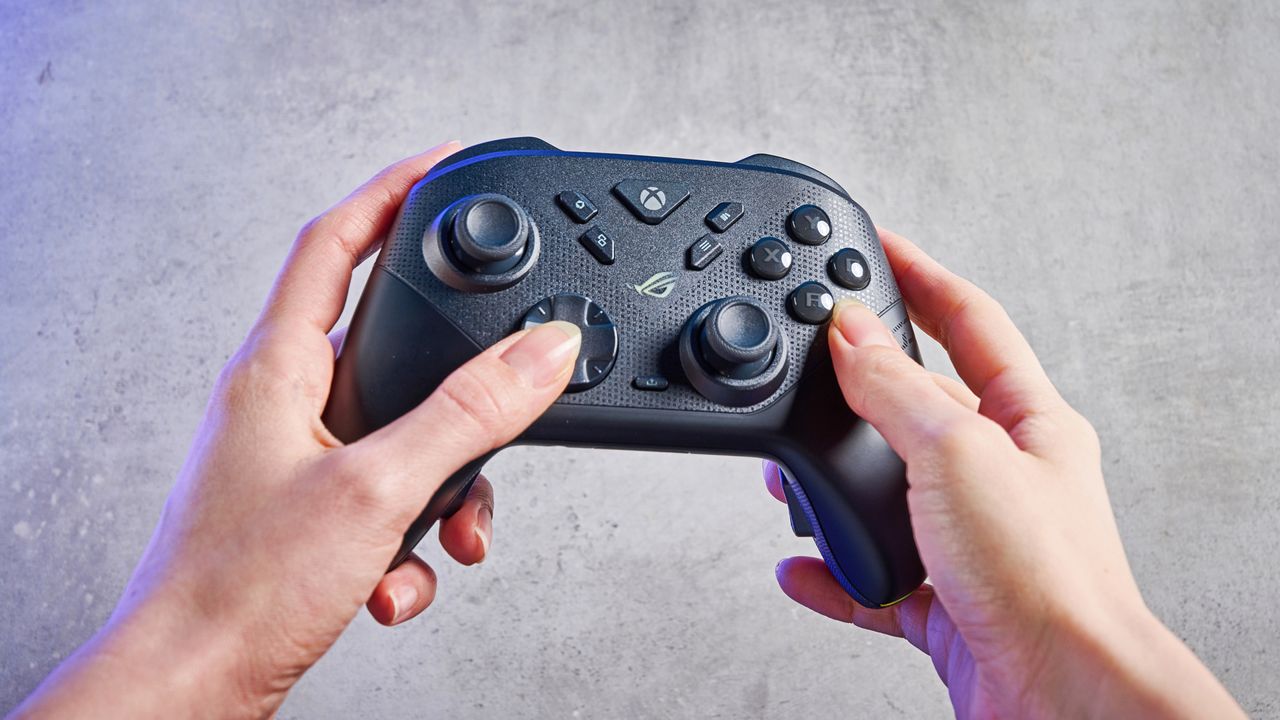
Gaming is one of my favorite hobbies. When I’m not working, you’ll usually find me sinking hours into my most-loved RPGs. I am, then, very lucky that I get to play video games for a living. Well, that’s a bit of an exaggeration — I test many gaming peripherals, including the best controllers, which means I get to play video games and call it work.
The most recent controller I’ve tested has, no lie, blown me away. They honestly don’t get better than this. The Asus ROG Raikiri II is a powerful gamepad for Microsoft’s consoles, and it beats the first-party Xbox Elite Series 2 in every which way.

It’s comfortable and packs performance in spades, and with extensive customization to boot, it gives you the advantage sought after by competitive players. Why do I say it’s better than the Xbox Elite 2? That’s what I’m here to talk about, so you’ll have to continue reading.
Spoiler alert: it might have something to do with the Raikiri II’s TMR thumbsticks and triggers…
‘TMR’ stands for ‘This Mechanic Rocks’

One of the things that stops me from recommending the first-party Xbox Elite Series 2 outright is its omission of Hall Effect or TMR sticks. The Elite 2 uses traditional analog sticks, although its triggers feature Hall Effect sensors. The downside of analog sticks is that they’re susceptible to stick drift — and as any gamer will know, stick drift is truly awful. To ensure longevity, many third-party manufacturers now fit Hall Effect or TMR sensors into their sticks.
Because the Asus ROG Raikiri II packs TMR tech into its sticks as well as triggers, it upstages the Elite 2 without breaking a sweat. TMR is an up-and-coming technology, and not many controllers feature it yet. TMR stands for Tunnel Magneto Resistance, and it uses weak electromagnetic waves rather than strong ones, which means that minute adjustments and movements are picked up by the sensor. It can get very technical but all you need to know is that it essentially gives you a massive competitive advantage — something analog sticks simply cannot do.

The Raikiri II goes a step further by using TMR in its triggers instead of Hall Effect, and becomes the first controller (at the time of writing) to do so. The triggers’ sensitivity can be changed between short clicky presses (great for FPS titles) and long presses (excellent for racing games), and they can be further extensively customized by Asus Gear Link. Once you start using a controller with TMR, it’s extremely difficult to go back to a non-TMR (or non-Hall Effect) one.
Even better in practice

So, in theory, TMR is excellent, which in turn makes the Asus ROG Raikiri II outstanding on paper, but how does the controller hold up in real-world usage?
Phenomenally, if you ask me.
I’ve used it extensively to play Cyberpunk 2077 and F1 25 on our testing rig, and Clair Obscur: Expedition 33 on an Xbox Series S. Being able to adjust each trigger’s sensitivity on the fly, via the locks on the back, is super handy.
In Cyberpunk 2077, I opted for short clicky presses as I didn’t want to press RT all the way down to rain gunfire down on NPCs, and my fingers didn’t feel fatigued either.
I opted for clicky presses in Expedition 33 too, as all I had to do to execute a Gradient Counter at the right moment was simply tap RT. Not only did this help me time my parries perfectly, but it also felt very satisfying as the short travel distance makes RT and LT feel like mouse clicks.
And those TMR sticks are something else too. Like I said earlier, TMR uses weak electromagnetic waves and even the most minute of movements is registered. With a sniper rifle equipped, I adjusted my aim ever so slightly in Cyberpunk 2077 to take out a specific NPC standing next to multiple others.
The extra-sensitive TMR sticks also had a chance to shine in F1 25 as they helped me make very slight changes to my car’s direction, especially when I was right behind another car and needed to overtake.
But is the price right?

Given that the Asus ROG Raikiri II utilizes the latest tech, it shouldn’t come as a surprise to anyone that it costs a premium. The Raikiri II retails for $189 / £180 at Amazon which is quite a bit, but it’s also $10 cheaper than the first-party Xbox Elite Series 2. In my opinion, the TMR thumbsticks and triggers alone do more than enough to justify that price tag. Why would you spend almost the same on the Elite 2 when you can get the superior Raikiri II?
Alongside the fantastic triggers and sticks, you’re also getting 50 hours of battery life — 10 more than the Elite 2. There’s more customization potential too, and the Raikiri II even comes with a charging dock to neatly display your controller. I really can’t think of a better Xbox controller, and the Raikiri II has really made me question why anyone would pay full price for the Elite 2.
But what do you think? Have you tried the Raikiri II? Or are you happy with the Elite Series 2? Or do you use a third-party controller that isn’t the Raikiri II? Let me know in the comments below!
More from Tom's Guide
- ‘The Xbox Elite 2 better watch its back’: I just tested the Asus ROG Raikiri II and it puts every other competitive controller to shame
- So long Hall Effect — I'm only using controllers with TMR sensors from now on
- I’ve finally found a PS5 controller that’s better than the DualSense — and no, it’s not the DualSense Edge