
Get all your news in one place.
100’s of premium titles.
One app.
Start reading
Space
Space
Science
Daisy Dobrijevic

Astrophotographer captures fiery plasma dancing above the sun in stunning close-up video

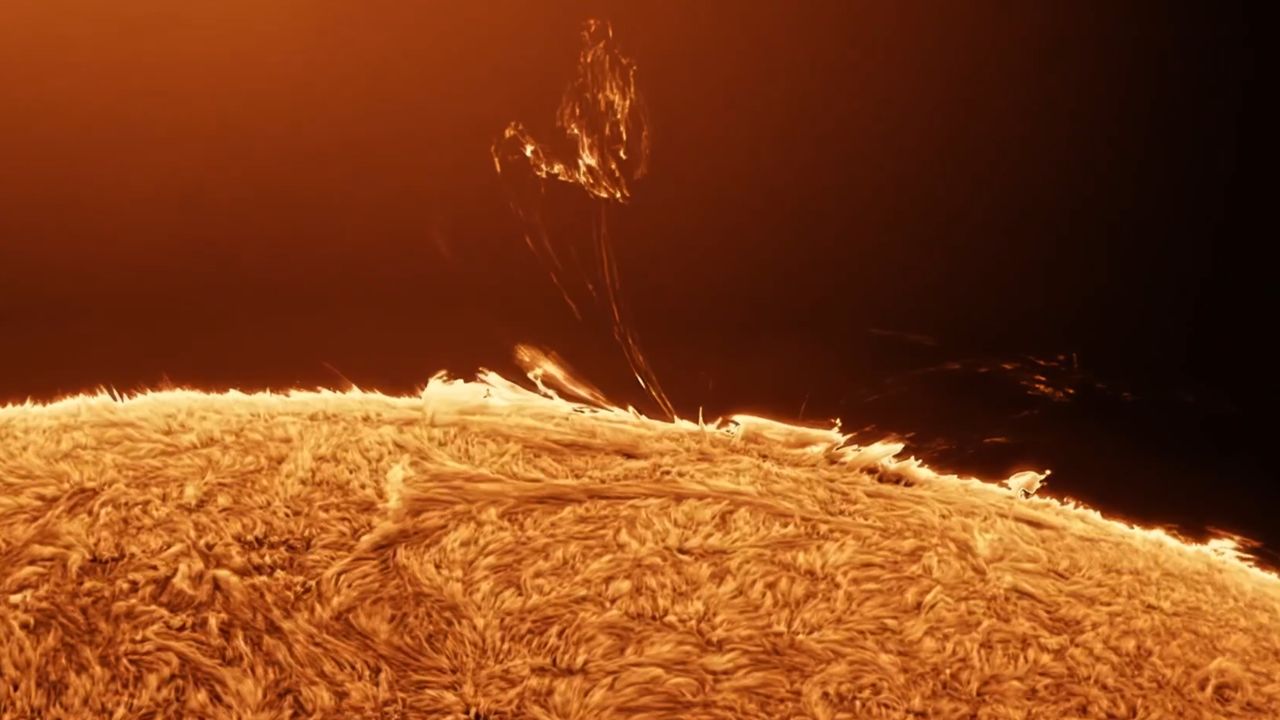
A close up view of the sun with a fiery tendril extending from the surface out into space and looping back down. the sun's surface looks fuzzy and soft, like you'd want to touch it - but you really shouldn't.

Astrophotographer Mark Johnston has captured a mesmerizing view of the sun, this time showing a cloud of hydrogen plasma twisting and dancing above the solar surface, suspended by powerful magnetic fields.


The incredible close-up, taken on Oct. 20, 2025, from Willow Springs Lake, Arizona, compresses 75 minutes of real-time solar activity into a hypnotic 6.5-second timelapse animation that's been looped. The extraordinary footage reveals a delicate, thread-like prominence as it hovers above the solar surface.

"The video shows a cloud of hydrogen plasma suspended above the sun's limb on magnetic fields," Johnston told Space.com. "I have a new upgrade on my solar etalon filter and when the seeing is good, I'm getting some fabulous results".

A solar prominence extends out from the sun. (Image credit: Mark Johnston)

A solar prominence, also known as a solar filament when seen against the solar disk, is a large bright structure extending from the sun's surface. The red glowing material is plasma, a hot gas made of charged hydrogen and helium, which flows along twisted magnetic field lines generated by the sun's internal dynamo. When these magnetic structures become unstable, the prominence can erupt, hurling plasma out into space. They are anchored to the sun's photosphere and extend into its hot upper atmosphere, known as the corona. Prominences can form over about a day and can persist for weeks or even months, looping hundreds of thousands of miles into space, according to NASA.

Close-up view of the solar prominence as it loops back over the sun. (Image credit: Mark Johnston)

To capture the footage, Johnston used a TEC160FL refractor equipped with a Baader Energy Rejection Filter, Baader 4ZS telecentric, Solar Spectrum 0.3Å hydrogen-alpha etalon, Lunt hydrogen-alpha etalon, and an ASI174M camera. The result is an astonishing level of detail, revealing the subtle motion of plasma as it interacts with the sun's dynamic magnetic environment.

Remember, viewing the sun without the right equipment can be dangerous. Never look directly at it with the naked eye or through a telescope unless you're using certified solar filters.

Sign up to read this article
Read news from 100’s of titles, curated specifically for you.
Already a member? Sign in here
Related Stories
Top stories on inkl right now
One subscription that gives you access to news from hundreds of sites
Already a member? Sign in here
Our Picks
Fourteen days free
Download the app
One app. One membership.
100+ trusted global sources.