
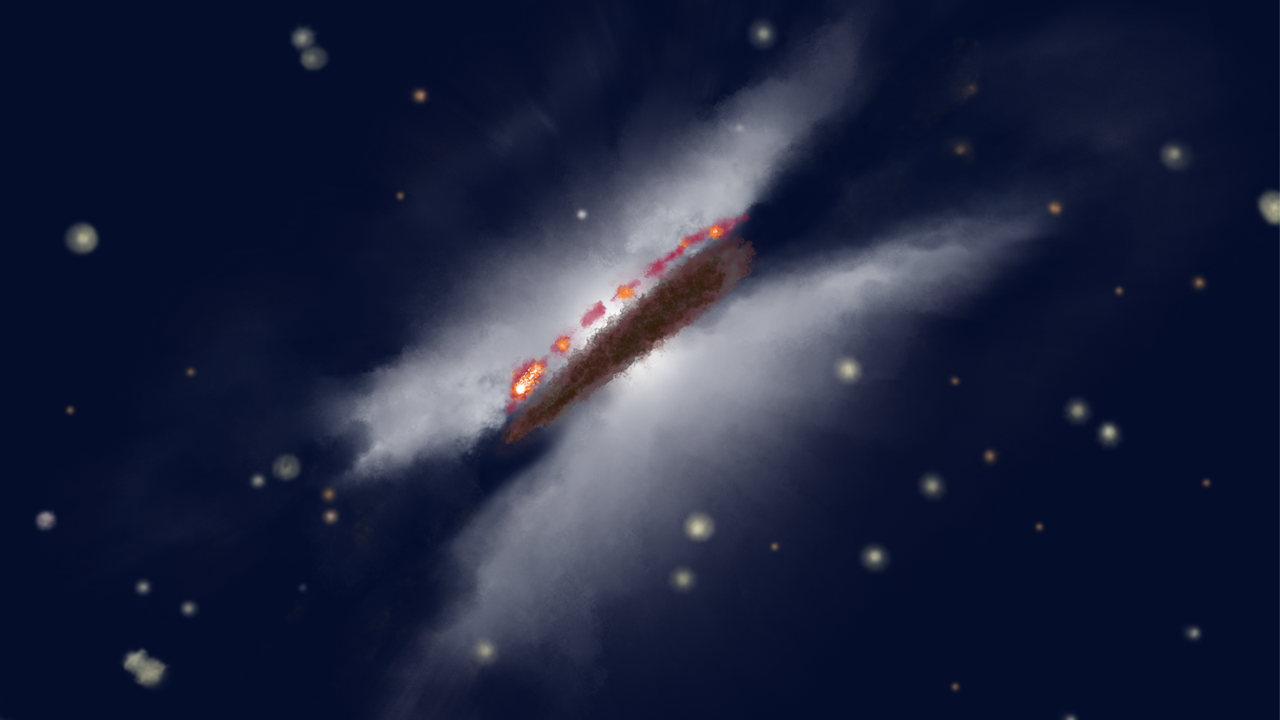
If you've ever discovered something completely unexpected in your hamburger, it was likely that neither delight nor intrigue were your first reaction. However, that isn't the case for a team of astronomers who have recently discovered something they didn't predict in a "cosmic hamburger," one of the biggest planet-forming disks of gas and dust, or protoplanetary disks, humanity has ever seen.
Using the Atacama Large Millimeter/submillimeter Array (ALMA), a powerful array of 66 radio antennas located in northern Chile, the team discovered the first signs of planet formation in the dense gas layers of a system known as Gomez's Hamburger (GoHam). GoHam's tasty appearance is due to the fact that from Earth it is seen edge-on with stacked layers of gas "buns" rotating around a young star "burger." This orientation allows the structure of Go Ham to be viewed in a way that isn't possible for other protoplanetary disks swirling around similar young stars. As such, the study of GoHam and the discovery of tantalizing hints of planet formation could give astronomers a better understanding of how giant planets form at great distances from their parent stars.