Get all your news in one place.
100's of premium titles.
One app.
Start reading
MyLifeXP
MyLifeXP
Deepak Rajeev

Ashwatthama Still Lives? The Truth No One Talks About

There are stories in the Mahabharata that end with the war- and then there are stories that refuse to end at all. Ashwatthama’s is one of them. For thousands of years, a quiet, unsettling belief has persisted across India: that one warrior from the Mahabharata never died. That somewhere beyond cities, beyond certainty, beyond time itself- he still walks. Even today, in remote parts of India, there are those who believe Ashwatthama has been seen- appearing in silence, never staying long, never speaking, always carrying the same unhealing wound. Some say he vanishes before dawn. Others claim his presence is felt more than seen, as though he belongs to a world just slightly out of reach. Not as a hero. Not as a king. But as a consequence. The question is no longer whether Ashwatthama is alive in a literal sense. The real question is why his story refuses to disappear.

The Warrior Who Crossed the Line

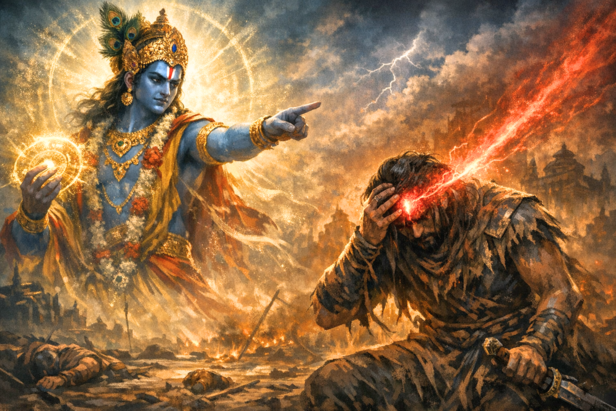
Story of Ashwatthama never ends (Image Credits: AI)

Ashwatthama was no ordinary warrior. The son of Guru Dronacharya, he was raised alongside the Pandavas and Kauravas, trained in divine warfare and entrusted with celestial weapons. But what defines him is not his power. It is the moment he lost control of it.

After the war had ended, Ashwatthama- consumed by grief over Duryodhana’s death- entered the Pandava camp at night and killed the sleeping sons of Draupadi. There was no battle. Only vengeance. And in the Mahabharata, such acts do not end- they echo.

The Curse That Became His Fate

Accounts of a lone figure seen in remote forests persists (Image Credit: AI)

When Ashwatthama stood before Lord Krishna, he did not receive death. He received something far more unbearable. A curse that Ashwatthama would not die. He would be forced to live- alone, wounded, suffering- until the end of time. His body would bear an unhealing wound. His existence would stretch across ages. And peace would never come. In a world where immortality is often imagined as power, Ashwatthama’s fate reveals something darker: To live without release is its own form of punishment.

The Wound That Never Heals

The wound on Ashwatthama's forehead (Image Credit: AI)

One detail remains constant across nearly every retelling- the wound on his forehead. Once, Ashwatthama possessed a divine gem, a symbol of protection and power. According to tradition, Krishna removed it as part of the curse. In its place remained a wound. Not a scar. A wound that never heals.

Symbolically, it carries something far heavier than flesh- it represents guilt that cannot fade, actions that cannot be undone and consequences that outlive the moment. Ashwatthama is not just living. He is remembering.

Sightings, Silence and the Power of Belief

Across generations, stories have quietly persisted- accounts of a lone figure seen in remote forests, near sacred rivers like the Narmada, or at ancient temples in the dead of night. A man who does not belong to any time. A presence that appears and disappears without explanation.

These accounts cannot be verified. But they endure. And what is striking is not whether they are true- but how consistently they are told. Because sometimes, a story survives not as fact, but as something deeper. As belief. As fear. As meaning.

Myth or Memory?

From a historical or scientific perspective, there is no evidence that Ashwatthama still lives. But the Mahabharata was never meant to be read as mere history. It is a mirror of the human condition. And in that mirror, Ashwatthama’s immortality transforms into something far more unsettling- and far more real. He becomes a symbol. Of consequences that do not end. Of actions that continue long after they are committed. Of a burden that cannot be laid down.

The Truth Behind the Story

Ashwatthama’s story does not offer closure. There is no redemption arc or final forgiveness or escape. There is only continuation. And that is precisely why it refuses to fade. Because modern life is built on the belief that everything can be resolved- that mistakes can be corrected, conflicts settled, endings written clean. Ashwatthama disrupts that illusion by standing as a reminder that some actions cannot be undone. But can only be carried.

The Final Thought

Maybe Ashwatthama still walks somewhere- through forests untouched by time, through silence beyond human reach. Or maybe he lives in a different way entirely i.e., in stories, in memory or in the quiet weight of consequence that every human carries in some form. Because Ashwatthama is not just a figure from the past. He is a question that continues to live. And perhaps that is the true meaning of his immortality: Not that he never dies. But that his story never ends.

Unlock insightful tips and inspiration on personal growth, productivity, and well-being. Stay motivated and updated with the latest at My Life XP.

Sign up to read this article
Read news from 100's of titles, curated specifically for you.
Already a member? Sign in here
Related Stories
Top stories on inkl right now
One subscription that gives you access to news from hundreds of sites
Already a member? Sign in here
Our Picks
Fourteen days free
Download the app
One app. One membership.
100+ trusted global sources.