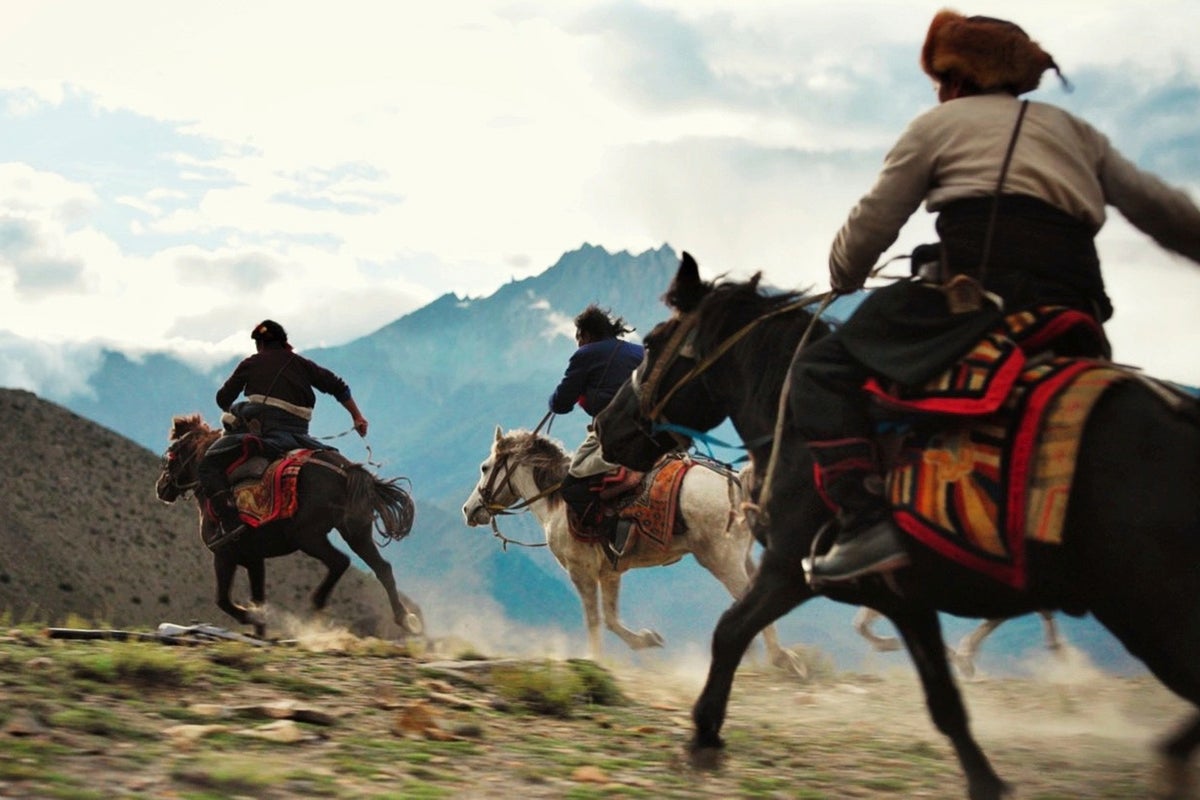
In the mountains of Nepal's Mustang region, just hours from the homeland he had never seen, Tenzin Rigzin Phurpatsang struggled to breathe the air his Tibetan ancestors had adapted to over generations. The thin air felt heavy.
The 37-year-old, first-time actor was in Mustang to film “Four Rivers Six Ranges,” a historical drama about resistance fighters who helped the Dalai Lama escape Tibet in 1959. A year later, Phurpatsang's own grandfather, Yeshi Wangyal, had returned to Tibet after CIA training to lead a separate guerrilla mission. He was killed fighting Chinese forces.

Born in exile in India, Phurpatsang is now a New York model. As he filmed firefight scenes in the mountains, a world away from his life, he thought of his family’s past.
“Wow, is that what my grandfather went through?” he asked himself.
Questions like this and others about Tibet's history, how it's remembered and who gets to tell it, are what Phurpatsang and director Shenpenn Khymsar hope “Four Rivers Six Ranges” will provoke at a moment when Tibet receives less sustained international attention than it once did.
The film premiered at the International Film Festival Rotterdam last year, before its Indian theatrical release on Sept. 18, a debut delayed as Chinese President Xi Jinping visited India.
The 91-year-old Dalai Lama’s succession plan looms over Tibet’s future and that of Tibetans who have sought to preserve their identity during China’s tight control. The world also has shifted, with China more powerful, the U.S. pulling back from its role as the world’s policeman and India and Beijing cautiously repairing ties.
Chinese state media has accused the film of promoting separatism, reiterating China’s position that Tibet has always been part of the country and saying the film rewrites history.
Khymsar insists it is rooted in history and that it is important for Tibetans to tell their own story. Phurpatsang too believes it is vital for younger Tibetans to know the history of the resistance they inherited.
“When you don't talk about it, these stories … they become lost,” Phurpatsang said.
Movie was filmed as a ‘covert operation’ in Nepal
Khymsar grew up watching films like “Seven Years in Tibet,” starring Brad Pitt, and Martin Scorsese’s “Kundun,” both released in 1997 and focused on the Dalai Lama's early life. But he wanted to tell the story of the ordinary Tibetans who formed the resistance group Chushi Gangdruk (“the land of four rivers and six ranges”).
The fighters regrouped among the wind-carved cliffs of Mustang, where they waged a 13-year guerrilla campaign against Chinese forces with U.S. support before disbanding in 1974, when U.S.-China relations improved. Khymsar said he wanted to shoot scenes in those mountains as his “tribute.”
But with Chinese surveillance and pressure in Nepal stifling the Tibetan community, he knew he wouldn't be able to secure the needed permits. He wrote and submitted what he described as a “dummy screenplay,” titled “The Himalayan Robin Hood,” and cut production from more than 45 days to just 19.
“The entire shoot was a covert operation,” Khymsar said.
There were other logistical hurdles. Much of the cast had never acted before, so Khymsar handpicked people, including social-media followers, and trained them in voice modulation and action. Some had never ridden horses and the production could not afford an action director or stunt team.
“I feel like the spirits of those warriors were there, helping me,” Khymsar said.
There have been no major Hollywood films about Tibet in recent decades, as studios sought increased access to the lucrative Chinese market, noted Carole McGranahan, an anthropologist and professor specializing in Tibet at the University of Colorado Boulder.
Indeed, Khymsar said he was struggling to secure international distribution.
“Four Rivers Six Ranges” matters, McGranahan said, because it is a “Tibetan telling of the history of Tibet.”
Another forthcoming film, “Tenzing,” about the late mountaineer Tenzing Norgay, could bring Tibetan history to a wider audience, she said. Norgay, a Sherpa, was born in Nepal to Tibetan parents and moved to Darjeeling, India, as a child, he said in a 1985 interview with India’s national broadcaster.
He and Edmund Hillary were the first two people confirmed to reach the summit of Mount Everest, in 1953. The biopic, starring Genden Phuntsok, Tom Hiddleston and Willem Dafoe, opens in select theaters Oct. 9 and premieres globally a week later on Apple TV.
“It’s not just a film about Everest, or about Nepal or India. It’s also about Tibet,” McGranahan said.
Tibet looms over India-China efforts to repair ties
“Four Rivers Six Ranges” was supposed to release in India on Sept. 11, a day before Xi's arrival for the BRICS summit and meeting with Indian Prime Minister Narendra Modi as the rival neighbors sought to repair ties strained by a deadly border clash six years earlier.
Before Xi’s arrival, Khymsar received a call from PVR INOX, India’s largest multiplex cinema operator, saying the release would have to be postponed a week.
“They said we cannot release it (yet). They got some pressure,” he recounted.
Asked whether PVR INOX had received government pressure, Deepa Menon, senior vice president for corporate communications, said she had no specific information to share. The Indian government did not immediately respond to questions about the delay.
India and China have economic incentives to deepen ties but competing strategic interests, said Manoj Kewalramani, a geopolitics expert at the Takshashila Institution in Bengaluru.
India wants China’s manufacturing expertise without becoming overly dependent on it, while Beijing wants access to India’s vast market but worries about enabling competition. Chinese companies also remain wary of investing in India if relations deteriorate, Kewalramani said.
Developments in Tibet could affect India’s territorial integrity because of competing claims over Arunachal Pradesh, which India considers a state in its northeast, Kewalramani said. Beijing claims it as part of China and calls it Zangnan, or “Southern Tibet.”
India officially recognizes Tibet as part of China, while also hosting the world’s largest Tibetan exile community, numbering about 70,000. It also is the seat of power for the government-in-exile, the Central Tibetan Administration, and shares deep cultural and religious ties with Tibet.
In 2011, the Dalai Lama formally ended his governance role in the Central Tibetan Administration, but he remains the Tibetan community's most prominent global figure.
“Because of the succession period looming, it becomes a bit of a powder keg,” Kewalramani said.
Kewalramani said Modi assured Xi, according to China’s readout of the meeting, that India would not allow “anti-China activities” on its soil, a reference Kewalramani interpreted as directly related to Tibet. The statement did not appear in India’s readout of the meeting, he said.
The period between the Dalai Lama’s death and the coming of age of his successor could be especially uncertain for Tibetans, McGranahan said.
This could mean years of leadership by a regent, following a centuries-old tradition. The Dalai Lama has said his successor should be identified according to Buddhist tradition, signaling China should stay out of the process.
China, meanwhile, has asserted its sole authority to approve the next religious leader and insists the reincarnation must be found in its Tibetan areas.
It is against this backdrop that McGranahan said the film could bring Tibet’s story to a mass audience.
“There is something about a story, told through a feature film, that can reach more people and touch them, in public and, hopefully, powerful ways,” she said.