Get all your news in one place.
100's of premium titles.
One app.
Start reading
The Conversation
The Conversation
Environment
Alyssa Kreikemeier, Assistant Professor of History, University of Idaho

As federal environmental priorities shift, sovereign Native American nations have their own plans

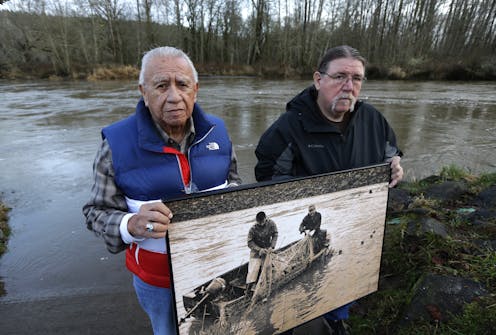
Billy Frank Jr., left, a Nisqually tribal elder, was arrested dozens of times while trying to assert his native fishing rights during the 'Fish Wars' of the 1960s and 1970s. In this 2014 photo, he stands with Ed Johnstone of the Quinault tribe. AP Photo/Ted S. Warren

Long before the large-scale Earth Day protests on April 22, 1970 – often credited with spurring significant environmental protection legislation – Native Americans stewarded the environment. As sovereign nations, Native Americans have been able to protect land, water and air, including well beyond their own boundaries.

Their actions laid the groundwork for modern federal law and policy, including national legislation aimed at reducing pollution. Now the Trump administration is seeking to weaken some of those limits and eliminate programs aimed at improving the environments in which marginalized people live and work.
Sign up to read this article
Read news from 100's of titles, curated specifically for you.
Already a member? Sign in here
Related Stories
Top stories on inkl right now
One subscription that gives you access to news from hundreds of sites
Already a member? Sign in here
Our Picks
Fourteen days free
Download the app
One app. One membership.
100+ trusted global sources.