A huge wall of water and debris swept down the Teesta valley in the eastern Himalayas on October 3 2023, causing widespread devastation and the tragic loss of over 50 people. This powerful flood in India was the result of a landslide which caused a glacial lake higher up the valley to spill over. This phenomenon is known as a glacial lake outburst flood, or GLOF.
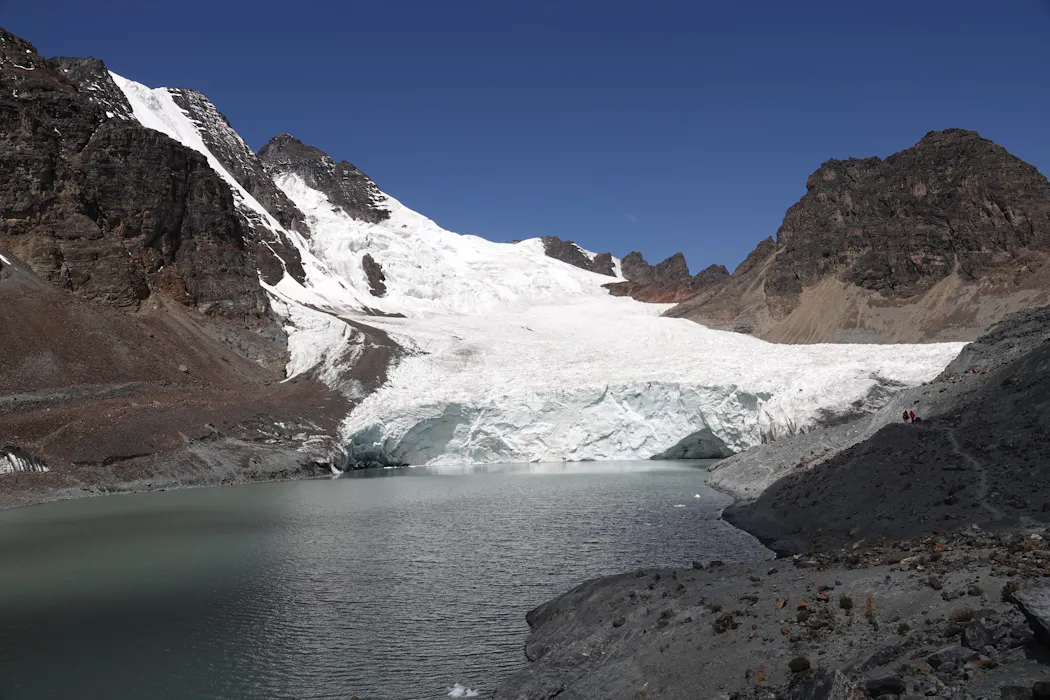
In a 2025 study of glacial lakes across the Bolivian Andes, my colleagues and I found that 11 are highly susceptible to producing potentially hazardous GLOFs. Such lakes are increasing in size and number as glaciers retreat around the world. In Bolivia, we saw 60 new lakes form in just six years.

Over the same six-year period, glaciers in the region shrank rapidly. If they continue to melt at the same rate, Bolivia will be entirely ice free by the 2080s. Unfortunately, this is likely to be a conservative estimate.
We modelled the shape of the land surface underneath the existing ice to predict where lakes might form in future. We found more than 50 potential lake sites. Further monitoring will ascertain which of these emerging lakes might pose a risk to downstream populations or infrastructure.
In our study, we used high resolution satellite imagery to monitor glaciers and glacial lakes across the Bolivian Andes. We mapped glacier and lake boundaries at annual intervals between 2016 and 2022.
Bolivia is home to nearly one-fifth of the world’s tropical glaciers. These glaciers are important in their own right, particularly during the dry season, when meltwater provides essential supplies for human consumption, agriculture and industry. Glaciers also play a role in the cultural life and heritage of Indigenous peoples in this region.
We found an alarming rate of shrinkage among these glaciers. Between 2016 and 2022, the total surface area of glaciers in Bolivia decreased by nearly 10% – at an average rate of almost two square miles per year. If these glaciers continue to retreat at the same rate, there will be none left in the region by the 2080s.
Yet this represents a best case scenario. As glaciers get smaller, they shrink more rapidly, so the rate of decline will probably increase over time.
Such rapid deglaciation not only threatens water security but may also damage ecosystems. In the Andes, high-altitude wetlands known as “bofedales” store vast amounts of carbon and help absorb water too. Should they dry out as a result of decreasing water availability, they may release the carbon they have been storing – driving further warming of the atmosphere.
As glaciers melted and shrank across the region, the number and size of glacial lakes increased. Around 60 new lakes formed over the course of the study period. Many of these lakes were small and would be unlikely to produce a GLOF capable of doing significant damage, but 120 were considered large enough to represent a potential hazard.
We analysed these lakes in order to assess their susceptibility to producing a GLOF and found that 11 were worthy of further investigation. For example, ascertaining the potential consequences on downstream populations of an outburst flood from one of these lakes could help to inform future monitoring and mitigation efforts.
To reduce the risk of future catastrophe, local communities can prepare in a range of ways. That includes the physical construction of spillways and diversion canals, strategic land-use planning and the design of flood-resistant infrastructure. Disaster preparedness also requires social measures, such as education and awareness raising so that residents understand clearly communicated evacuation plans or early warning systems.
Modelling the hollows
Using existing global glacier thickness data combined with our findings, we created a digital model representing the shape of the land surface underneath the ice. Glaciers are immensely powerful erosive agents and can carve deep hollows into the bedrock that they travel over. As the ice retreats, these hollows often fill with water and become lakes.
We found 55 potential future lake sites. Not all of these lakes will definitely form. Shallow depressions may fill with sediment instead of water while deeper ones may be drained by gorges which can’t be detected by modelling because they’re just too narrow for the tech to find. Models would be even more reliable with access to higher resolution datasets which are not currently available for the Bolivian Andes.
Future lakes across Bolivia may represent important sources of water – partially offsetting the consequences of losing glacial meltwater. Nevertheless, these lakes may be susceptible to producing GLOFs, so rapid and sustained international action to reduce the effect of climate change on the world’s glaciated regions is critical.
Jamie MacManaway receives funding from NERC.
This article was originally published on The Conversation. Read the original article.