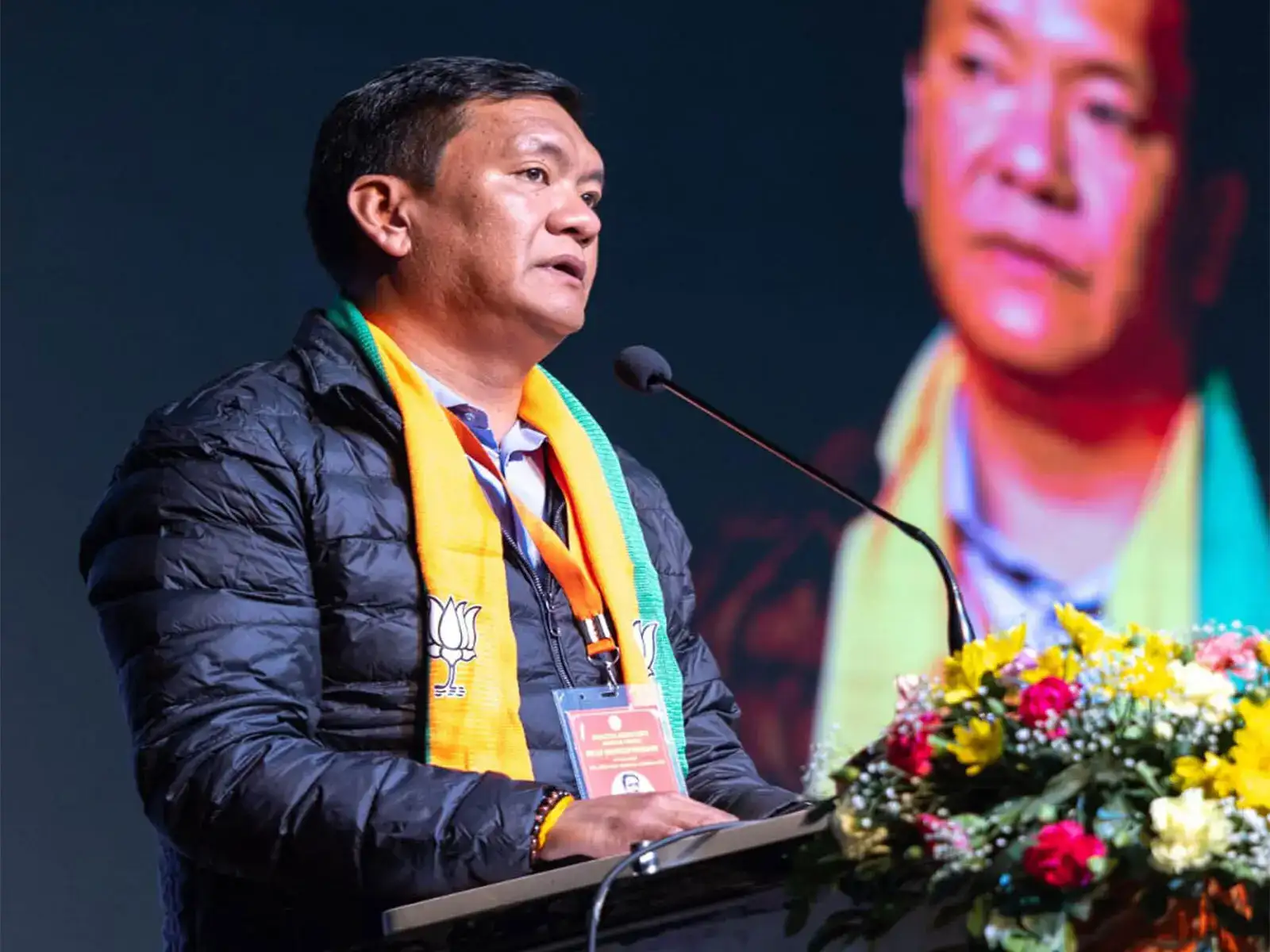
Itanagar: Arunachal Pradesh Chief Minister Pema Khandu on Friday said his government has constituted four high-powered committees to examine infiltration issues, strengthen the Inner Line Permit system, re-verify ST certificates and protect the rights of indigenous people.
Khandu said the panels were formed in line with the resolutions adopted at consultative meetings, held on May 27 and May 29 under his chairmanship, on issues concerning indigenous tribal rights, Arunachal Pradesh Scheduled Tribes, the ILP framework and related concerns.

Also read: 'Insult to SC': Congress on Arunachal CM having 'control' over files amid CBI probe
Khandu said the panels bring together representatives of the All India Tribal Federation (AITF), All Arunachal Pradesh Students' Union (AAPSU), Arunachal ST Bachao Andolan Committee, legal experts, scholars and government officials to ensure a broad-based and participatory approach in addressing the issues.
Addressing concerns over infiltration and illegal immigrants, the government has formed a high-powered committee headed by Environment and Forests Minister Wangki Lowang, an official order stated.
The committee has been tasked with studying the prevalence of infiltration and immigration in the state and recommending measures for stronger border control, biometric and digital verification systems, and action against forged identity documents and undocumented settlement networks.
The panel has also been mandated to suggest administrative and legal measures to curb illegal immigration and strengthen existing safeguards within the constitutional and legal framework.
It will submit its recommendations to the government within six months of its first meeting.
To further strengthen the Inner Line Permit regime, the government has constituted another committee headed by Agriculture and Horticulture Minister Gabriel D Wangsu.
The committee will examine the existing system of issuance, monitoring and verification of ILPs, review the 2026 ILP guidelines and recommend restructuring measures to strengthen the framework.
It has also been tasked with proposing technology-driven mechanisms for ILP issuance and monitoring, developing a robust verification process, and recommending suitable categories for issuance of such permits to tourists, visitors and workers.
The government has also constituted a panel headed by Education Minister Pasang Dorjee Sona to examine the re-verification of APST certificates and related matters.
The panel will review the existing system of issuance, monitoring and verification of APST certificates, including the guidelines notified in 2022.
The committee will recommend a robust methodology for APST verification, suggest amendments to existing guidelines, and propose advanced security features, digital and biometric verification systems, village-level scrutiny mechanisms and district-level verification procedures.
It has also been asked to recommend legal and administrative measures against forged or illegally obtained APST certificates and fraudulent claims of tribal status.
Another committee, headed by Law Minister Kento Jini, has been constituted to examine issues relating to non-APST lineage claims, protection of indigenous rights and related matters.
The panel will study the existing system governing acquisition and protection of tribal rights, identify loopholes that allow misuse or indirect acquisition of such rights, and recommend legal and administrative safeguards concerning tribal identity, inheritance, lineage verification, indigenous land protection and reservation benefits.
It has also been tasked with suggesting measures to prevent misuse of tribal protections through manipulated documentation or indirect claims and recommending legal action against illegally acquired tribal rights.
The government orders stated that all four committees have been empowered to seek reports, data and status updates from departments and district administrations and are required to submit their recommendations within six months of their first meetings.