Two stories always form part of a US Open build-up. Will Phil Mickelson finally win his national championship, and how brutal will the course set-up be?
It's possible that we've seen the last of Mickelson at the US Open, with the 56-year-old currently taking some time away from the sport to deal with a private family health matter.

However, just how difficult the United States Golf Association (USGA) decides to make the course will always be one of the biggest talking points, especially when it comes to hosting the Major at somewhere like Shinnecock Hills on Long Island, New York.
Widely considered to be the toughest challenge in the men's game, US Opens are not for the faint-hearted - and the USGA has often been accused of making the challenge unfair.
However, with strong winds forecasted, the USGA has opted to play it safe this week, with the greens set to run at their slowest speed since 1995.
The last time Shinnecock hosted the US Open, in 2018, gusty conditions pushed the first round scoring average to more than six over par.
Come Saturday, the strain started to take effect, with Mickelson resorting to hitting a moving ball to prevent his putt from rolling off the 13th green.
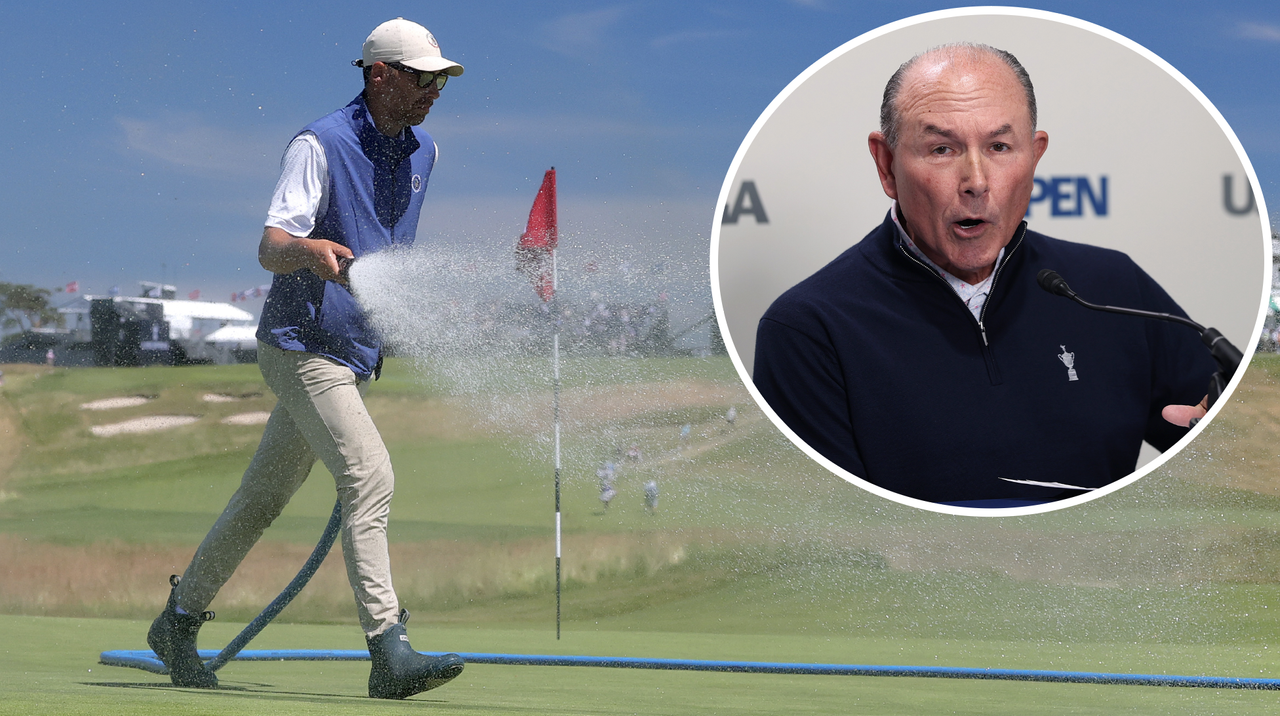
Chief Championships Officer John Bodenhamer, the man tasked with getting the balance right this week, addressed the contentious topic during the USGA’s pre US Open news conference.
Asked whether "we've gone to far" with green speeds in general across the country, Bodenhamer replied, "I guess I would say yes, I would make that argument.
"But I think every venue has its own culture. It's different."
Bodenhamer added, "I've never seen poa annua putting greens like you see at Oakmont. They're naturally 15. They just are. It might feel something much different somewhere else."
Many top players favor putting on fast greens, but when they dry out and the wind gets up, they can become unplayable.
The other issue, more so for the fans, is certain pin positions cannot be used.
"I do think that when you go to America's greatest venues, when we're so fast, you can't use some of the hole locations that maybe Bob Jones made a putt or Walter Hagen or some of those great champions," added Bodenhamer.
"That's really what we were endeavoring to do here.
"For us it's a comprehensive test. It's not what happens just on the putting greens with uber-slick greens and some of those things.
"We want to stay with what the architect intended. I think in some places, yes, I would make the argument, not just at a US Open, but across the country to be able to do that, dialing back the green speed is part of that."
Talking more about the game in general, Bodenhamer added: "I don't think speed is the number one consideration for a player, an amateur player, at any level.
"I think smoothness is. You just want a smooth putt. Doesn't necessarily have to be the fastest, and this race to green speed is probably something that the game would benefit, pace would benefit, the experience would benefit if we curb back a little bit.
"I would agree with that."
Bodenhamer said the aim is for the speeds to be "around the mid 10s" throughout the tournament - and they haven't been that slow since Corey Pavin won at Shinnecock Hills over 30 years ago.
The USGA was accused of 'losing the golf course' during the controversial 2004 and 2018 US Opens at the Long Island venue.
Along with slower green speeds and more subtle pin placements, the USGA will syringe the greens during Thursday and Friday - with the plan to add water between the early and later waves of players.