Get all your news in one place.
100’s of premium titles.
One app.
Start reading
Euronews
Euronews
Mohamed Elashi

FIFA Arab Cup kicks off in Doha after dazzling opening ceremony as Palestine beat hosts Qatar

The FIFA Arab Cup Qatar 2025 opened on Monday with a sweeping ceremony at Al Bayt Stadium that blended culture, politics and performance — before Palestine delivered a shock 1–0 victory over hosts Qatar in their opening Group A fixture.

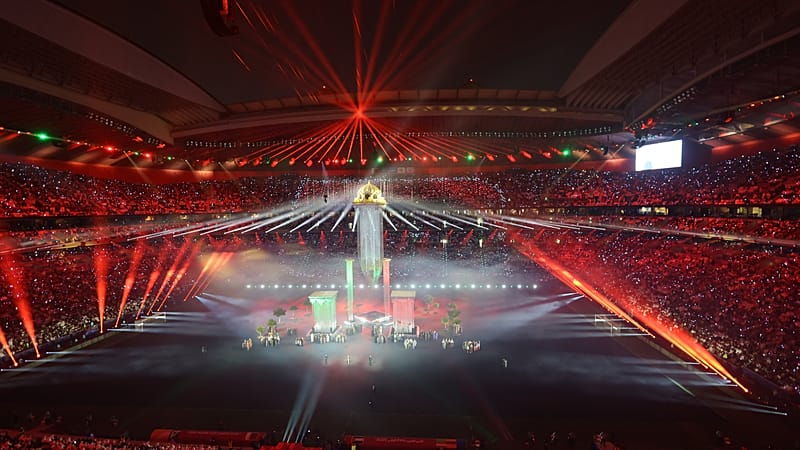
More than 60,000 fans filled the stadium in Al Khor for an opening show built around themes of unity, peace and renewal. Produced by Katara Studios, the 15-minute performance unfolded as a three-chapter narrative, tracing the rise, fracture and rebirth of Arab unity through music, choreography and large-scale visual storytelling.

Fans pack Al Bayt Stadium, with 61,465 in attendance for the Arab Cup opener. (Fans pack Al Bayt Stadium, with 61,465 in attendance for the Arab Cup opener.)

The show opened with imagery of Jerusalem and two doves of peace, followed by narration from Syrian actor Rashid Assaf.

British actor Jeremy Irons made a surprise appearance as “The Stranger”, a symbolic character whose whispered question triggers the collapse of the story’s great monument — a metaphor for division in the Arab world.

A children’s choir later performed the Arab National Anthem in a segment underscoring hope and the role of future generations.

The ceremony also featured singers from across the region and the tournament’s two official songs, "Makani and Zamani", which have been released as part of the event’s official soundtrack.

Al Bayt Stadium in Al Khor, one of the six venues hosting matches in the FIFA Arab Cup Qatar 2025. (Al Bayt Stadium in Al Khor, one of the six venues hosting matches in the FIFA Arab Cup Qatar 2025.)

This year’s edition returns to Qatar with 16 teams competing from 1 to 18 December, marking the second consecutive time the country hosts the tournament. Interest has been high - organisers announced that more than 700,000 tickets have been sold so far, including over 210,000 purchased by fans travelling from outside Qatar.

The competition has also drawn strong regional media attention, with almost 4,000 journalists applying for accreditation. Match-day travel will be free for ticket holders on the Doha Metro, and all six stadiums — including Lusail, Ahmad Bin Ali, Education City, Khalifa International and Stadium 974 — are connected via Qatar’s rail network.

This edition also highlights the Arab Cup’s growing stature under FIFA. Following the 2021 tournament, the competition now carries official international recognition, with match points counted in global rankings and new tie-breaking regulations enhancing its competitive value. Prize money has increased to a record $36.5 million (€33.5 million), reflecting the tournament’s rising importance in the region and internationally.

Palestine deliver historic win

Once the opening ceremony concluded, attention shifted to the hosts’ Group Stage clash with Palestine — and the match ended in one of the biggest surprises in the tournament’s history.

Hosts Qatar took on Palestine following the opening ceremony. (Hosts Qatar took on Palestine following the opening ceremony.)

In the 95th minute, Qatar defender Sultan Al Brake turned the ball into his own net, handing Palestine their first Arab Cup victory in 59 years. Their last win in the competition came in 1966 against North Yemen.

Qatar dominated possession for much of the match but failed to break through a disciplined Palestinian side who defended in numbers and grew in confidence as the evening unfolded.

The late goal sent the Palestinian bench into emotional celebration and immediately placed Qatar under pressure ahead of their next match.

What’s next for Group A

Earlier on Monday, Syria stunned Tunisia 1–0 in Al Rayyan, giving the Eagles of Carthage an early setback in the group.

Following Monday’s results, Palestine and Syria top the group ahead of Thursday’s fixtures when Qatar face Syria and Tunisia take on the fourth team in Group A. Palestine will then meet Tunisia on Sunday as they look to build on their historic start.

A total of 16 nations are competing across four groups in this year’s tournament, with the top two from each group advancing to the quarter-finals.

Sign up to read this article
Read news from 100’s of titles, curated specifically for you.
Already a member? Sign in here
Related Stories
Top stories on inkl right now
One subscription that gives you access to news from hundreds of sites
Already a member? Sign in here
Our Picks
Fourteen days free
Download the app
One app. One membership.
100+ trusted global sources.