Get all your news in one place.
100’s of premium titles.
One app.
Start reading
The Texas Tribune
The Texas Tribune
National
Jaden Edison

Judge orders Texas to extend school voucher deadline in response to lawsuit from Islamic schools

A federal judge on Tuesday ordered Texas to extend the application deadline for private school vouchers until March 31 due to the state’s exclusion of Islamic schools from the program. 

The extension comes after four Muslim parents and three Islamic private schools sued Texas leaders earlier this month, arguing state leaders discriminated against their religion by excluding them from the program.
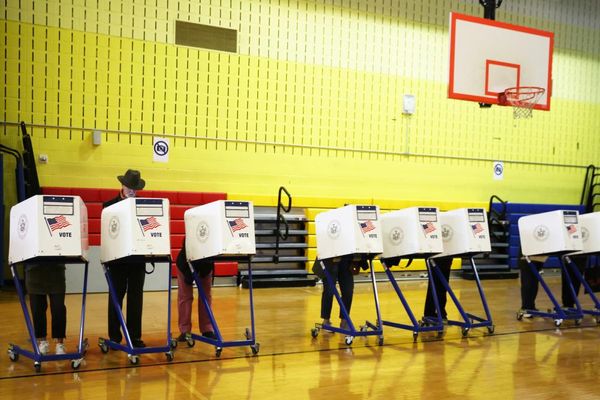
The order from U.S. District Judge Alfred Bennett prevents the state from considering which families will receive school voucher funding. The lawyers representing Islamic schools and families want the court to extend the order beyond March 31 — until the next hearing in late April — when they plan to argue for further action. 

Acting Comptroller Kelly Hancock — Texas’ chief financial officer who manages the voucher program — has prevented Islamic schools from participating in the program over claims that some are associated with foreign terrorist organizations. 

Hancock has said schools accredited by the company Cognia hosted events organized by the Council on American-Islamic Relations, a Muslim civil rights group that Gov. Greg Abbott recently designated a terrorist organization. CAIR has sued Abbott over the label, calling it defamatory and false. The U.S. State Department has not designated the organization a terrorist group.

The comptroller’s office did not immediately provide comment after the court order.  

Before the court order, the application window for Texas’ school voucher program was set to close at 11:59 p.m. Tuesday for families who want to use public funds to pay for private school or home-school during the 2026-27 academic year. 

As of Monday afternoon, families had submitted applications for more than 200,000 students, more than what $1 billion in available state funding can pay for. More than 2,200 private schools have opted in to accept voucher students, according to the comptroller’s office.

So far, at least 71% of Texas voucher applicants come from families whose children attended a private school or home-school during the 2024-25 academic year, according to data released earlier this month and confirmed Monday by the comptroller. 

The comptroller in late February denied a public records request from The Texas Tribune asking how many applicants currently attend private school or home-school, saying the office did not collect that data during the application period.

Most participating families with children in private schools will receive about $10,500 annually. Home-schoolers can receive up to $2,000 per year. Children with disabilities qualify for up to $30,000 — an amount based on what it would cost to educate that child in a public school.

The comptroller will use a lottery system to determine how the state will divide $1 billion among eligible students. Applicants will be considered in this order:

  • Students with disabilities in families with an annual income at or below 500% of the federal poverty level, which includes a four-person household earning less than roughly $165,000 a year.
  • Families at or below 200% of the poverty level, which includes a four-person household earning less than roughly $66,000.
  • Families between 200% and 500% of the poverty level.
  • Families at or above 500% of the poverty level; these families can receive up to $200 million of the program’s total budget.

Families must still find private schools — which are generally not required to make special education accommodations — to accept their children. Parents do not have to have their children enrolled in a school until July 15. Private schools will then confirm enrollment with the state by July 31.

Early data from the comptroller shows 35% of students come from households that make at or below $66,000 per year for a family of four. Thirty-seven percent make between $66,000 and $165,000 per year. Students in households making more than $165,000 annually comprise 28% of the application pool.

The data also shows:

  • Nearly 80% of applicants plan to attend a private school next year, while the remaining applicants say they plan to home-school.
  • Most families applied to receive vouchers for pre-K, though half of them do not meet the eligibility criteria.
  • Most applicants reside in the Houston region, followed by the Richardson, Fort Worth, San Antonio and Austin regions.

Before Tuesday’s court order, the comptroller’s office said it planned to release finalized data from the application pool later this week. 

Due to confusion over the voucher program rules, some families of children with disabilities will not qualify for additional funding for students who need special education services. Those families did not know they needed a special education evaluation from a public school to qualify for the funding. Obtaining legal documentation proving a child received the evaluation can take months, while the voucher application window lasted only 41 calendar days.

The comptroller recently clarified its interpretation of the voucher law, saying it believes families of students with disabilities can still apply for the funding boost next year. 

Sign up to read this article
Read news from 100’s of titles, curated specifically for you.
Already a member? Sign in here
Related Stories
Top stories on inkl right now
One subscription that gives you access to news from hundreds of sites
Already a member? Sign in here
Our Picks
Fourteen days free
Download the app
One app. One membership.
100+ trusted global sources.