Get all your news in one place.
100's of premium titles.
One app.
Start reading
Tom’s Hardware
Tom’s Hardware
Technology
Andrew E. Freedman

Apple turns 50 — one of the world's biggest tech companies started with hobbyist computers

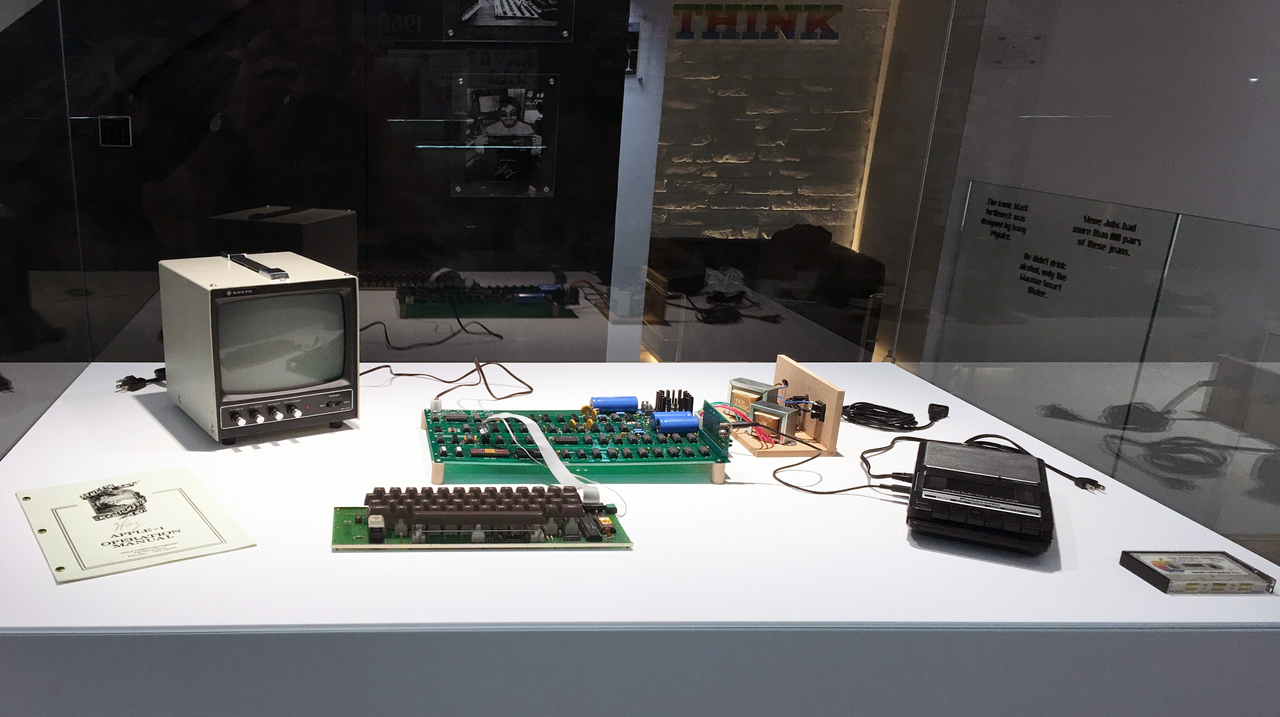
Apple-1 with accessories and monitor.

Apple is 50 years old. The consumer tech giant, famous for the iPhone, AirPods, and, yes, its Mac laptops and desktops, has a larger footprint than ever. It also now encompasses TV production, music streaming apps, a massive App Store, and even a $599 system for the masses, the MacBook Neo. But all of that is rooted in a tradition of hobbyist computing, starting with the company's first product: the Apple-1.

Apple Computer Inc. was founded in 1976 as a partnership between Steve Jobs, Steve Wozniak, and Ronald Wayne (of Atari fame, who was at Apple very briefly and worked on documentation). The company was built around the Apple-1, designed by Wozniak, and officially incorporated in Cupertino, California, in January 1977.

In retellings of the Apple legend, Wozniak was the true engineer, who was working at HP at the time. Jobs had an interest in electronics (and was reportedly pretty good at soldering at his job at Atari), but he was more of a marketing guy.

Either way, the pair, along with the early team they built, didn't have a company based on lifestyle – at least not yet. It was based in the hobbyist PC space. The Apple-1 came without a case, a keyboard, or a power supply, but did include a MOS Technology 6502 microprocessor and four kilobytes of memory. If you wanted to run Integer BASIC, you needed to do it on a cassette. Only about 200 were ever made, mostly for Byte Shop in nearby Mountain View.

At the time, the Apple-1 delivered a surprising amount of convenience for personal computing. Even though you still had to bring many components, the board was built and tested. Wozniak would show it off at the Homebrew Computer Club in Silicon Valley, to acclaim.But it was the Apple II that brought Apple's computers to the masses, assembling everything together, including the keyboard and case. You would use a television to serve as the screen. Heck, BASIC was even stored in memory. The Apple II was an iconic beige box that would be popularized by two further advancements in computing: a floppy disk drive and VisiCalc, an early spreadsheet program, which boosted its popularity.

There would be many variations on the Apple II, including the ill-fated Apple III, the upgraded Apple IIe, and the Lisa, the first commercially available PC with a GUI and mouse (inspired by work at Xerox's Palo Alto Research Center, such as the Xerox Alto), which was quite expensive at $9,995.

The original Macintosh, later dubbed the Macintosh 128K. (Image credit: Andrew E. Freedman)


But in 1984, following an internal power struggle, a second computing group within Apple revealed the Macintosh (later the Macintosh 128K), bringing forward the idea of the "all-in-one" PC, which included a monitor. There would be many variations in the Mac line, but they'd become popularized again in 1998, when Jobs, back from his exile from the company from 1985 through 1997, announced the iMac G3, designed by Jony Ive, in Bondi Blue. That would be followed by multiple colorways on the portable iBook laptops.

There would be hits (the iMac G4, with a modern design between a lamp and a flower) and misses. The Power Mac G4 Cube was a gorgeous machine with cosmetic issues in the injection-molded plastic and cooling issues thanks to its fanless design. The press release about Apple suspending production lives on on its website.

In 2001, Apple released the iPod, promising "1,000 songs in your pocket." The third-gen iPod, in 2003, added support for Windows, helping propel it to be one of the most popular consumer devices of all time. In 2007, Apple would launch the iPhone, which would take over the American smartphone market, become the company's largest focus and flagship product, and introduce the App Store, a huge business success for the company, as well as other services like iCloud, Apple Music, and Apple Pay. (The iPhone would ultimately lead to the death of Flash and the headphone jack on phones, but change the way many people use devices forever.)

But the next biggest hit would be the MacBook Air. By this time, Apple was firmly in its Intel era. Sure, it was extremely expensive when it launched in 2008, starting at $1,799 with an 80GB HDD and a 1.6 GHz Intel Core 2 Duo processor (a 64GB SSD was an upgrade option!). But when Jobs pulled that computer out of a manila envelope, the tech world was stunned. It was stunned again when, in 2010, Apple redesigned the Air in two sizes: 11- and 13.3-inches, starting at $999 for the smaller model and $1,299 for the larger one (and it got rid of the spinning hard drive).

The MacBook Air would push leading PC companies to chase Apple in laptops for well more than a decade, as Dell updated the XPS line, HP jumped to the premium Spectre, and even Lenovo's ThinkPads saw the X1 series.

The MacBook Air would stay in the spotlight, 12 years later. Following some hum-dum upgrades in Apple's last Intel years, including the lackluster Touch Bar (in fact, in 2018, with little attention, I wrote for Laptop Mag that Apple needed to either upgrade or kill the laptop), it would be one of the first machines, along with the MacBook Pro and Mac Mini, to ditch Intel and move to Apple's first in-house silicon, the M1 system-on-a-chip. It was widely seen as a success.

The MacBook Neo starts at $599, or $499 with an education discount. (Image credit: Tom's Hardware)

Today, Macs don't have the kind of modularity or upgradeability they had when Wozniak showed off the Apple-1 at the Homebrew Computer Club. But with the release of the $599 MacBook Neo, time has caught up with Apple at 50 years old. There's another computer that feels like an all-in-one package for more people. But there are more challenges to come, as Apple faces a new world focused on AI, with new players and competitors. While the company still seems to be trying to deliver on promises around Apple Intelligence, the company has partnered with Google to use Gemini models to make an AI-focused Siri.

The 50-year anniversary has inspired celebrations, with museum collections, like the Mimms Museum of Technology and Art in Georgia showing off over 2,000 artifacts related to the company's history, and the vaunted Computer History Museum in Mountain View offering special programming. Apple has had an array of concerts and other performances at stores globally. But for most, it's just Wednesday, even if you have an iPhone in your pocket.

Sign up to read this article
Read news from 100's of titles, curated specifically for you.
Already a member? Sign in here
Related Stories
Top stories on inkl right now
One subscription that gives you access to news from hundreds of sites
Already a member? Sign in here
Our Picks
Fourteen days free
Download the app
One app. One membership.
100+ trusted global sources.