
Get all your news in one place.
100’s of premium titles.
One app.
Start reading
Tom’s Hardware
Tom’s Hardware
Technology
Hassam Nasir

Apple's MacBook Neo modded to a 1 TB SSD, breaking the firm's 512 GB barrier — base 256 GB model gets modded in expert NAND swap surgery

MacBook Neo with 1 TB of storage .

By repurposing a mobile chip and fitting it inside an aluminum chassis, Apple showed just how low the bar really is for the often-overlooked budget laptop segment. The MacBook Neo is a great machine for the price, but clearly, some corners had to be cut in order to minimize costs, like limited RAM and storage. Thankfully, one modder from China is showing how at least one of those things can be solved.

DirectorFeng is an expert repairer and technician who's worked on a number of Apple devices, including iPhones and previous MacBook models. His latest stint involves the MacBook Neo, specifically the base 256 GB model that includes barely enough storage for modern-day usage. Since Apple doesn't allow you to upgrade storage on your own, DirectorFeng will swap the very NAND chip itself with a higher-capacity one, then reflash MacOS so it recognizes the new SSD.

That sounds simple, but it's a job meant only for professionals, which you can tell by watching the video. After the unboxing, DirectorFeng began with disassembling the device; a few screws and a couple of picks later, the back cover was off. He neatly showed off all the parts and described what each of them does, eventually getting to the logic board up top that houses the SSD.

(Image credit: DirectorFeng on YouTube)

Several undone connectors later, the board comes out. He removed the shielding tape to expose the dense componentry, which includes the SSD. He started heating up the NAND chip, slowly removing the BGA glue around it until it eventually came off. Then, after cleaning the solder pads with some flux, he simply plopped the new 1 TB module on there and warmed up the area again to fix it in place.

The hard part was done, and DirectorFeng then connected the Neo with another MacBook via a USB cable to flash macOS. After the testing was done, he shut down the laptop to reapply the BGA glue on the new chip, after which the entire logic board was thrown into a reflow oven to make the glue set properly. The board was put back in its place in the chassis, and all the connectors were resecured before final assembly.

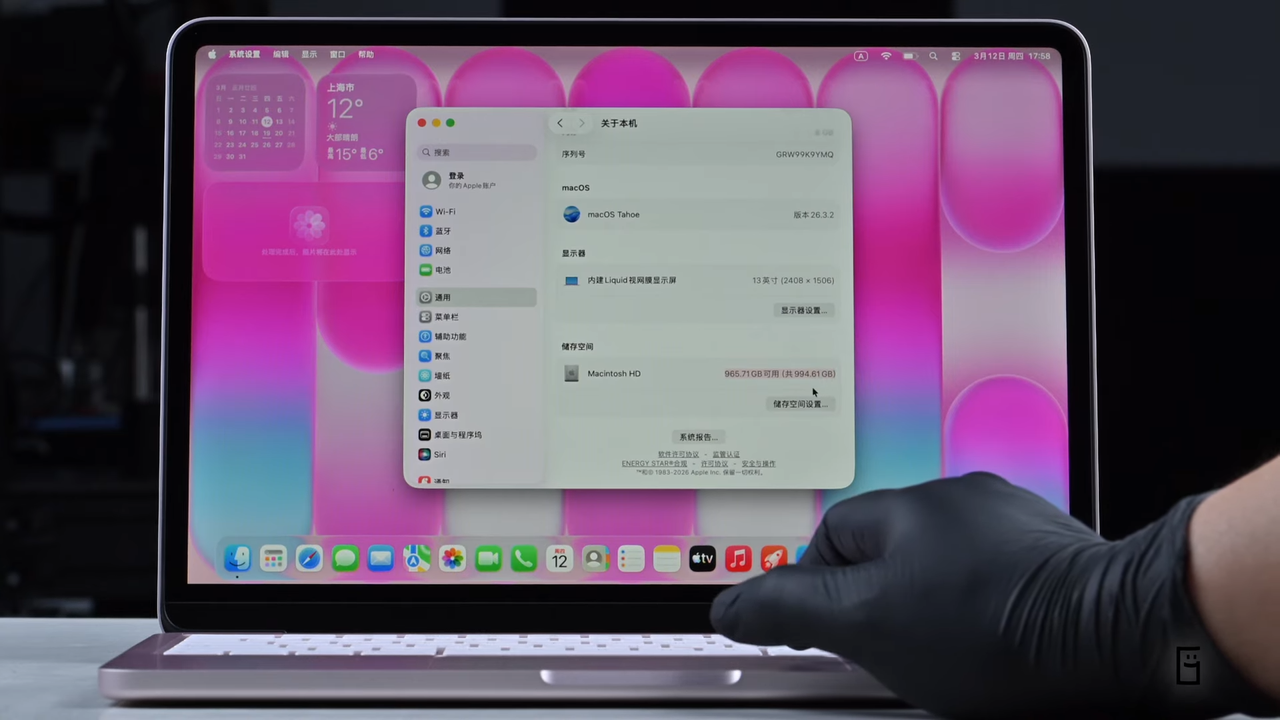
After quickly checking the device's settings and seeing 994.61 GB under "Macintosh HD," the job was complete. This is the world's first MacBook Neo with a terabyte of storage. That's enough for most people, given the Neo's target audience, but the procedure overall has diminishing returns. For a device as cheap as the Neo, opting for an expensive mod like this almost negates the point of the laptop in the first place.

We can only imagine how much the chip itself costs during a component shortage, and then the labor on top might make an external drive a more sensible purchase. That's before we even begin to think about the data safety issues that could be possible with a modded SSD. But we can't deny the skill on display here, and if you can afford to pay for it, this is some impressive work. Especially when you consider that even the transfer speeds got a little bump at the end.

The stock 256 GB SSD was at around 1,500 MB/s in the Blackmagic Disk Speed Test, while the new 1 TB SSD reached up to 1,600 MB/s. Faster storage can make a difference when it comes to memory-deprived situations. Only 8 GB of RAM on the Neo forces macOS to switch to swap very often, so faster interfacing with the SSD could make paging files quicker to access, but that would require a much larger speed difference.

Sign up to read this article
Read news from 100’s of titles, curated specifically for you.
Already a member? Sign in here
Related Stories
Top stories on inkl right now
One subscription that gives you access to news from hundreds of sites
Already a member? Sign in here
Our Picks
Fourteen days free
Download the app
One app. One membership.
100+ trusted global sources.







